
Heat Shrink Tubing in Marine and Shipbuilding Applications: Saltwater Corrosion, MIL-SPEC Compliance, and Engine Room Fire Safety
A cargo vessel crosses the North Atlantic in January. Salt spray lashes the deck. Below, the engine room runs at 55°C with humidity near 90 percent. Every wire junction, every battery terminal, every sensor connection is under constant chemical and thermal assault. In this environment, standard polyolefin heat shrink tubing fails within months — it cracks, absorbs moisture, and exposes bare copper to saltwater. The result is galvanic corrosion, short circuits, and equipment failures that can strand a ship at sea. This is why marine engineers specify marine-grade heat shrink tubing rated for continuous saltwater exposure and engine-room temperatures.
The stakes are higher than equipment downtime. A fire in an engine room or a short circuit in a navigation system can endanger the entire crew. Maritime classification societies — DNV, ABS, Lloyd’s Register, and Bureau Veritas — now require materials that meet specific fire, smoke, and toxicity standards. MIL-SPEC tubing used by naval forces sets an even higher bar. Selecting the correct heat shrink tubing for marine applications is not a procurement detail. It is a safety decision. This article covers the material science, standards, and selection criteria that marine engineers need to know.
Why Marine Environments Destroy Standard Heat Shrink Tubing
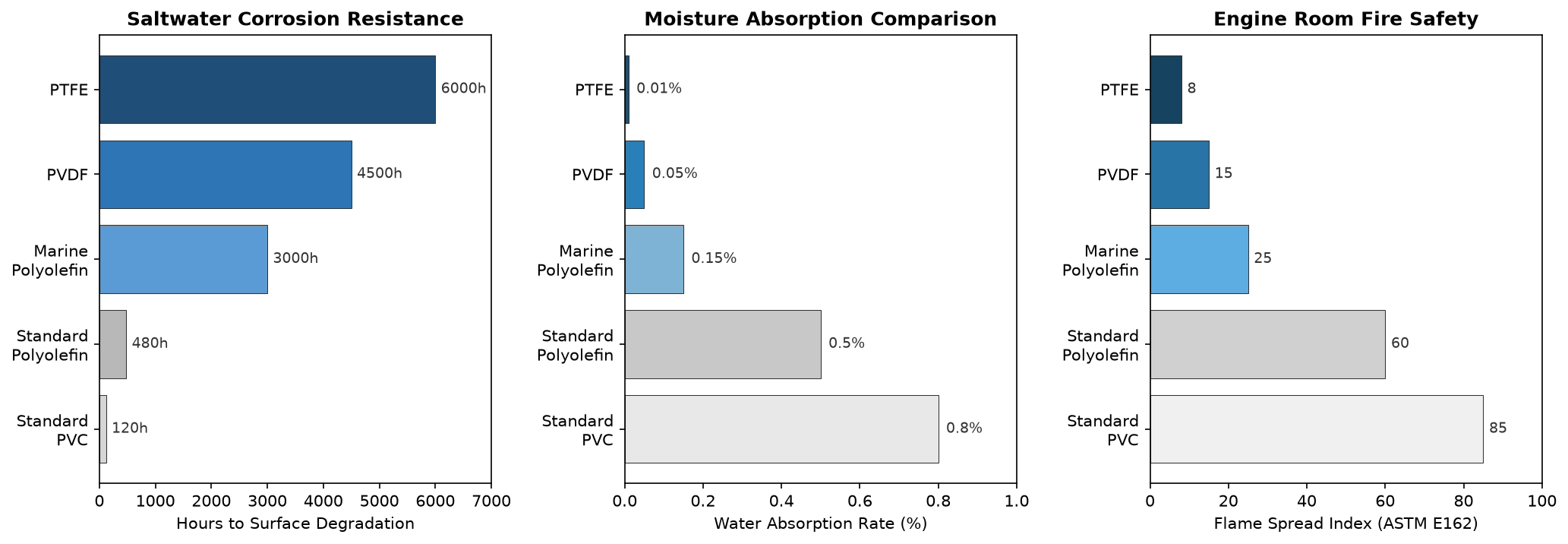
Saltwater is one of the most aggressive corrosive environments on Earth. Sodium chloride ions penetrate polymer surfaces, disrupt chemical bonds, and accelerate oxidation of underlying metals. Standard polyolefin tubing, designed for indoor or light industrial use, lacks the chemical resistance to withstand continuous salt exposure. Within 200 to 500 hours of salt spray, microscopic cracks appear in the wall. Moisture travels through these fissures to the conductor, initiating corrosion that spreads invisibly until the joint fails.
The problem compounds in engine rooms. Ambient temperatures of 50 to 70°C, combined with vibration from diesel engines, place thermal cycling stress on the polymer. Each expansion-contraction cycle widens micro-cracks. UV radiation from deck lighting degrades the outer surface further. Oils, fuels, and hydraulic fluids add chemical attack to the mix. A tubing product that survives five years in a factory may last less than one year in a marine engine room.
Water absorption is the silent killer. Standard polyolefin absorbs 0.3 to 0.5 percent water by weight over time. This may seem negligible, but absorbed moisture reduces dielectric strength, increases leakage current, and promotes corrosion at the conductor interface. Marine-grade heat shrink tubing uses modified polymers or fluoropolymers that reduce absorption to below 0.15 percent, blocking moisture transport entirely.
Materials That Survive Saltwater and Engine Room Heat
The marine environment demands materials with inherent chemical resistance, low water absorption, and sustained flexibility at elevated temperatures. Five polymer families are commonly used in marine heat shrink tubing, each with distinct advantages and limitations. Engineers must match the material to the specific zone within the vessel — deck, engine room, bilge, or navigation bridge.
Modified polyolefin is the baseline marine material. It offers good general-purpose resistance, a temperature range of -55 to 135°C, and a reasonable cost. However, it is not suitable for continuous fuel or oil exposure. For engine room connections near fuel lines, PVDF (polyvinylidene fluoride) is preferred. PVDF withstands continuous temperatures up to 150°C and resists hydrocarbon fuels, hydraulic fluids, and most solvents.
For the most demanding applications — bilge areas, underwater seals, and naval combat systems — PTFE (polytetrafluoroethylene) provides the ultimate defense. PTFE resists virtually every chemical, absorbs essentially zero water, and operates up to 260°C. The trade-off is cost and installation difficulty: PTFE requires very high shrink temperatures (350°C) and is three to five times more expensive than polyolefin.
Willele manufactures all five marine-grade materials with full material certificates. You can explore the complete range at Willele’s heat shrinkable tubes catalog, where each product listing includes its applicable marine certifications and test data.
| Material | Temp Range (°C) | Water Absorption (%) | Salt Spray Resistance (h) | Fuel/Oil Resistance | Relative Cost |
|---|---|---|---|---|---|
| Standard Polyolefin | -55 to 135 | 0.50 | 500 | Poor | 1x |
| Marine Polyolefin | -55 to 135 | 0.15 | 3000 | Fair | 1.5x |
| PVDF | -40 to 150 | 0.05 | 4500 | Excellent | 2.5x |
| PTFE | -55 to 260 | 0.01 | 6000+ | Excellent | 4x |
| Marine Dual-Wall (Adhesive) | -40 to 125 | 0.10 | 4000 | Good | 2x |
MIL-SPEC Standards for Naval Heat Shrink Tubing
The United States military has developed some of the most rigorous specifications for heat shrink tubing in the world. These MIL-SPEC documents define not just material properties, but also quality control, traceability, and testing protocols. Naval vessels operate in extreme conditions for decades, so the specifications leave nothing to chance.
MIL-DTL-23053 is the overarching specification for electrical sleeving used in military applications. It defines 21 different material classes, each identified by a slash number. For marine use, the most relevant classes are MIL-DTL-23053/5 (crosslinked polyolefin, general purpose), MIL-DTL-23053/15 (PVDF, high temperature and fluid resistant), and MIL-DTL-23053/18 (elastomeric, flexible at low temperatures).
MIL-I-23053/1 covers the original specification for heat shrink tubing used in naval applications. Although superseded by MIL-DTL-23053, many procurement documents still reference it. Engineers specifying for naval contracts must verify which version is current. The Defense Logistics Agency (DLA) maintains qualified products lists (QPL) that identify manufacturers whose products have been independently tested and certified.
For a deeper understanding of military material specifications, refer to Wikipedia’s overview of United States Military Standards. Engineers should also consult the EverySpec database for downloadable MIL-SPEC documents.
| MIL-SPEC | Material Class | Temp Range (°C) | Key Marine Property | Typical Application |
|---|---|---|---|---|
| MIL-DTL-23053/5 | Crosslinked Polyolefin | -55 to 135 | General marine | Deck wiring, lighting |
| MIL-DTL-23053/15 | PVDF | -40 to 175 | Fuel and fluid resistant | Engine room, fuel systems |
| MIL-DTL-23053/18 | Elastomeric | -75 to 150 | Low-temp flexibility | Arctic vessels, exposed deck |
| MIL-DTL-23053/16 | Fluoroelastomer | -40 to 200 | Chemical and oil resistant | Bilge, chemical storage |
| SAE AS81531 | Multiple | Varies | Marine cable marking | Identification sleeving |
Marine Classification Society Requirements
Commercial vessels must meet the requirements of classification societies such as DNV (Det Norske Veritas), ABS (American Bureau of Shipping), Lloyd’s Register, and Bureau Veritas. Each society publishes rules for electrical installations that include specific requirements for cable protection materials. These rules are not optional — a vessel cannot operate without a valid class certificate.
DNV Rule for Ships Part 4 Chapter 8 specifies that all cable protection materials in engine rooms must meet IEC 60332-1 flame retardance and IEC 61034 smoke density requirements. ABS Rules for Building and Classing Steel Vessels require that materials in areas of high fire risk meet SOLAS (Safety of Life at Sea) Chapter II-1 requirements for low flame spread and low smoke emission. Lloyd’s Register has similar provisions in its Rules and Regulations for the Classification of Ships.
The key test is IEC 60332-3, which evaluates flame propagation on bunched wires and cables. Marine heat shrink tubing must not propagate flame along a cable run. Additionally, IEC 61034 measures smoke density — light transmittance must exceed 60 percent during combustion to ensure that crew members can see escape routes during a fire. These twin requirements make LSZH (low-smoke zero-halogen) formulations increasingly popular in marine applications, particularly for cruise ships and ferries where passenger evacuation is a priority.
Willele supplies marine heat shrink tubing with DNV and ABS type approval certificates. Each shipment includes a material certificate linking the batch to the original type approval test data. This documentation is essential for shipyard quality assurance and classification society surveys.
Engine Room Fire Safety: Flame, Smoke, and Toxicity
Engine rooms are the highest fire-risk zones on any vessel. Fuel lines, hot surfaces, turbochargers, and electrical equipment create multiple ignition sources. SOLAS regulation II-1/15 requires that all materials in engine rooms have low flame spread characteristics. Heat shrink tubing used in these spaces must self-extinguish within seconds of flame removal.
The ASTM E162 flame spread index measures how quickly flame travels across a material surface. A lower index indicates better fire resistance. Marine polyolefin typically scores 20 to 30, while PVDF achieves 10 to 15. Standard PVC, despite its flame retardance, scores above 80 — the smoke it produces when burning makes it unsuitable for marine engine rooms despite its self-extinguishing property.
Toxicity is the third leg of marine fire safety. In a shipboard fire, crew members may be trapped in confined spaces for extended periods. Burning halogenated materials release hydrogen chloride and hydrogen bromide, which can be lethal at concentrations as low as 35 parts per million. The IMO (International Maritime Organization) has adopted FTP Code Part 5, which specifies toxicity limits for materials used in ship construction. Zero-halogen formulations meet these limits naturally, while halogenated materials require additional justification and are increasingly restricted.
Selecting and Installing Marine Heat Shrink Tubing
Selecting the right tubing for a marine application requires matching material properties to the specific zone within the vessel. The five zones — deck, engine room, bilge, navigation bridge, and cargo hold — each present different environmental challenges. Engineers should use the selection table below as a starting point, then verify specific requirements with the vessel’s classification society rules.
For deck and exposed areas, UV-stabilized marine polyolefin with a 3:1 shrink ratio is the default choice. The 3:1 ratio accommodates the transition from connector bodies to individual wire diameters, which are common in deck lighting and navigation equipment. For engine room wiring near fuel or hydraulic systems, PVDF is mandatory. Its resistance to hydrocarbon fluids prevents the softening and degradation that occurs when polyolefin contacts diesel fuel or lubricating oil.
In bilge areas where water is always present, dual-wall tubing with adhesive lining creates a waterproof seal that prevents moisture from reaching the conductor. The adhesive must be marine-grade — standard hot-melt adhesive degrades in continuous water immersion. Willele’s marine dual-wall products use a meltable adhesive formulated for permanent underwater service, with tested immersion resistance exceeding five years.
Installation requires attention to surface preparation. All connections must be clean, dry, and free of salt residue before shrinking. Even trace salt on a conductor surface can accelerate galvanic corrosion under the tubing. Use a solvent wipe (isopropyl alcohol) followed by a clean dry cloth. Apply heat evenly starting from the center and working outward to force trapped air out. For dual-wall products, verify adhesive flow at both ends. In cold weather installations (below 10°C), pre-warm the tubing with a brief heat pass before full shrink, as cold material may crack if heated too aggressively.
| Vessel Zone | Recommended Material | Shrink Ratio | Key Requirement | Expected Service Life |
|---|---|---|---|---|
| Exposed Deck | UV-Stabilized Polyolefin | 3:1 | UV and salt spray resistance | 5-7 years |
| Engine Room | PVDF | 2:1 | Fuel and heat resistance | 10+ years |
| Bilge | Dual-Wall Adhesive | 3:1 | Continuous immersion seal | 8-10 years |
| Navigation Bridge | Standard Polyolefin | 2:1 | General protection, low smoke | 10+ years |
| Cargo Hold | Marine Polyolefin | 2:1 | Mechanical abrasion resistance | 7-10 years |
| Combat Systems (Naval) | PTFE | 2:1 | MIL-SPEC, chemical immunity | 20+ years |
FAQ: Marine Heat Shrink Tubing Questions
What is the difference between marine-grade and standard heat shrink tubing?
Marine-grade tubing uses modified polymer formulations with enhanced UV stabilizers, lower water absorption rates, and higher salt spray resistance. It typically undergoes additional testing per ASTM B117 salt spray standards and carries marine type approval certificates from classification societies.
Can I use standard polyolefin tubing on a boat?
For interior, dry areas with no fuel exposure, standard polyolefin may work for several years. However, any exterior or engine room application requires marine-grade material. Using standard tubing in these zones risks premature failure, corrosion, and non-compliance with classification society rules.
What shrink temperature do marine tubing materials require?
Marine polyolefin shrinks at 90 to 130°C. PVDF requires 170 to 190°C. PTFE needs 350°C or higher. Always check the manufacturer datasheet. Using insufficient heat results in incomplete shrink and poor conformity, while excess heat can scorch the material and reduce its dielectric strength.
Is dual-wall adhesive-lined tubing necessary for marine applications?
For any connection exposed to moisture, yes. The adhesive creates a waterproof seal that blocks water vapor transport. Without adhesive lining, moisture migrates through the tubing wall and reaches the conductor within months in bilge or deck applications. Willele offers marine-specific dual-wall products with immersion-rated adhesive.
Do classification societies require specific tubing brands?
No, they require type approval certificates, not specific brands. Any manufacturer with valid DNV, ABS, or Lloyd’s Register type approval can supply compliant material. Willele maintains current type approvals across multiple societies. Always request the certificate before procurement.
How does MIL-SPEC tubing differ from commercial marine tubing?
MIL-SPEC tubing meets additional requirements for nuclear survivability, fungus resistance, and extreme temperature cycling that go beyond commercial marine standards. It also requires full lot traceability and QPL listing. Naval vessels and defense contractors must use MIL-SPEC materials, while commercial vessels can use marine-certified commercial products.
Summary
Marine environments punish electrical connections with saltwater, vibration, fuel exposure, and fire risk. Standard heat shrink tubing fails quickly in these conditions, creating safety hazards and maintenance nightmares. The correct approach is to match material properties to each vessel zone — UV-stabilized polyolefin on deck, PVDF in engine rooms, dual-wall adhesive products in bilges, and PTFE for naval combat systems.
Classification society rules from DNV, ABS, and Lloyd’s Register define the minimum requirements for marine cable protection. MIL-SPEC documents set even higher standards for naval applications. Engineers must verify that their chosen tubing carries the correct type approval certificates and meets the applicable flame, smoke, and toxicity requirements. The cost of using inadequate material is measured in corrosion failures, fire risk, and vessels stranded at sea.
For marine projects requiring certified heat shrink tubing, Willele provides a complete range with DNV and ABS type approval. Contact us with your specifications and drawings, and our engineering team will respond within 24 hours with material recommendations, certification documentation, and pricing for your vessel project. Whether you need MIL-SPEC tubing for a naval refit or dual-wall adhesive products for a commercial shipyard, Willele has the manufacturing capability and test infrastructure to deliver on schedule.