
Introduction
When selecting heat shrink tubing for industrial applications, understanding the fundamental differences between cross-linked and non-cross-linked materials is crucial for optimal performance and cost-efficiency. At willele Electric, a leading B2B manufacturer specializing in high-quality heat shrink tube solutions, we recognize that material selection directly impacts product longevity, safety, and operational effectiveness.
This comprehensive guide examines the critical distinctions between cross-linked vs non-cross-linked heat shrink tube materials, helping procurement professionals, engineers, and technical buyers make informed decisions for their specific applications.
What is Cross-Linking Technology?
Cross-linking is a chemical process that creates three-dimensional bonds between polymer chains, fundamentally altering the molecular structure of heat shrink materials. This process transforms thermoplastic polymers into thermoset materials with enhanced performance characteristics.
The Cross-Linking Process
During manufacturing, polymer chains are exposed to high-energy radiation (electron beam or gamma rays) or chemical initiators that create covalent bonds between adjacent molecular chains. These intermolecular connections form a networked structure that significantly improves material properties.
Molecular Structure Differences
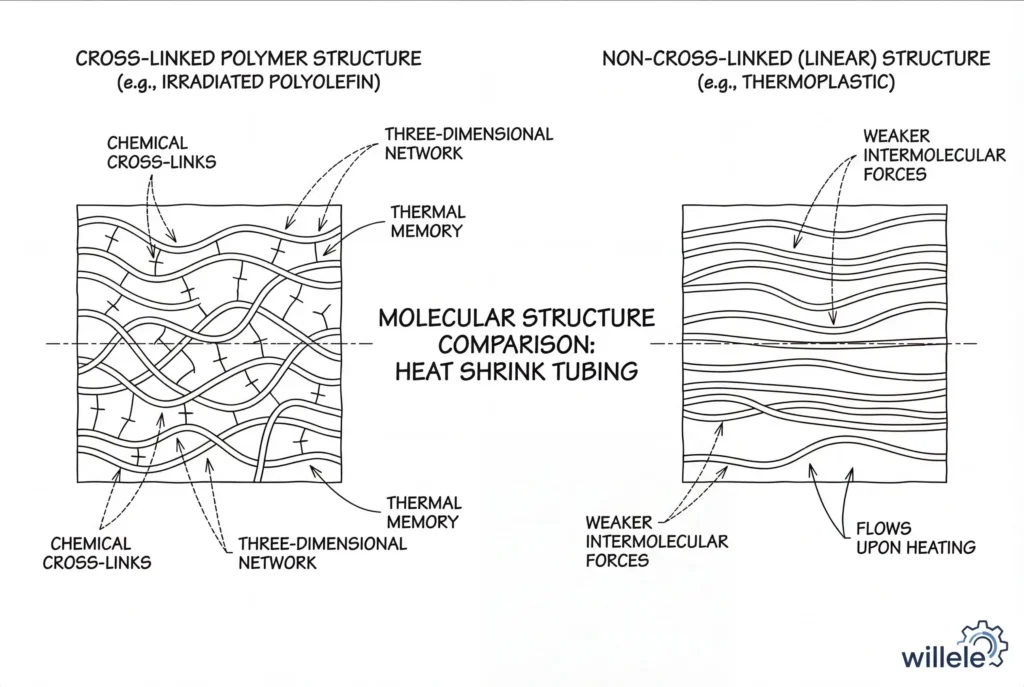
Cross-Linked Structure: Features a three-dimensional network where polymer chains are chemically bonded together, creating a rigid, interconnected matrix that resists deformation and degradation.
Non-Cross-Linked Structure: Consists of linear or branched polymer chains held together by weaker van der Waals forces, allowing molecular movement and potential flow under heat and stress.
Manufacturing Processes Comparison
Cross-Linked Heat Shrink Tube Production
- Material Extrusion: Base polymer (typically polyolefin) is extruded into tube form
- Cross-Linking Treatment: Tubes undergo electron beam irradiation or chemical treatment
- Expansion Process: Cross-linked tubes are heated and mechanically expanded
- Cooling and Stabilization: Expanded tubes are rapidly cooled to “freeze” the expanded state
- مراقبة الجودة: Rigorous testing for shrink ratio, mechanical properties, and heat resistance
Non-Cross-Linked Heat Shrink Tube Production
- Direct Extrusion: Polymer is extruded and oriented during the extrusion process
- Mechanical Orientation: Tubes are stretched while hot to create molecular alignment
- Rapid Cooling: Quick cooling preserves the oriented structure
- Packaging: Less stringent storage requirements compared to cross-linked versions
Comprehensive Performance Comparison
Material Properties Table
| Property | Cross-Linked Heat Shrink Tube | Non-Cross-Linked Heat Shrink Tube |
|---|---|---|
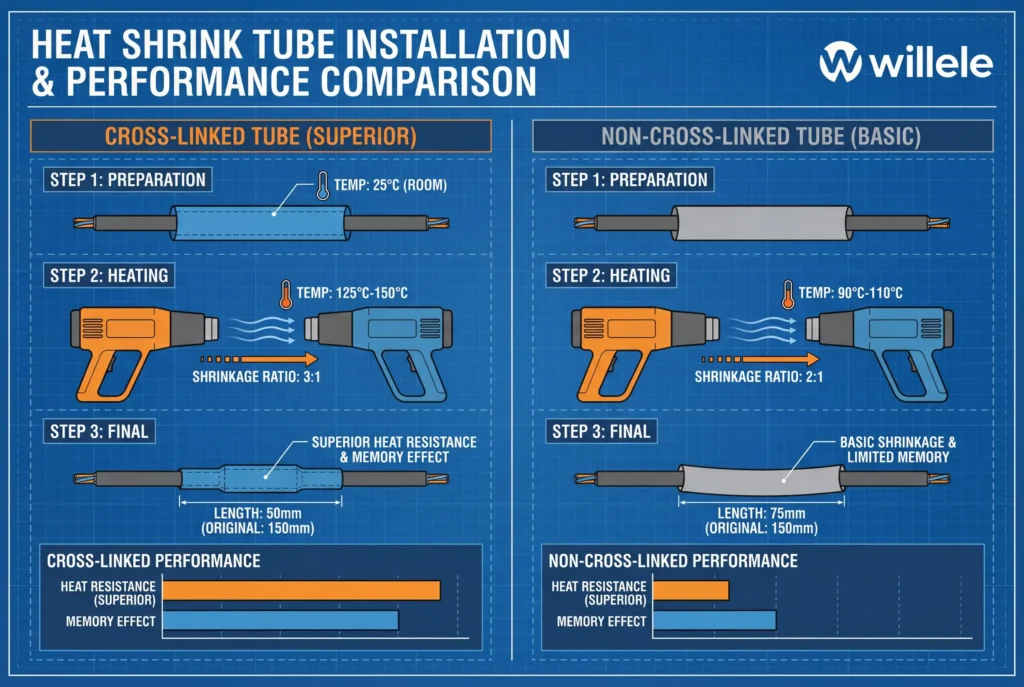
| Maximum Operating Temperature | 125-150°C (257-302°F) | 70-90°C (158-194°F) |
| Shrink Temperature | 90-110°C (194-230°F) | 70-90°C (158-194°F) |
| نسبة الانكماش | 2:1 to 6:1 available | Typically 2:1 to 3:1 |
| قوة الشد | 10-15 MPa | 6-10 MPa |
| الاستطالة عند الاستراحة | 200-400% | 300-500% |
| مقاومة المواد الكيميائية | ممتاز | Good to Moderate |
| تأثير الذاكرة | Exceptional | Limited |
| مثبطات اللهب | Available (V-0, V-1 rated) | Limited options |
| مقاومة الأشعة فوق البنفسجية | ممتاز | معتدل |
Performance Characteristics Table
| Characteristic | Cross-Linked | Non-Cross-Linked | Impact on Application |
|---|---|---|---|
| Heat Resistance | متفوقة | Basic | Critical for high-temperature environments |
| Dimensional Stability | ممتاز | معتدل | Affects long-term reliability |
| Recovery After Deformation | Complete | Partial | Important for mechanical stress applications |
| Abrasion Resistance | عالية | معتدل | Determines product lifespan |
| Fluid Resistance | ممتاز | جيد | Essential for chemical exposure |
| Flexibility at Low Temperatures | Maintains flexibility to -55°C | Becomes brittle at -30°C | Affects cold climate applications |
| Aging Resistance | Minimal degradation over time | Moderate degradation | Long-term performance factor |
Advantages and Disadvantages
Cross-Linked Heat Shrink Tubes
Advantages:
- Superior Heat Resistance: Withstands continuous exposure to elevated temperatures without deformation
- Exceptional Memory Effect: Returns to original expanded diameter when reheated, allowing rework
- Enhanced Mechanical Properties: Greater tensile strength and abrasion resistance
- Chemical and Solvent Resistance: Maintains integrity when exposed to oils, fuels, and solvents
- Dimensional Stability: Minimal creep or deformation under stress
- Longer Service Life: Resists aging and environmental degradation effectively
Disadvantages:
- Higher Manufacturing Cost: Complex production process increases unit price
- Specialized Equipment Required: Installation may require precise heat application
- Limited Color Options: Some colors may be harder to achieve with certain cross-linking methods
- Longer Lead Times: More complex manufacturing may extend delivery schedules
Non-Cross-Linked Heat Shrink Tubes
Advantages:
- فعالة من حيث التكلفة: Lower production costs translate to competitive pricing
- Easy Processing: Simpler manufacturing enables faster production
- Wider Color Range: Easier to incorporate pigments and dyes
- Suitable for Low-Temperature Applications: Adequate for standard electrical insulation
- Faster Shrinking: Lower activation temperature speeds installation
Disadvantages:
- Limited Heat Resistance: Cannot withstand high-temperature environments
- No Memory Effect: Cannot be reworked once shrunk
- Lower Mechanical Strength: More susceptible to abrasion and physical damage
- Reduced Chemical Resistance: May degrade when exposed to harsh chemicals
- Dimensional Instability: May deform or creep under sustained mechanical stress
Application Scenarios Comparison
Industry-Specific Applications Table
| Industry/Application | Recommended Type | Rationale |
|---|---|---|
| Automotive Wiring Harnesses | Cross-Linked | High under-hood temperatures, fuel/oil exposure |
| Aerospace & Aviation | Cross-Linked | Extreme temperature variations, stringent safety requirements |
| Military & Defense | Cross-Linked | Harsh environments, long-term reliability critical |
| الاتصالات السلكية واللاسلكية | Non-Cross-Linked | Indoor applications, cost-sensitive projects |
| الإلكترونيات الاستهلاكية | Non-Cross-Linked | Moderate temperature, high-volume production |
| التطبيقات البحرية | Cross-Linked | Moisture, salt, and temperature extremes |
| Industrial Machinery | Cross-Linked | High vibration, mechanical stress, chemical exposure |
| HVAC Systems | Non-Cross-Linked | Standard operating temperatures, cost considerations |
| Renewable Energy (Solar/Wind) | Cross-Linked | UV exposure, outdoor environmental factors |
| الأجهزة الطبية | Cross-Linked | Sterilization requirements, chemical resistance |
Technical Selection Criteria
Decision Matrix for Material Selection
| Selection Factor | Choose Cross-Linked When | Choose Non-Cross-Linked When |
|---|---|---|
| Operating Temperature | Above 90°C (194°F) | Below 80°C (176°F) |
| قيود الميزانية | Performance is priority | Cost optimization is critical |
| Chemical Exposure | Regular contact with solvents, fuels | Minimal chemical exposure |
| Environmental Conditions | Outdoor, harsh environments | Indoor, controlled environments |
| Expected Service Life | 10+ years required | 3-5 years sufficient |
| Regulatory Requirements | UL, CSA, military specs needed | Standard commercial applications |
| Installation Complexity | Rework capability valuable | Single-use installation |
Key Considerations for Procurement Professionals
Quality Assurance Parameters
When sourcing heat shrink tubes from manufacturers like willele Electric, evaluate these critical parameters:
- Shrink Ratio Consistency: Verify uniform shrinkage across product batches
- Wall Thickness Tolerance: Ensure specifications meet application requirements
- Certification Compliance: Confirm UL, CSA, RoHS, or industry-specific certifications
- Lot Traceability: Verify manufacturing documentation and quality records
- Shelf Life: Cross-linked products typically have 1-2 year shelf life when properly stored
- Packaging Integrity: Proper storage prevents premature shrinkage
Cost-Benefit Analysis
Initial Investment vs. Lifecycle Cost:
- Cross-linked tubes cost 30-50% more initially but offer 3-5x longer service life
- Non-cross-linked tubes provide immediate cost savings for short-term applications
- Total cost of ownership includes installation labor, replacement frequency, and downtime
Storage and Handling Requirements
Environmental Storage Conditions
| Parameter | Cross-Linked | Non-Cross-Linked |
|---|---|---|
| Storage Temperature | 15-30°C (59-86°F) | 10-35°C (50-95°F) |
| Humidity Range | 30-70% RH | 30-80% RH |
| UV Protection | Recommended | Essential |
| Shelf Life | 12-24 months | 24-36 months |
FAQ Section
Q1: Can I use non-cross-linked heat shrink tubes in automotive applications?
A: Non-cross-linked tubes are generally not recommended for automotive under-hood applications due to high operating temperatures (often exceeding 100°C) and exposure to oils and fuels. However, they may be suitable for interior cabin wiring where temperatures remain moderate. For engine compartments and critical systems, cross-linked heat shrink tubes are the industry standard.
Q2: What is the “memory effect” in cross-linked heat shrink tubes, and why is it important?
A: The memory effect allows cross-linked tubes to return to their expanded diameter when reheated above their shrinking temperature. This unique property enables rework and repositioning without replacing the tube, reducing material waste and installation costs. This characteristic is absent in non-cross-linked tubes, which permanently shrink upon heating.
Q3: How do I determine the correct shrink ratio for my application?
A: The shrink ratio should accommodate the largest diameter component plus any connectors or irregularities. For example, a 3:1 shrink ratio tube can fit over objects three times its recovered diameter. Consider: (1) maximum diameter before shrinking, (2) minimum diameter after shrinking, (3) wall thickness required for protection, and (4) any geometric irregularities that affect coverage.
Q4: Are cross-linked heat shrink tubes more environmentally friendly?
A: While cross-linked tubes have longer service life (reducing replacement frequency and waste), both types can be challenging to recycle due to their thermoset (cross-linked) or specialized thermoplastic (non-cross-linked) nature. The extended lifespan of cross-linked products often results in lower overall environmental impact despite higher manufacturing energy requirements. willele Electric offers guidance on sustainable disposal practices for both material types.
Q5: Can heat shrink tubes be used in outdoor applications?
A: Cross-linked heat shrink tubes with UV-resistant formulations are specifically designed for outdoor applications and can withstand years of sun exposure, temperature cycling, and moisture. Non-cross-linked tubes typically degrade faster under UV exposure and are better suited for indoor or protected environments unless specifically formulated with UV stabilizers.
Q6: What installation equipment is required for each type?
A: Both cross-linked and non-cross-linked heat shrink tubes can be installed using heat guns, ovens, or torches. However, cross-linked tubes require slightly higher temperatures (typically 90-110°C vs. 70-90°C for non-cross-linked). For high-volume production, automated heating tunnels ensure consistent results. willele Electric provides detailed installation specifications and equipment recommendations for all product lines.
الخاتمة
Selecting between cross-linked and non-cross-linked heat shrink tube materials requires careful analysis of operational requirements, environmental conditions, and long-term performance expectations. While cross-linked heat shrink tubes offer superior heat resistance, chemical compatibility, and durability for demanding applications, non-cross-linked alternatives provide cost-effective solutions for standard electrical insulation needs.
As a trusted B2B manufacturer, willele Electric offers comprehensive technical support to help you select the optimal heat shrink solution for your specific application requirements. Our engineering team can provide material recommendations, performance data, and custom formulations to meet your exact specifications.
For detailed product specifications, samples, or technical consultation regarding cross-linked vs non-cross-linked heat shrink tube materials, contact willele Electric’s technical sales team today.