

Introduction
In harsh industrial environments, electrical components face constant exposure to corrosive chemicals, aggressive solvents, and reactive substances that can compromise system integrity. Selecting heat shrinkable tubes with appropriate chemical resistance properties is critical for preventing premature failure, ensuring worker safety, and minimizing costly downtime. The chemical resistance properties of industrial heat shrinkable tubes determine their ability to maintain physical and electrical characteristics when exposed to specific chemicals over extended periods.
As a leading B2B manufacturer specializing in industrial heat shrink tubing solutions, willele Electric understands that chemical compatibility is often the decisive factor in material selection. Whether you’re protecting wiring harnesses in automotive manufacturing, insulating connections in chemical processing plants, or securing critical aerospace components, understanding the chemical resistance properties of industrial heat shrinkable tubes ensures optimal performance and longevity. This comprehensive guide provides engineers and procurement professionals with the technical insights needed to make informed material selection decisions based on specific chemical exposure scenarios.
Understanding Chemical Resistance in Heat Shrinkable Tubes
Chemical resistance refers to a heat shrink tube’s ability to withstand degradation, swelling, cracking, or loss of mechanical and electrical properties when exposed to various chemicals. This characteristic is fundamental to protective sleeving performance in industrial applications where contact with oils, fuels, cleaning agents, hydraulic fluids, or process chemicals is inevitable.
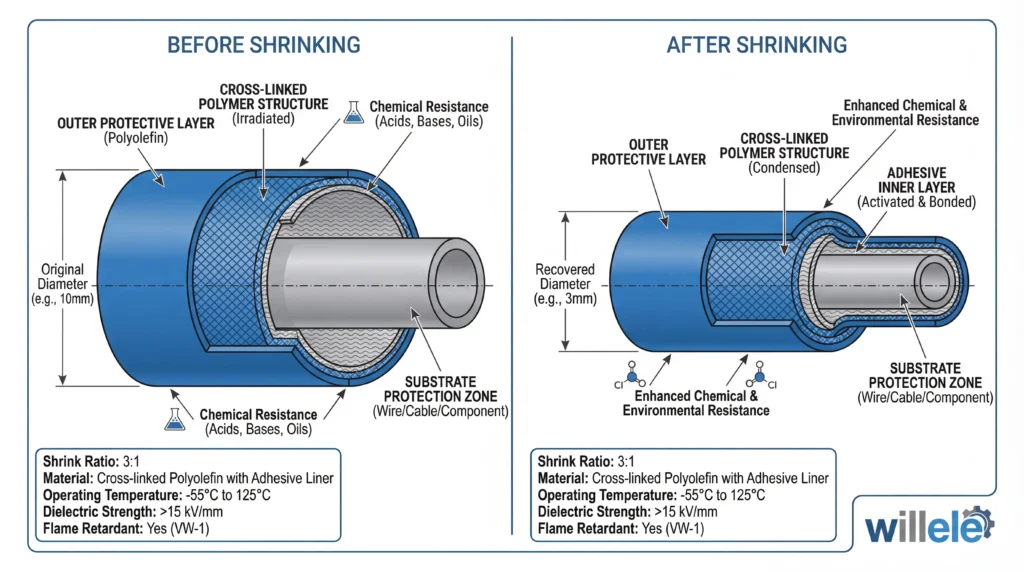
The chemical resistance properties of industrial heat shrinkable tubes are determined by the polymer structure and molecular composition of the base material. When chemicals contact the tube surface, several interactions may occur: surface absorption, molecular penetration, chemical reaction, or physical degradation. Materials with excellent chemical resistance maintain their dimensional stability, dielectric strength, and mechanical properties despite prolonged exposure.
Understanding chemical compatibility is essential because even brief exposure to incompatible substances can cause immediate failure or initiate gradual degradation that compromises long-term reliability. Factors such as chemical concentration, exposure temperature, and duration significantly influence resistance performance. Additionally, some materials may resist certain chemical classes excellently while showing poor resistance to others, making material-specific knowledge crucial for proper application engineering.
Industrial environments rarely involve exposure to a single chemical. Most applications require heat shrink tubes to withstand multiple substances simultaneously or sequentially, necessitating comprehensive compatibility assessments. This complexity underscores why chemical resistance properties of industrial heat shrinkable tubes must be thoroughly evaluated against actual operating conditions rather than relying on general-purpose recommendations.
Material Types and Chemical Resistance
Different polymer materials used in heat shrinkable tube manufacturing exhibit distinct chemical resistance profiles. Understanding these material-specific characteristics enables precise matching of protective sleeving to application requirements.
Comprehensive Material Comparison
| Material Type | Temperature Range | Acids | Bases/Alkalis | Aliphatic Hydrocarbons | Aromatic Hydrocarbons | Alcohols | Ketones | Esters | Key Advantages | Typical Applications |
|---|---|---|---|---|---|---|---|---|---|---|
| Polyolefin (PE/PP) | -55°C to 135°C | Good to Excellent | Excellent | Excellent | Fair to Good | Excellent | Fair | Fair | Cost-effective, flexible, general-purpose | General wire protection, automotive harnesses |
| PVC (Polyvinyl Chloride) | -40°C to 105°C | Excellent | Good to Excellent | Good | Poor | Excellent | Poor | Poor | Flame retardant, economical | Indoor electrical installations, low-temp applications |
| PVDF (Kynar) | -55°C to 175°C | Excellent | Excellent | Excellent | Good | Excellent | Good to Excellent | Fair to Good | Superior chemical resistance, UV stable | Chemical processing, outdoor installations |
| FKM/Viton (Fluoroelastomer) | -40°C to 200°C | Excellent | Fair to Good | Excellent | Excellent | Good | Fair to Good | Poor | Outstanding fuel/oil resistance | Aerospace fuel systems, automotive fuel lines |
| PTFE (Teflon) | -200°C to 260°C | Excellent | Excellent | Excellent | Excellent | Excellent | Excellent | Excellent | Universal chemical resistance | Aggressive chemical environments, high-temperature applications |
Polyolefin-Based Heat Shrink Tubes represent the most widely used material category due to their balanced properties and cost-effectiveness. Cross-linked polyolefin offers good resistance to most common industrial chemicals, including weak acids, bases, and aliphatic solvents. However, prolonged exposure to aromatic hydrocarbons (benzene, toluene) or chlorinated solvents may cause swelling and property degradation.
PVC Heat Shrink Tubing provides excellent resistance to acids, bases, and alcohols at economical pricing points. Its inherent flame retardancy makes it suitable for applications requiring fire safety compliance. However, PVC demonstrates poor resistance to aromatic and chlorinated solvents, and its lower temperature ceiling limits use in high-heat environments.
PVDF (Polyvinylidene Fluoride) offers exceptional chemical resistance approaching that of PTFE but at significantly lower cost. This fluoropolymer material resists most acids, bases, solvents, and oxidizing agents while maintaining excellent mechanical properties across wide temperature ranges. PVDF’s outstanding UV resistance and weatherability make it ideal for outdoor installations and exposed chemical processing equipment.
FKM/Viton Fluoroelastomer tubes excel in applications involving petroleum products, fuels, oils, and hydraulic fluids. This material maintains flexibility and sealing properties even when continuously exposed to aggressive automotive and aerospace fluids. However, FKM shows limited resistance to ketones, esters, and some amines.
PTFE Heat Shrink Tubing represents the premium choice for ultimate chemical resistance. This fluoropolymer resists virtually all industrial chemicals, solvents, and corrosives across extreme temperature ranges. PTFE’s inert nature and non-stick properties prevent chemical absorption and facilitate cleaning. The primary limitations are higher cost and reduced mechanical strength compared to other options.
Chemical Resistance Rating System
Standardized rating systems help engineers quickly assess material suitability for specific chemical exposures. Understanding these ratings and their underlying test conditions is essential for accurate material selection.
Resistance Rating Definitions
| Rating | Description | Material Behavior | Exposure Conditions | Recommended Use |
|---|---|---|---|---|
| Excellent | No visible effect | No swelling, discoloration, or property loss | Continuous exposure at 23°C for 30+ days | Primary material choice for extended exposure |
| Good | Slight effect | Minor swelling (<5%), slight discoloration, <10% property change | Intermittent exposure at 23°C for 30 days | Acceptable for intermittent contact or limited exposure |
| Fair | Moderate effect | Noticeable swelling (5-15%), visible discoloration, 10-25% property loss | Limited exposure at 23°C for 7 days | Short-term exposure only, monitor condition |
| Poor | Severe degradation | Significant swelling (>15%), cracking, >25% property loss | Brief exposure at 23°C causes damage | Not recommended, select alternative material |
These ratings typically assume room temperature (23°C) exposure conditions. Temperature significantly impacts chemical resistance – materials rated “Good” at room temperature may exhibit “Poor” resistance at elevated temperatures. Similarly, chemical concentration affects rating applicability, as dilute solutions generally cause less aggressive attack than concentrated forms.
Testing protocols evaluate multiple performance parameters including dimensional change (swelling/shrinkage), weight change, tensile strength retention, elongation retention, and visual appearance. A material receives its overall rating based on the most severely affected property. This conservative approach ensures reliability in real-world applications.
Important Considerations: Published resistance charts provide valuable guidance but cannot account for all possible conditions. Synergistic effects occur when multiple chemicals combine, potentially reducing resistance below individual ratings. Stress factors like mechanical flexing, thermal cycling, or electrical current can accelerate chemical attack. For critical applications, willele Electric recommends application-specific testing under actual operating conditions to validate material selection.
Industry-Specific Chemical Exposure
Different industrial sectors present unique chemical exposure challenges that dictate specific material requirements for heat shrinkable tube applications.
Chemical Exposure by Industry
| Industry Sector | Common Chemical Exposures | Operating Temperature | Environmental Factors | Recommended Materials | Critical Considerations |
|---|---|---|---|---|---|
| Automotive Manufacturing | Motor oils, transmission fluids, brake fluids, gasoline, diesel, coolants, cleaning solvents | -40°C to 150°C | Vibration, abrasion, thermal cycling | Polyolefin, FKM/Viton | Fuel resistance, flexibility, abrasion resistance |
| Aerospace | Jet fuel (JP-4, JP-5), hydraulic fluids (Skydrol), de-icing fluids, lubricants | -55°C to 200°C | Altitude, pressure changes, extreme temps | PTFE, FKM/Viton, PVDF | Fire resistance, weight considerations, certifications |
| Chemical Processing | Concentrated acids (H₂SO₄, HCl), bases (NaOH), organic solvents, oxidizing agents | -20°C to 175°C | High chemical concentrations, corrosive vapors | PVDF, PTFE | Continuous exposure, chemical purity requirements |
| Oil & Gas | Crude oil, refined fuels, natural gas, H₂S, drilling muds, hydraulic fracturing fluids | -40°C to 180°C | High pressure, moisture, outdoor exposure | FKM/Viton, PVDF, PTFE | Hydrocarbon resistance, weatherability, safety compliance |
| Food & Beverage | Cleaning agents, sanitizers, food acids, vegetable oils, ethanol | -10°C to 135°C | Washdown environments, FDA compliance | PVDF, cross-linked polyolefin | Chemical sanitizer resistance, FDA/food contact approval |
| Marine & Offshore | Saltwater, diesel fuel, hydraulic oils, corrosion inhibitors | -20°C to 125°C | UV exposure, moisture, salt spray | PVDF, polyolefin with marine rating | Corrosion resistance, UV stability, water immersion |
| Pharmaceutical | Isopropyl alcohol, acetone, cleaning validation agents, WFI (water) | 15°C to 125°C | Cleanroom compatibility, validation requirements | PVDF, PTFE | Extractables/leachables, sterilization compatibility |
Automotive applications demand heat shrink tubes that resist petroleum-based fluids while maintaining flexibility through temperature extremes and constant vibration. Engine compartment harnesses require materials rated for continuous oil and fuel exposure at elevated temperatures. FKM/Viton excels for direct fuel system applications, while high-quality cross-linked polyolefin serves general under-hood protection needs.
Aerospace environments present perhaps the most demanding combination of chemical exposure, temperature extremes, and safety requirements. Skydrol hydraulic fluid, commonly used in aircraft systems, is particularly aggressive toward many polymers. PTFE and specially formulated FKM compounds provide necessary resistance while meeting stringent flammability and smoke generation standards.
Chemical processing facilities require materials that withstand continuous exposure to aggressive process chemicals, often at elevated temperatures and concentrations. PVDF and PTFE dominate these applications due to their broad chemical resistance spectrum and temperature capabilities. Installation around process analyzers, control wiring, and instrumentation must consider both primary process chemicals and cleaning/maintenance substances.
Oil and gas operations expose protective sleeving to crude oil, refined products, hydrogen sulfide, and various drilling chemicals under harsh environmental conditions. Material selection must address both chemical compatibility and outdoor weathering resistance, as installations often span decades. PVDF provides excellent balance of chemical resistance, UV stability, and mechanical properties for topside applications, while PTFE serves more aggressive downhole environments.
Testing Standards and Certifications
Standardized testing protocols ensure consistent evaluation of chemical resistance properties across manufacturers and applications. Familiarity with relevant standards helps verify material suitability and compliance requirements.
Key Testing Standards
| Standard | Issuing Body | Test Scope | Key Parameters | Industry Relevance |
|---|---|---|---|---|
| ASTM D543 | ASTM International | Resistance of plastics to chemical reagents | Weight change, dimensional change, visual appearance | General industrial, chemical processing |
| ASTM D471 | ASTM International | Rubber property changes in liquids | Volume swell, tensile/elongation retention | Automotive, oil & gas, elastomeric materials |
| IEC 60684-2 | International Electrotechnical Commission | Flexible insulating sleeving – Test methods | Specific chemical immersion tests for electrical insulation | Electrical/electronic applications worldwide |
| MIL-DTL-23053 | U.S. Department of Defense | Heat shrinkable tubing for electrical applications | Comprehensive chemical resistance testing | Military, aerospace, defense contractors |
| SAE AMS-DTL-23053 | SAE International | Aerospace material specification | Chemical resistance per aerospace requirements | Commercial and military aerospace |
| ISO 1817 | International Organization for Standardization | Rubber – Determination of effect of liquids | Standardized immersion testing protocols | International applications, global supply chains |
| UL 224 | Underwriters Laboratories | Extruded insulating tubing | Specific chemical exposure requirements for electrical safety | North American electrical safety compliance |
ASTM D543 provides fundamental methodology for evaluating plastic materials’ resistance to chemical reagents. This standard specifies immersion conditions, specimen preparation, and measurement procedures for determining weight change, dimensional changes, and visual effects. Results from ASTM D543 testing form the basis for most published chemical resistance charts.
IEC 60684-2 specifically addresses flexible insulating sleeving, making it directly applicable to heat shrinkable tubes used in electrical applications. This standard prescribes specific test chemicals relevant to electrical environments and defines pass/fail criteria based on electrical and mechanical property retention.
Military specifications (MIL-DTL-23053) impose rigorous chemical resistance requirements for aerospace and defense applications. These specifications often require testing against specific fluids like jet fuel, hydraulic fluid (Skydrol), and lubricants at elevated temperatures. Compliance with military specifications indicates suitability for demanding applications beyond military use.
Material certifications and test reports should specify the exact standard used, test conditions (temperature, duration, concentration), and quantitative results. Generic claims of “good” or “excellent” chemical resistance without supporting data and test method references provide insufficient information for critical applications. willele Electric maintains comprehensive testing documentation following international standards to support informed material selection decisions.
Factors Affecting Chemical Resistance
Chemical resistance is not a fixed material property but varies significantly based on exposure conditions. Understanding these influencing factors enables accurate prediction of real-world performance.
Interactive Effect Matrix
| Temperature | Chemical Concentration | Exposure Duration | Combined Effect on Resistance | Recommended Action |
|---|---|---|---|---|
| Room Temp (23°C) | Dilute (<10%) | Intermittent (<8 hrs/day) | Minimal effect – ratings apply directly | Use published ratings as-is |
| Moderate (50-80°C) | Moderate (10-50%) | Regular (8-16 hrs/day) | Moderate acceleration – reduce rating one level | Downgrade rating (Excellent→Good, Good→Fair) |
| Elevated (80-120°C) | Concentrated (50-90%) | Continuous (24 hrs/day) | Significant acceleration – reduce two levels | Test under actual conditions required |
| High (>120°C) | Pure (>90%) | Continuous with thermal cycling | Severe acceleration – unpredictable | Extensive testing mandatory, consider PTFE |
Temperature represents the most significant factor influencing chemical resistance. Chemical reaction rates typically double with every 10°C temperature increase. A material exhibiting “Excellent” resistance at room temperature may show “Good” or “Fair” resistance at 80°C with the same chemical. High temperatures accelerate diffusion processes, allowing chemicals to penetrate deeper into the polymer matrix and cause greater swelling and property degradation.
Chemical Concentration directly impacts aggressiveness. Dilute acids or bases often cause minimal attack, while concentrated forms may severely degrade the same material. Some chemicals exhibit threshold concentrations below which resistance remains excellent but above which rapid degradation occurs. For example, many polymers resist dilute sulfuric acid excellently but fail quickly in concentrated sulfuric acid above 70%.
Exposure Duration determines whether chemical effects remain superficial or penetrate throughout the material cross-section. Brief splash exposure may cause only surface discoloration, while continuous immersion allows complete saturation. Long-term exposure reveals degradation mechanisms like stress cracking that don’t appear in short-term tests. Applications involving continuous chemical contact require materials with proven long-term stability, not just short-term resistance.
Stress and Mechanical Factors can significantly reduce chemical resistance. Materials under mechanical stress (tension, compression, flexing) develop microcracks that provide pathways for chemical penetration. The combination of chemical exposure and mechanical stress often causes failure at chemical concentrations and exposure times that would not affect unstressed materials. This stress-cracking phenomenon particularly affects applications involving vibration, thermal expansion/contraction, or tight bending radii.
Synergistic Effects occur when multiple chemicals combine to produce effects greater than either chemical alone. For instance, a material might resist both acetone and methanol individually but degrade rapidly when exposed to their mixture. Chemical mixtures, particularly common in industrial environments, require specific compatibility testing rather than relying on single-chemical data.
Selection Guide
Proper material selection requires systematic evaluation of chemical exposure categories against material capabilities. This decision matrix provides practical guidance for matching applications to appropriate heat shrinkable tube materials.
Chemical Class Material Selection Matrix
| Chemical Class | Example Chemicals | Polyolefin | PVC | PVDF | FKM/Viton | PTFE | Selection Notes |
|---|---|---|---|---|---|---|---|
| Inorganic Acids | H₂SO₄, HCl, HNO₃, H₃PO₄ | Good (dilute only) | Excellent | Excellent | Good | Excellent | PVDF/PTFE for concentrated; polyolefin adequate for dilute |
| Organic Acids | Acetic, citric, formic | Excellent | Excellent | Excellent | Good | Excellent | Most materials suitable; consider temperature |
| Strong Bases | NaOH, KOH | Excellent | Excellent | Excellent | Fair | Excellent | Avoid FKM for concentrated bases |
| Aliphatic Hydrocarbons | Hexane, heptane, mineral spirits | Excellent | Good | Excellent | Excellent | Excellent | All materials except PVC perform well |
| Aromatic Hydrocarbons | Benzene, toluene, xylene | Fair | Poor | Good | Excellent | Excellent | FKM, PVDF, or PTFE required |
| Alcohols | Methanol, ethanol, isopropanol | Excellent | Excellent | Excellent | Good | Excellent | Generally not problematic for any material |
| Ketones | Acetone, MEK | Fair | Poor | Good | Fair | Excellent | PVDF or PTFE preferred for continuous exposure |
| Esters | Ethyl acetate, butyl acetate | Fair | Poor | Fair | Poor | Excellent | PTFE strongly preferred |
| Chlorinated Solvents | Methylene chloride, trichloroethylene | Poor | Poor | Good | Good | Excellent | PTFE or PVDF only |
| Petroleum Products | Gasoline, diesel, jet fuel, motor oil | Excellent | Fair | Excellent | Excellent | Excellent | FKM ideal for fuel systems; polyolefin for general |
| Hydraulic Fluids | Mineral oil-based, phosphate ester | Good | Good | Excellent | Excellent (Skydrol) | Excellent | FKM specifically formulated for phosphate esters |
| Oxidizing Agents | Hydrogen peroxide, chlorine, ozone | Fair | Good | Excellent | Fair | Excellent | PVDF or PTFE for strong oxidizers |
Decision Framework: Begin material selection by identifying the primary chemicals present in your application environment, including process fluids, cleaning agents, and incidental exposures. Cross-reference these chemicals against the selection matrix, noting any “Fair” or “Poor” ratings that eliminate materials from consideration.
Next, evaluate operating temperature ranges. Even if a material shows excellent chemical resistance, verify its temperature rating accommodates both normal operating conditions and potential temperature excursions. Applications exceeding 135°C eliminate standard polyolefin from consideration, while those above 175°C require FKM or PTFE.
Consider exposure frequency and duration. Intermittent splash exposure permits use of materials showing “Good” ratings, while continuous immersion demands “Excellent” ratings. Applications involving thermal cycling or mechanical stress should upgrade to materials with superior resistance margins.
Cost-Performance Optimization: Select the most economical material meeting technical requirements. Polyolefin serves the majority of general industrial applications excellently at lowest cost. Upgrade to PVDF when chemical mixtures, outdoor exposure, or elevated temperatures challenge polyolefin capabilities. Reserve PTFE for truly aggressive environments where its superior resistance justifies premium pricing.
For complex chemical environments or critical applications, willele Electric recommends submitting samples for application-specific testing under actual operating conditions. This validation approach eliminates uncertainty and prevents costly field failures.
Best Practices for Installation
Proper installation practices preserve the chemical resistance properties of industrial heat shrinkable tubes and ensure long-term protection integrity.
Surface Preparation: Clean all surfaces thoroughly before heat shrink tube installation. Remove oils, greases, moisture, and contaminants that may become trapped beneath the tubing. These trapped substances can concentrate and attack the substrate, even if the tube itself resists external chemicals. Use compatible cleaning agents that won’t affect the heat shrink material.
Adequate Overlap: Maintain sufficient overlap onto adjacent components or successive tube sections. Minimum 25% overlap prevents chemical ingress at joints and transitions. For harsh chemical environments, consider 50% overlap or use of adhesive-lined heat shrink tubes that seal interfaces completely.
Controlled Heating: Apply heat evenly using appropriate tools (heat gun, oven, or infrared heater) following manufacturer specifications. Overheating can degrade polymer structure and reduce chemical resistance. Underheating results in incomplete shrinkage and poor mechanical contact, creating gaps where chemicals accumulate.
Compatibility Verification: Ensure all system components demonstrate compatible chemical resistance. A PTFE heat shrink tube over PVC-insulated wire provides limited benefit if chemicals attack the underlying insulation. System-level compatibility assessment prevents weak links in protective barriers.
Environmental Considerations: Account for installation environment when selecting and applying heat shrink tubing. Outdoor installations require UV-resistant materials even if primary chemical exposure occurs indoors. Enclosed spaces with poor ventilation may accumulate chemical vapors requiring higher resistance ratings than liquid exposure alone.
Inspection and Maintenance: Establish regular inspection protocols for heat shrink tube installations in chemical exposure areas. Visual examination reveals early degradation signs like discoloration, swelling, or cracking. Prompt replacement of affected sections prevents progression to complete failure and potential system damage.
Frequently Asked Questions
Q: How do I determine if a heat shrink tube material is compatible with my specific chemical?
A: Start by consulting comprehensive chemical resistance charts from the manufacturer. Identify your chemical, its concentration, exposure temperature, and duration. If published data is unavailable or conditions are severe, request application-specific testing. willele Electric provides detailed compatibility data and can conduct immersion testing under your actual operating conditions.
Q: Can heat shrink tubes resist chemical mixtures not listed in standard charts?
A: Chemical mixtures may exhibit synergistic effects not predictable from individual component data. For critical applications involving chemical mixtures, laboratory testing using the actual mixture is recommended. Many industrial environments involve complex mixtures where empirical testing provides the only reliable compatibility information.
Q: What is the typical service life of heat shrink tubes in continuous chemical exposure?
A: Service life varies dramatically based on material selection, chemical aggressiveness, temperature, and concentration. Properly selected materials in moderate exposure conditions may last 10-20+ years, while aggressive chemicals at high temperatures may limit life to 2-5 years even with optimal material choice. PVDF and PTFE generally offer longest service life in harsh chemical environments.
Q: Does chemical resistance change as heat shrink tubes age?
A: Yes, polymer aging affects chemical resistance over time. UV exposure, thermal cycling, and oxidation gradually alter polymer structure, potentially reducing resistance. Materials like PVDF and PTFE show excellent aging stability, while standard polyolefin may become more susceptible to chemical attack after years of service. Outdoor installations particularly benefit from UV-stabilized formulations.
Q: Can I use heat shrink tubes rated for intermittent exposure in continuous immersion applications?
A: No, this is not recommended. Rating systems distinguish between intermittent and continuous exposure because cumulative effects and saturation occur during prolonged contact. Materials adequate for splash or occasional exposure may fail rapidly under continuous immersion. Always match the exposure rating to your actual application duty cycle.
Q: Are there heat shrink tubes that resist all chemicals?
A: PTFE heat shrink tubes offer the broadest chemical resistance, withstanding virtually all industrial chemicals, solvents, and corrosives. However, even PTFE has limitations with certain exotic fluorinated compounds and molten alkali metals. For practical industrial applications, PTFE provides universal chemical resistance, though at higher cost than specialized materials sufficient for specific chemical classes.
Q: How does temperature affect chemical resistance ratings?
A: Temperature dramatically accelerates chemical attack. Resistance rated “Excellent” at room temperature may degrade to “Good” or “Fair” at elevated temperatures. Each 10°C increase roughly doubles reaction rates. Always consider maximum operating temperature, including transient temperature spikes, when evaluating chemical resistance data.
Q: Can willele Electric provide custom formulations for specific chemical environments?
A: Yes, willele Electric develops custom formulations for demanding applications requiring specific chemical resistance profiles. Our engineering team works with customers to characterize exposure conditions, conduct testing, and optimize material composition. Custom solutions address unique industry challenges where standard materials prove inadequate.
Q: What certifications validate chemical resistance claims?
A: Reputable manufacturers provide test reports following standards like ASTM D543, IEC 60684-2, or MIL-DTL-23053. These documents specify test methods, conditions, and quantitative results. Request detailed test data rather than accepting generic claims. willele Electric maintains comprehensive testing documentation and certifications for all products.
Q: How do I handle applications with multiple simultaneous chemical exposures?
A: Identify all chemicals present, including cleaning agents and maintenance substances often overlooked. Select materials showing adequate resistance to the most aggressive chemical in your environment. When possible, conduct application-specific testing with all chemicals present simultaneously, as mixtures may produce unexpected interactions affecting resistance.
Conclusion
The chemical resistance properties of industrial heat shrinkable tubes directly determine their suitability and longevity in demanding industrial environments. Successful material selection requires comprehensive understanding of chemical exposure conditions, material capabilities, and the factors influencing resistance performance. By systematically evaluating chemical types, concentrations, temperatures, and exposure durations against material characteristics, engineers and procurement professionals can specify optimal protective sleeving solutions that prevent failures and minimize lifecycle costs.
willele Electric’s extensive portfolio of heat shrinkable tube materials—from cost-effective polyolefin to premium PTFE—enables precise matching of chemical resistance properties to application requirements. Our technical team provides expert guidance through material selection, compatibility testing, and custom formulation development for unique chemical environments. Contact willele Electric today to discuss your specific chemical resistance requirements and discover how our industrial heat shrinkable tubes deliver reliable protection for your critical applications.