
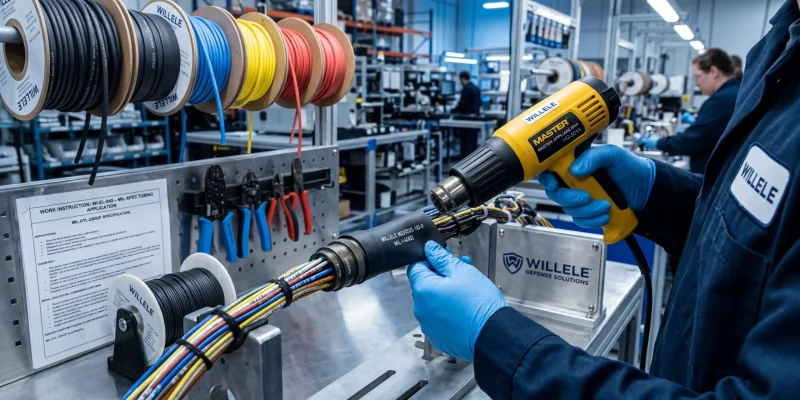
In the demanding world of military and defense operations, component reliability isn’t just important—it’s mission-critical. Heat shrink tubing has emerged as an indispensable solution for protecting electrical systems in some of the harshest environments imaginable, from the depths of submarines to the cockpits of fighter jets. As defense technologies advance and operational requirements become more stringent, understanding the specialized applications and specifications of military-grade heat shrink tubing has never been more crucial.
Understanding Military-Grade Heat Shrink Tubing
Military and defense applications of heat shrink tubing differ fundamentally from commercial uses. While standard heat shrink provides basic insulation and protection, military-spec (MIL-SPEC) heat shrink tubing must meet rigorous performance standards defined by detailed specifications, primarily under the MIL-DTL-23053 (now AS23053) designation. These specifications ensure that every piece of tubing can withstand extreme temperatures, resist chemical exposure, maintain electrical insulation under high stress, and perform reliably in life-or-death situations. citation citation
The transition from M23053 to AS23053 nomenclature reflects the Society of Automotive Engineers (SAE) International’s takeover of these standards, but the stringent requirements remain unchanged. Each classification within the AS23053 family addresses specific material compositions, shrink ratios, temperature ranges, and performance characteristics designed for distinct military applications. citation
Key Military Specifications and Standards
AS23053 Classification System
The AS23053 specification family encompasses multiple classes of heat shrink tubing, each engineered for specific defense applications:
AS23053/1 (formerly M23053/1) – Neoprene-based heat shrink tubing designed for general-purpose military applications where flexibility and moderate environmental resistance are required.
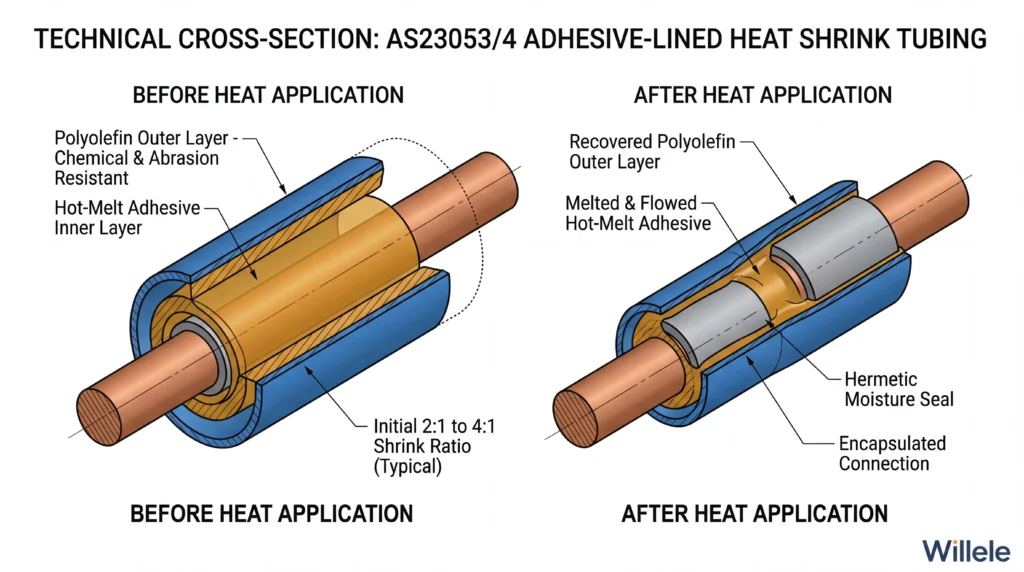
AS23053/4 (formerly M23053/4) – Adhesive-lined heat shrink tubing represents one of the most widely used specifications in military applications. This dual-wall construction features an inner adhesive layer that melts during heat application, creating a moisture-proof seal around wire connections. Available in 2:1, 3:1, and 4:1 shrink ratios, AS23053/4 tubing operates reliably across a temperature range of -40°C to 130°C (-40°F to 266°F), making it ideal for outdoor environments, naval applications, and industrial locations where corrosion and moisture pose constant threats. citation
AS23053/5 (formerly M23053/5) – Standard 2:1 shrink ratio tubing used extensively for bundling cables, wire harnesses, terminations, and wire splices across all military platforms. This specification provides the foundation for countless electrical protection applications in military equipment and vehicles. citation
AS23053/11 (formerly M23053/11) – Teflon FEP (fluorinated ethylene propylene) heat shrink tubing designed for the most demanding chemical and temperature environments. This specification has been in continuous use for over 50 years and is approved by all Department of Defense agencies. The FEP material provides exceptional chemical resistance, making it essential for applications involving fuel systems, hydraulic lines, and chemical processing equipment in military vehicles and aircraft. citation
AS23053/15 (formerly M23053/15) – Heavy-duty heat shrink tubing with self-sealing adhesive lining and 3:1 shrink ratio, engineered for applications requiring maximum environmental protection and mechanical strain relief.
Compliance and Certification Requirements
Military heat shrink tubing must comply with multiple overlapping standards beyond the AS23053 specifications. UL 224 certification ensures fire safety and electrical insulation properties, while RoHS compliance guarantees environmental safety by restricting hazardous substances. Many defense contractors also require traceability documentation, including batch certifications, material test reports, and compliance declarations that create a complete audit trail for every component used in military systems. citation
Critical Defense Applications
Aerospace and Aviation Systems
Military aircraft operate in some of the most extreme conditions imaginable, where temperatures can swing from -67°F at high altitude to over 275°F near engine components. Heat shrink tubing protects the thousands of wire connections throughout fighter jets, transport aircraft, and helicopters from vibration, electromagnetic interference, and environmental exposure. Custom-printed heat shrink tubing enables rapid identification of critical circuits during maintenance, reducing aircraft downtime and preventing potentially catastrophic wiring errors. citation
High-voltage protection systems in military aircraft rely on specialized heat shrink formulations that maintain dielectric strength even under extreme stress. The tubing prevents arc tracking, reduces electromagnetic interference, and provides redundant insulation layers that ensure flight-critical systems remain operational even if primary insulation fails.
Naval and Maritime Defense
Submarines, destroyers, and aircraft carriers present unique challenges for electrical systems. Constant exposure to saltwater, high humidity, and pressure variations demands heat shrink solutions with superior moisture resistance and corrosion prevention capabilities. Adhesive-lined heat shrink tubing creates hermetic seals around wire splices and connections, preventing the moisture ingress that would otherwise cause rapid corrosion of copper conductors and connector contacts. citation
Shipboard cable systems protected with military-grade heat shrink tubing maintain operational integrity for decades in marine environments. The tubing’s resistance to saltwater, diesel fuel, hydraulic fluids, and cleaning solvents ensures that naval vessels can complete extended deployments without electrical system failures that could compromise mission capability or crew safety.
Ground Vehicles and Armored Systems
Military ground vehicles—from light tactical vehicles to main battle tanks—operate in desert heat, arctic cold, and everything in between. Heat shrink tubing protects the complex electrical systems that control weapons systems, communications equipment, navigation systems, and vehicle operations. The tubing must withstand constant vibration, impact shock, dust infiltration, and temperature extremes while maintaining electrical insulation and mechanical protection. citation
Armored vehicles benefit particularly from wrap-around heat shrink solutions that enable field repairs without disconnecting entire wire harnesses. When combat damage or component failure requires electrical repairs in forward operating areas, wrap-around heat shrink tubing allows maintenance personnel to restore system functionality quickly, getting critical assets back into operation without requiring depot-level facilities.
Communications and Electronic Warfare Systems
Modern military operations depend on secure, reliable communications and sophisticated electronic warfare capabilities. The antenna systems, signal processing equipment, and transmission lines that enable these capabilities require heat shrink protection that maintains signal integrity while providing environmental protection. Low-dielectric-constant materials minimize signal loss, while shielding configurations reduce electromagnetic interference that could compromise operational security or system performance.
Portable communications equipment used by infantry units faces particularly harsh treatment, including repeated deployment and retrieval, exposure to weather extremes, and rough handling in combat conditions. Heat shrink tubing provides the strain relief and environmental protection that keeps these life-saving communications systems operational when soldiers need them most.
Missile and Weapons Systems
Precision-guided munitions, missile systems, and advanced weapons platforms contain sophisticated electronics that must function flawlessly despite exposure to extreme acceleration forces, temperature variations, and electromagnetic environments. Heat shrink tubing protects the sensor connections, guidance system wiring, and firing circuits that ensure these weapons reach their targets accurately. The tubing must maintain its properties during long-term storage, survive transportation shock, and perform reliably when called upon, even after years in inventory. citation
Material Properties and Performance Characteristics
Temperature Performance
Military-grade heat shrink tubing specifications define precise operating temperature ranges that ensure reliable performance across all defense applications:
| Spezifikation | Material Base | Betriebstemperaturbereich | Shrink Temperature |
|---|---|---|---|
| AS23053/1 | Neoprene | -55°C to 105°C (-67°F to 221°F) | 120°C – 150°C |
| AS23053/4 | Polyolefin + Adhesive | -40°C to 130°C (-40°F to 266°F) | 90°C – 120°C |
| AS23053/5 | Polyolefin | -55°C to 135°C (-67°F to 275°F) | 90°C – 120°C |
| AS23053/11 | Teflon FEP | -67°C to 200°C (-89°F to 392°F) | 327°C – 343°C |
| AS23053/15 | Heavy Wall Polyolefin | -55°C to 110°C (-67°F to 230°F) | 90°C – 120°C |
These temperature specifications ensure that heat shrink tubing maintains mechanical strength, electrical insulation properties, and dimensional stability throughout the operational envelope of military equipment.
Chemical and Environmental Resistance
Military operations expose equipment to an extraordinary range of chemical hazards, from jet fuel and hydraulic fluids to chemical warfare decontamination agents. Military-grade heat shrink tubing resists degradation from:
- Aviation fuels (JP-4, JP-5, JP-8)
- Hydraulic fluids (MIL-PRF-83282, MIL-PRF-87257)
- Lubricating oils and greases
- Saltwater and humidity
- Mild acids and alkalis
- Cleaning solvents and decontamination solutions
This comprehensive chemical resistance ensures that electrical protection remains intact even when equipment is exposed to chemical spills, requires decontamination, or operates in chemically aggressive environments. citation
Mechanical and Electrical Properties
Beyond environmental resistance, military heat shrink tubing must meet stringent mechanical and electrical performance standards:
Zugfestigkeit: Military-grade tubing typically exhibits tensile strength exceeding 1,500 psi after shrinking, providing robust mechanical protection against abrasion and impact.
Dielektrische Festigkeit: Voltage withstand capabilities range from 600V to over 7,000V depending on wall thickness and material composition, ensuring electrical isolation even in high-voltage military systems.
Flammbeständigkeit: Self-extinguishing properties prevent fire propagation in military vehicles and aircraft, where electrical fires pose catastrophic risks in confined spaces.
Flexibilität: Even after years of service, military-grade heat shrink maintains flexibility that prevents cracking during vibration and thermal cycling.
Comparison: Military-Spec vs. Commercial Heat Shrink Tubing
Understanding the differences between military-specification and commercial-grade heat shrink tubing helps procurement teams make informed decisions:
| Feature | Military-Spec (AS23053) | Commercial Grade |
|---|---|---|
| Testing Requirements | Extensive qualification testing with documented results | Basic performance verification |
| Temperaturbereich | -67°C to 200°C+ depending on spec | Typically -30°C to 105°C |
| Traceability | Full batch traceability with certifications | Limited or no traceability |
| Qualitätskontrolle | 100% inspection with statistical process control | Sample-based inspection |
| Chemische Beständigkeit | Tested against military fluids and fuels | General chemical resistance |
| Flammbeständigkeit | Self-extinguishing per UL 224 VW-1 | May or may not be flame retardant |
| Kosten | 3-10x higher than commercial | Lower cost |
| Availability | May require lead time for certification | Readily available |
| Shelf Life | Documented and guaranteed | Often unspecified |
| Application | Mission-critical defense systems | General industrial and commercial |
While commercial heat shrink tubing serves adequately for non-critical applications, military and defense systems require the enhanced performance, documented reliability, and traceability that only MIL-SPEC products provide. citation
Installation and Field Repair Considerations
Standard Installation Procedures
Proper installation of military-grade heat shrink tubing follows strict procedures to ensure optimal performance:
- Surface Preparation: Clean all surfaces thoroughly to remove contaminants, oils, and oxidation that could compromise adhesion or electrical insulation.
- Sizing Selection: Choose tubing with recovered diameter 20-30% smaller than the substrate diameter to ensure proper grip without excessive stress.
- Heat Application: Use calibrated heat guns or ovens to apply uniform heat, ensuring complete shrinkage and adhesive flow without overheating that could degrade material properties.
- Inspection: Verify complete shrinkage, proper adhesive flow (for lined tubing), and absence of voids or gaps that could allow moisture ingress.
Field Repair Solutions
Combat operations and remote deployments often require electrical repairs far from depot facilities. Wrap-around heat shrink tubing enables field repairs on assembled wire harnesses without requiring disconnection of connectors or removal of components. This capability dramatically reduces repair time and gets mission-critical equipment back into service quickly. citation
Military maintenance personnel carry pre-cut heat shrink repair kits sized for common wire gauges and connector types, enabling rapid response to electrical failures. The availability of products with National Stock Numbers (NSN) facilitates procurement through military supply chains and ensures that repair materials meet required specifications.
Procurement and Supply Chain Management
National Stock Numbers (NSN)
Many military-grade heat shrink tubing products carry National Stock Numbers that simplify procurement through government supply systems. NSN designation ensures that products meet stringent military standards and facilitates inventory management across defense organizations. The NSN system enables rapid identification, ordering, and tracking of approved heat shrink tubing products throughout the military supply chain. citation
Supplier Qualification
Defense contractors and military procurement offices must verify that heat shrink tubing suppliers maintain appropriate quality management systems, typically requiring ISO 9001 certification or AS9100 (aerospace quality management) registration. Supplier qualification includes verification of testing capabilities, review of quality control procedures, and validation of certification documentation.
Cost Considerations
Military-grade heat shrink tubing costs significantly more than commercial alternatives, reflecting the extensive testing, quality control, and documentation required. However, the total cost of ownership favors MIL-SPEC products in defense applications when considering:
- Reduced failure rates and maintenance costs
- Extended service life in harsh environments
- Avoided costs of mission failures or equipment downtime
- Compliance with contractual requirements
- Reduced risk of counterfeit or substandard materials
Emerging Trends and Future Developments
Advanced Material Formulations
Research continues into next-generation heat shrink materials that offer enhanced performance characteristics. Developments include:
- Nano-enhanced polymers that provide superior mechanical strength and chemical resistance
- Self-healing materials that can repair minor damage autonomously
- Smart materials with embedded sensors that monitor electrical system health
- Environmentally sustainable formulations that maintain military performance while reducing environmental impact
Additive Manufacturing Integration
As 3D printing technologies advance into military applications, heat shrink tubing manufacturers are developing products specifically designed to protect printed electronics and hybrid assemblies that combine traditional and additive manufacturing techniques.
Enhanced Electromagnetic Shielding
Modern electronic warfare environments require increasingly sophisticated electromagnetic interference (EMI) protection. New heat shrink formulations incorporate conductive fillers and shielding layers that provide EMI protection while maintaining the flexibility and environmental resistance of traditional heat shrink tubing.
Why Choose Willele for Military and Defense Applications
At Willele, we understand that military and defense applications demand uncompromising quality and reliability. Our heat shrink tubing products are manufactured to meet or exceed MIL-DTL-23053 specifications, with full traceability documentation and certification support for defense contractors and government procurement offices.
Our technical team works directly with defense engineers to specify the optimal heat shrink solutions for each application, whether you’re protecting avionics in fighter aircraft, securing connections in naval vessels, or ensuring reliability in ground combat vehicles. We maintain extensive inventory of military-grade heat shrink tubing in multiple specifications, sizes, and colors to support both production programs and field maintenance operations.
With decades of experience serving the defense industry, Willele provides not just products, but comprehensive technical support that helps military programs succeed. Our commitment to quality, compliance, and customer service makes us a trusted partner for defense contractors, military maintenance facilities, and government procurement offices worldwide.
Frequently Asked Questions
Q: What is the difference between M23053 and AS23053 specifications?
A: AS23053 is the current designation for military heat shrink tubing specifications, replacing the older M23053 nomenclature when SAE International took over the standards from the Department of Defense. The technical requirements remain essentially unchanged—AS23053 and M23053 specifications are functionally equivalent, and products meeting either designation are acceptable for military applications.
Q: How long can military-grade heat shrink tubing be stored before use?
A: When stored properly in cool, dry conditions away from direct sunlight and ozone sources, military-grade heat shrink tubing typically maintains its properties for 5-10 years or longer. Always verify storage requirements and shelf life with your supplier, and request fresh material for critical applications.
Q: Can commercial heat shrink tubing be substituted for MIL-SPEC products?
A: While commercial heat shrink may physically fit and provide basic protection, it should never be substituted for MIL-SPEC products in defense applications. Military specifications exist because defense systems require documented performance, traceability, and reliability that commercial products cannot guarantee. Using non-specified materials may violate contract requirements and compromise system reliability.
Q: What documentation is required when procuring military-grade heat shrink tubing?
A: Defense applications typically require a Certificate of Compliance (CoC) or Certificate of Conformance stating that the product meets specified military standards, along with material test reports, batch traceability information, and in some cases, first article inspection reports. Your supplier should provide all required documentation as part of the delivery package.
Q: How do I select the correct heat shrink specification for my military application?
A: Selection depends on multiple factors including operating temperature range, chemical exposure, mechanical stress, electrical requirements, and specific contract requirements. Consult with your heat shrink tubing supplier’s technical team, providing details about your application environment and performance requirements. For defense contracts, always verify that the selected specification is approved in your contract documentation.
Q: Is adhesive-lined heat shrink tubing always required for military applications?
A: Not always. Adhesive-lined tubing (such as AS23053/4 or AS23053/15) provides superior moisture sealing and is preferred for outdoor, marine, and high-humidity applications. However, standard heat shrink (like AS23053/5) is adequate for many indoor applications or where moisture is not a primary concern. The choice depends on your specific environmental requirements and contract specifications.