
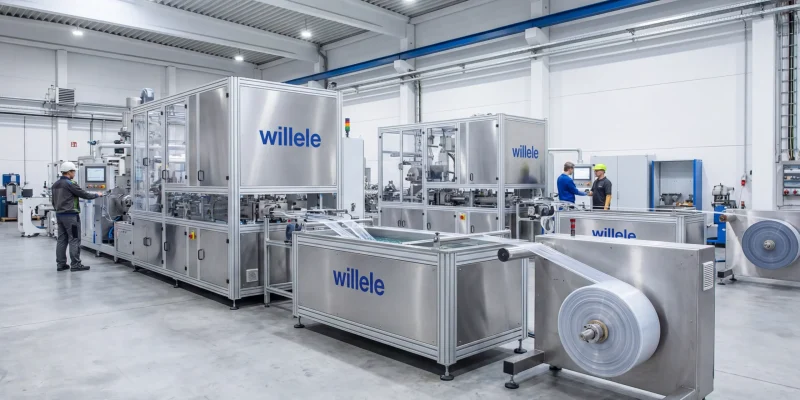
Understanding the Critical Role of Safety Standards in Heat Shrink Insulation
In the electrical equipment manufacturing industry, heat shrink sleeve insulation plays a vital role in protecting connections, preventing electrical hazards, and ensuring long-term system reliability. As a B2B manufacturer, understanding and adhering to electrical safety standards for heat shrink sleeve insulation is not just a regulatory requirement—it’s a commitment to quality, safety, and professional excellence.
Electrical safety standards for heat shrink sleeve insulation provide comprehensive guidelines covering material composition, thermal performance, dielectric strength, and environmental resistance. These standards ensure that heat shrink products perform reliably under demanding conditions, from industrial power distribution to telecommunications infrastructure.
Major International Safety Standards for Heat Shrink Sleeve Insulation
Global Standards Framework
Heat shrink sleeve insulation must comply with various international standards depending on target markets and applications. Understanding these standards is essential for manufacturers, procurement specialists, and electrical engineers.
| Πρότυπο | Issuing Body | Primary Focus | Geographic Applicability |
|---|---|---|---|
| UL 224 | Underwriters Laboratories | Extruded insulating tubing | North America |
| IEC 60684 | International Electrotechnical Commission | Flexible insulating sleeving | International |
| CSA C22.2 | Canadian Standards Association | Electrical insulation materials | Canada |
| VDE 0304 | Association for Electrical, Electronic & Information Technologies | Insulating tubes and sleeves | Europe/Germany |
| BS EN 60684 | British Standards Institution | Flexible insulating sleeving | United Kingdom/Europe |
| JIS C 3406 | Japanese Industrial Standards | Heat-shrinkable tubing | Japan |
UL 224 Standard Requirements
UL 224 establishes rigorous requirements for extruded insulating tubing, including heat shrink sleeves. Key parameters include:
- Voltage Rating: Classified from 300V to 35,000V
- Εύρος θερμοκρασίας: Continuous operation ratings from -55°C to +200°C
- Αντοχή στη φλόγα: Must meet VW-1 flame test requirements
- Διηλεκτρική αντοχή: Minimum withstand voltage based on wall thickness
IEC 60684 Series Specifications
The IEC 60684 series provides comprehensive specifications for flexible insulating sleeving, including heat-shrinkable types. This international standard covers:
- Material classification (polyolefin, fluoropolymer, elastomeric)
- Dimensional requirements and shrink ratios
- Electrical properties and voltage classifications
- Thermal endurance characteristics
- Chemical and environmental resistance
Critical Safety Parameters for Heat Shrink Sleeve Insulation
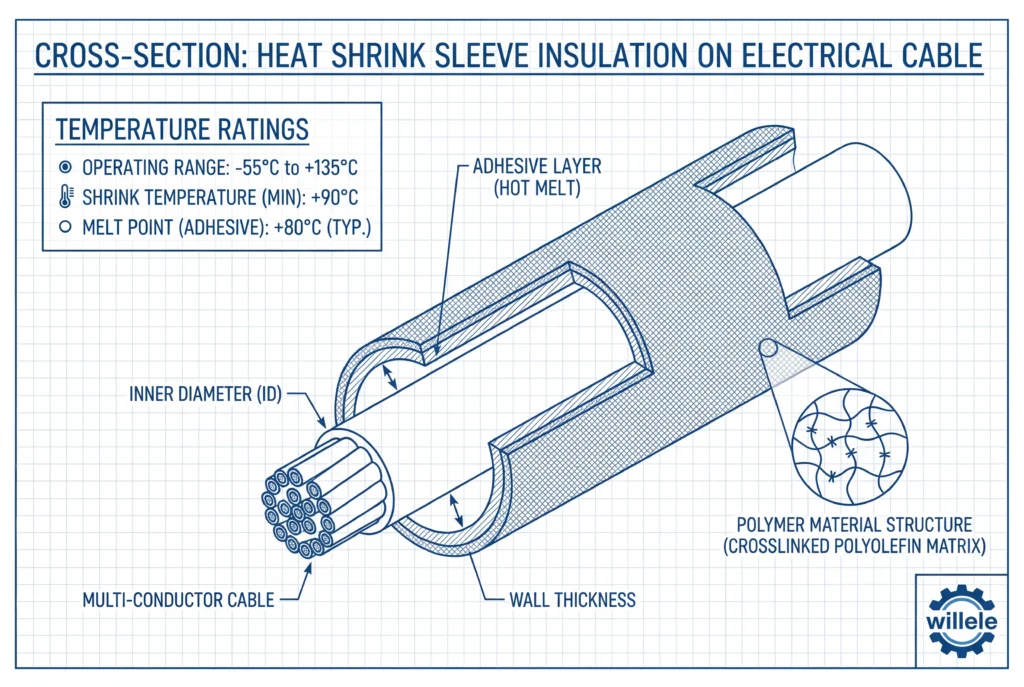
Dielectric Strength Requirements
Dielectric strength measures the insulation’s ability to withstand electrical stress without breakdown. This critical parameter varies based on wall thickness and voltage class.
| Πάχος τοιχώματος | Minimum Dielectric Strength | Voltage Class |
|---|---|---|
| 0.4 mm | 6 kV | Low voltage (≤1 kV) |
| 0.8 mm | 12 kV | Medium voltage (1-10 kV) |
| 1.5 mm | 20 kV | Medium voltage (10-35 kV) |
| 2.5 mm | 30 kV | High voltage (>35 kV) |
Temperature Rating Classifications
Operating temperature ranges are fundamental to electrical safety standards for heat shrink sleeve insulation. Different materials offer varying temperature capabilities:
| Τύπος υλικού | Continuous Operating Temp | Short-Term Rating | Shrink Temperature |
|---|---|---|---|
| Polyolefin (Standard) | -55°C to +125°C | +150°C | 90-120°C |
| Polyolefin (High-Temp) | -55°C to +150°C | +175°C | 100-130°C |
| Fluoropolymer (FEP/PTFE) | -65°C to +200°C | +260°C | 175-275°C |
| Cross-Linked Polyolefin | -55°C to +135°C | +160°C | 95-125°C |
| Elastomeric | -45°C to +175°C | +200°C | 110-150°C |
Flame Resistance Standards
Flame resistance is a critical safety requirement to prevent fire propagation in electrical systems. Heat shrink sleeve insulation must meet specific flame test criteria:
VW-1 Vertical Wire Flame Test (UL 224)
- Burn time after removal of flame: Maximum 60 seconds
- Dripping of flaming particles: Not permitted if they ignite cotton below
- Indicator flag consumption: Maximum 25%
IEC 60684 Flame Test Requirements
- Must self-extinguish within specified time
- No flaming droplets that ignite tissue paper
- Limited char length propagation
Voltage Class Specifications
Electrical safety standards categorize heat shrink insulation by voltage capability:
| Voltage Class | Rated Voltage | Typical Applications | Minimum Wall Thickness |
|---|---|---|---|
| Class 0 | <300V | Consumer electronics, low voltage | 0.25-0.4 mm |
| Class 1 | 300-600V | Residential wiring, appliances | 0.4-0.6 mm |
| Class 2 | 600-1,000V | Industrial equipment, motors | 0.6-1.0 mm |
| Class 3 | 1,000-5,000V | Distribution systems, substations | 1.0-1.8 mm |
| Class 4 | 5,000-15,000V | Medium voltage distribution | 1.8-2.5 mm |
| Class 5 | >15,000V | High voltage transmission | >2.5 mm |
Material Specifications and Compliance Requirements
Material Property Comparisons
Different materials offer distinct advantages for specific applications. Understanding these properties ensures compliance with electrical safety standards for heat shrink sleeve insulation:
| Property | Πολυολεφίνη | Fluoropolymer | Elastomeric | Polyester |
|---|---|---|---|---|
| Max Operating Temp | 135°C | 200°C | 175°C | 155°C |
| Dielectric Constant | 2.3-2.6 | 2.0-2.1 | 3.0-7.0 | 3.0-3.5 |
| Ειδική αντίσταση όγκου | 10¹⁴-10¹⁶ Ω·cm | >10¹⁸ Ω·cm | 10¹³-10¹⁵ Ω·cm | 10¹³-10¹⁴ Ω·cm |
| Αντοχή σε εφελκυσμό | 10-20 MPa | 20-35 MPa | 5-15 MPa | 40-60 MPa |
| Flame Rating | VW-1/V-0 | V-0 | VW-1 | VW-1/V-0 |
| Χημική αντίσταση | Καλή | Εξαιρετικό | Καλή | Μέτρια |
| Cost Factor | 1.0x | 4-8x | 2-3x | 1.5-2x |
RoHS and Environmental Compliance
Modern electrical safety standards for heat shrink sleeve insulation include environmental considerations:
- RoHS Directive: Restriction of hazardous substances (lead, mercury, cadmium, hexavalent chromium, PBB, PBDE)
- REACH Compliance: Registration, evaluation, authorization of chemicals
- Halogen-Free Requirements: Low smoke, zero halogen (LSZH) for enclosed spaces
- Recyclability: End-of-life disposal and material recovery considerations
Testing Procedures and Certification Processes
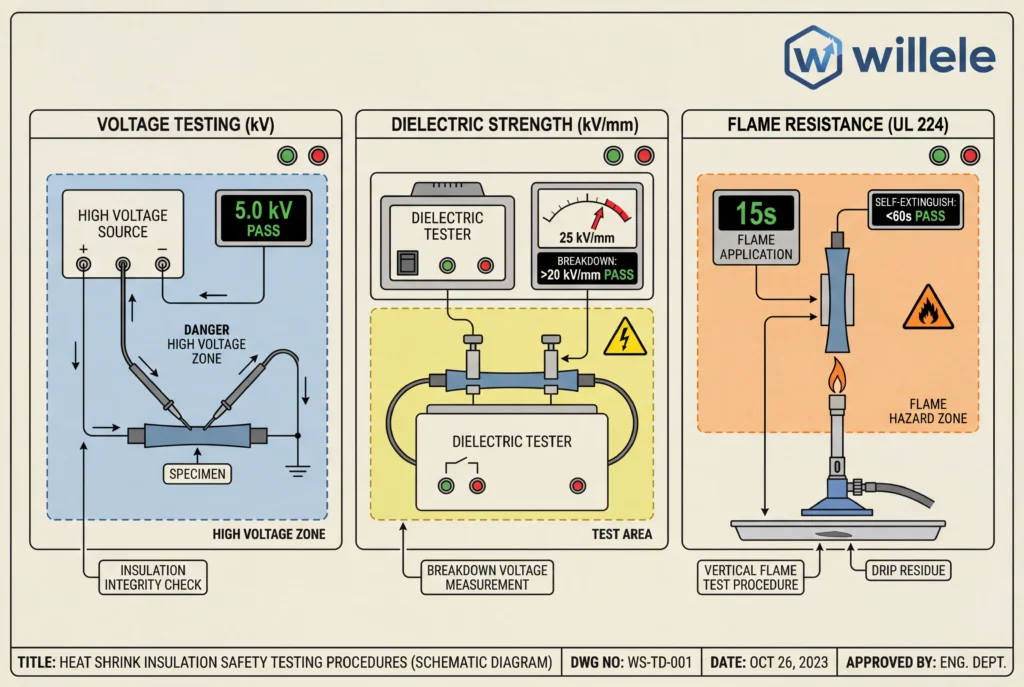
Mandatory Testing Requirements
Comprehensive testing ensures heat shrink sleeve insulation meets safety standards:
| Test Type | Standard Method | Acceptance Criteria | Test Frequency |
|---|---|---|---|
| Dielectric Withstand | IEC 60243-1 | No breakdown at rated voltage × 2.5 | Per batch |
| Αντοχή σε εφελκυσμό | ASTM D638 | Min. 10 MPa (polyolefin) | Weekly |
| Επιμήκυνση κατά τη θραύση | ASTM D638 | Min. 200% | Weekly |
| Αναλογία συρρίκνωσης | In-house/IEC 60684 | 2:1 to 6:1 as specified | Per batch |
| Longitudinal Change | IEC 60684-2 | Max. ±5% | Monthly |
| Heat Shock | IEC 60684-2 | No cracks or splits | Per batch |
| Cold Bend | IEC 60684-2 | No cracks at -55°C | Monthly |
| Αντοχή στη φλόγα | UL VW-1/IEC 60695 | Self-extinguishing | Quarterly |
| Thermal Aging | IEC 60216 | <50% property loss after rated hours | Annual |
| Ειδική αντίσταση όγκου | IEC 60093 | Min. 10¹⁴ Ω·cm | Quarterly |
Certification Process Overview
Obtaining certification for electrical safety standards compliance involves:
- Product Testing: Submit samples to accredited laboratories (UL, TUV, CSA)
- Factory Inspection: Certification bodies audit manufacturing processes and quality systems
- Ανασκόπηση τεκμηρίωσης: Technical files, material specifications, and test reports evaluated
- Initial Certification: Upon successful completion, certification mark granted
- Ongoing Surveillance: Regular factory inspections and product re-testing (typically annual)
Quality Assurance and Manufacturing Best Practices
Process Control Standards
Maintaining compliance with electrical safety standards for heat shrink sleeve insulation requires rigorous quality control:
- Raw Material Verification: Testing of incoming materials for purity and consistency
- In-Process Monitoring: Real-time measurement of wall thickness, dimensions, and shrink ratio
- Statistical Process Control: Continuous monitoring of critical parameters
- Environmental Controls: Temperature and humidity monitoring in production areas
- Traceability Systems: Batch tracking from raw materials through finished products
Documentation Requirements
Proper documentation demonstrates compliance with safety standards:
- Material safety data sheets (MSDS)
- Certification test reports
- Manufacturing process specifications
- Quality control records
- Batch traceability logs
- Customer-specific compliance declarations
Industry-Specific Applications and Standards
Power Distribution and Transmission
High-voltage applications require specialized heat shrink insulation meeting enhanced safety standards:
- Minimum creepage and clearance distances
- Corona resistance testing
- Long-term voltage endurance
- Moisture barrier properties
Telecommunications and Data Centers
Communication systems demand heat shrink insulation with specific characteristics:
- Low dielectric constant for signal integrity
- Excellent dimensional stability
- Flame retardancy for plenum spaces
- Chemical resistance to cleaning agents
Automotive and Transportation
Automotive applications require compliance with additional standards:
- SAE J2030 for low voltage primary cable insulation
- ISO 6722 for road vehicle cables
- Enhanced abrasion resistance
- Fluid resistance (oils, fuels, coolants)
Why Choose Willele Electric for Compliant Heat Shrink Solutions
As a specialized B2B manufacturer of electrical equipment, Willele Electric maintains rigorous adherence to all major international electrical safety standards for heat shrink sleeve insulation. Our manufacturing facilities are certified to ISO 9001:2015 quality management standards, and our products carry UL, CSA, VDE, and IEC certifications.
Every Willele heat shrink product undergoes comprehensive testing throughout the manufacturing process, ensuring consistent compliance with electrical safety standards. Our technical team provides expert guidance on standard selection, material specifications, and application-specific requirements.
For procurement professionals and electrical engineers requiring certified heat shrink sleeve insulation that meets the highest safety standards, Willele Electric offers comprehensive solutions backed by technical expertise and proven quality.
Frequently Asked Questions
Q: What is the difference between UL 224 and IEC 60684 standards for heat shrink insulation?
A: UL 224 is primarily focused on North American markets and emphasizes flame resistance testing and voltage ratings for extruded insulating tubing. IEC 60684 is an international standard with broader material classifications and more comprehensive specifications for flexible insulating sleeving, including detailed requirements for different polymer types and application conditions.
Q: How do I determine the correct voltage class for my heat shrink sleeve insulation application?
A: Select a voltage class rated at least 25% above your system’s maximum operating voltage. For example, if your system operates at 480V, choose Class 2 (600-1,000V rated) insulation. Also consider transient voltages, safety factors, and environmental conditions that may affect insulation performance.
Q: What are the key differences between standard polyolefin and fluoropolymer heat shrink sleeves?
A: Fluoropolymer heat shrink sleeves offer superior temperature ratings (up to 200°C vs. 135°C), excellent chemical resistance, and better electrical properties. However, they cost 4-8 times more than polyolefin and require higher shrink temperatures. Choose fluoropolymer for high-temperature applications, chemical exposure, or critical electrical performance requirements.
Q: How often should certified heat shrink insulation products be re-tested?
A: Certification standards typically require annual surveillance testing and factory audits. Manufacturers should conduct batch testing for critical parameters (dielectric strength, dimensions) and quarterly testing for flame resistance and environmental properties. Full comprehensive testing should occur annually or when product formulations change.
Q: What does “halogen-free” mean in heat shrink insulation, and when is it required?
A: Halogen-free (LSZH – Low Smoke Zero Halogen) heat shrink contains no chlorine or fluorine compounds that produce toxic and corrosive gases when burned. It’s required in enclosed spaces like tunnels, ships, aircraft, and buildings where smoke toxicity poses risks to occupants. Many European standards and increasingly North American specifications mandate LSZH materials.
Q: Can heat shrink sleeve insulation lose its certification over time?
A: Properly stored heat shrink products maintain their certification. However, exposure to UV radiation, extreme temperatures, chemicals, or moisture before installation can degrade properties. Always store heat shrink insulation in cool, dry conditions away from sunlight. Manufacturers like Willele Electric provide shelf-life recommendations (typically 3-5 years) to ensure performance meets safety standards at installation time.