

Selecting the correct heat shrink tubing is critical for ensuring the longevity, safety, and performance of electrical connections. Whether you are managing a large-scale industrial assembly line or designing specialized electrical equipment, using the wrong size tubing can lead to insulation failure, moisture ingress, and mechanical strain.
As a leading B2B manufacturer of electric equipment, Willele Electric understands that precision is everything. This guide will walk you through the technical steps of how to choose the right size heat shrink tubing for your wire, ensuring your projects meet rigorous industrial standards.
Understanding the Basics: How Heat Shrink Tubing is Measured
Before diving into selection charts, it is essential to understand the specific terminology used by manufacturers like Willele Electric. Heat shrink tubing is not measured like standard pipe or conduit; it has two distinct states.
- Supplied Diameter (Expanded I.D.): This is the internal diameter of the tube as you receive it, before heat is applied. It must be large enough to slide over your wire, cable, or connector easily.
- Recovered Diameter (Shrunk I.D.): This is the internal diameter of the tube after it has been fully shrunk. This measurement must be smaller than the object you are covering to ensure a tight seal.
The Golden Rule of Sizing: The “80:20” Rule
To achieve the perfect fit, you should never choose a tube that fits “just right” in its supplied state, nor one that maxes out its shrinking capability.
- The Clearance Rule: The supplied diameter should be at least 20% to 30% larger than the largest part of the object you are covering. This ensures the tube slides on without friction, which could damage the wire strands or the tubing itself.
- The Compression Rule: The recovered diameter (after shrinking) should be at least 10% to 20% smaller than the object you are covering. This tension creates the mechanical bond and environmental seal.
Why Precision Matters
If the supplied tube is too tight, it will take too long to position, slowing down production lines. If the recovered diameter is too loose, moisture and dust will penetrate the seal, leading to corrosion and short circuits.
Understanding Shrink Ratios
The shrink ratio indicates how much the tubing will reduce in size. Choosing the right ratio depends heavily on the geometry of the component you are covering.
| Shrink Ratio | Description | Ideal Application |
|---|---|---|
| 2:1 | Shrinks to half its original size. | Standard wire insulation, color coding, and identification. Most common for uniform wires. |
| 3:1 | Shrinks to one-third its original size. | irregular shapes, fitting over connectors to seal the wire behind them. |
| 4:1 | Shrinks to one-quarter its original size. | heavy-duty applications, large connector transitions, and repairing damaged cable jackets without removing connectors. |
| 6:1 | High shrink ratio. | Specialized industrial applications requiring extreme size transitions (e.g., large battery terminals). |

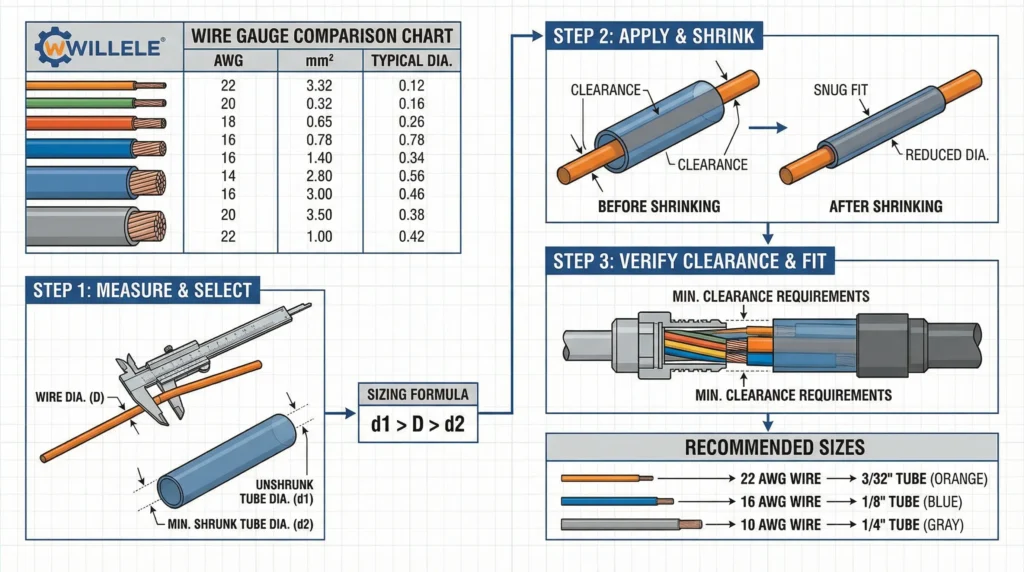
Step-by-Step Guide: How to Choose the Right Size Heat Shrink Tubing for Your Wire
Follow this technical process to ensure you select the correct Willele Electric product for your application.
Step 1: Measure the Largest Diameter
Identify the widest point the tubing must slide over. This is often not the wire itself but the connector, terminal, or splice attached to the end.
- Measurement A: The largest diameter (e.g., the ring terminal).
Step 2: Measure the Smallest Diameter
Identify the smallest area that needs to be covered and sealed. This is usually the bare wire or the cable jacket insulation.
- Measurement B: The smallest diameter (e.g., the wire insulation).
Step 3: Select the Supplied ID
Choose a heat shrink tube with a Supplied Internal Diameter (ID) that is slightly larger than Measurement A.
- Formula: Supplied ID ≥ Measurement A + 20% clearance.
Step 4: Verify the Recovered ID
Ensure the tube’s Recovered Internal Diameter (ID) is smaller than Measurement B.
- Formula: Recovered ID ≤ Measurement B – 10% tension.
Wire Gauge to Heat Shrink Selection Chart
For engineers working with standard AWG (American Wire Gauge), the following table provides a general guideline for selecting 2:1 ratio tubing. Note: Always verify actual insulation thickness as it varies by wire type (THHN, XHHW, etc.).
| Wire Gauge (AWG) | Approx. Wire OD (mm) | Recommended Tube Size (Supplied ID) |
|---|---|---|
| 18 – 16 AWG | 1.02 – 1.29 mm | 3/32″ (2.4 mm) or 1/8″ (3.2 mm) |
| 14 – 12 AWG | 1.63 – 2.05 mm | 1/8″ (3.2 mm) or 3/16″ (4.8 mm) |
| 10 AWG | 2.59 mm | 3/16″ (4.8 mm) or 1/4″ (6.4 mm) |
| 8 AWG | 3.26 mm | 1/4″ (6.4 mm) |
| 6 AWG | 4.11 mm | 3/8″ (9.5 mm) |
| 4 AWG | 5.19 mm | 3/8″ (9.5 mm) or 1/2″ (12.7 mm) |
| 2 AWG | 6.54 mm | 1/2″ (12.7 mm) |
| 1/0 – 2/0 AWG | 8.25 – 9.27 mm | 3/4″ (19.1 mm) |
Critical Factor: Longitudinal Shrinkage
A common oversight when determining how to choose the right size heat shrink tubing for your wire is ignoring length changes. Heat shrink tubing does not just shrink in diameter; it also shrinks in length.
- The Phenomenon: As the diameter decreases, the tube walls thicken, and the overall length decreases.
- Standard Rate: Most industrial tubing, including standard polyolefin, has a longitudinal shrinkage of 5% to 7%.
- The Fix: Always cut your tubing slightly longer than the area you intend to cover to account for this retraction.
Wall Thickness Considerations
The wall thickness of the tubing changes as it shrinks.
- Nominal Wall Thickness: Usually refers to the thickness in the fully recovered state.
- Importance: Thicker walls offer better dielectric strength (insulation) and mechanical protection against abrasion.
- Dual-Wall Tubing: For moisture protection, choose dual-wall (adhesive-lined) tubing. As the outer wall shrinks, the inner adhesive layer melts and flows into voids, creating a waterproof seal. This adds bulk, so factor this into your space requirements.
Common Sizing Mistakes to Avoid
- Buying the exact size: If your wire is 6mm and you buy 6mm tubing, it will likely get stuck halfway on. Always allow for clearance.
- Overheating to force a fit: Applying excessive heat to make a large tube shrink further than its rated ratio will cause the material to become brittle, char, or split.
- Ignoring the connector: Sizing for the wire but forgetting the tube must pass over a bulky connector first. In this scenario, a high-ratio tube (3:1 or 4:1) is required.
Frequently Asked Questions (FAQ)
1. How much overlap should I leave on the wire insulation?
Ideally, the heat shrink tubing should overlap the existing wire insulation by at least 0.5 inches (12mm) on both ends to ensure proper strain relief and seal integrity.
2. What happens if I use a heat shrink tube that is too large?
If the Recovered ID of the tube is larger than the wire, the tubing will be loose. It will slide around, failing to provide waterproofing or strain relief, and may trap moisture inside, accelerating corrosion.
3. Can I cut heat shrink tubing lengthwise?
No. Cutting heat shrink tubing lengthwise destroys its hoop stress capabilities. When heated, it will pull apart rather than shrinking down tightly around the wire.
4. What is the difference between Single-Wall and Dual-Wall tubing?
Single-wall is used for electrical insulation and color coding. Dual-wall (adhesive-lined) contains an inner layer of hot-melt adhesive that seals against water and dust, making it ideal for outdoor or harsh B2B environments.
5. Does the color of the tubing affect the shrink size?
Generally, no. However, clear (transparent) tubing is sometimes made from a slightly different compound which may have different shrink characteristics. Always check the specific datasheet from Willele Electric.
6. What tools should I use to shrink the tubing?
For professional results, use a heat gun with temperature control. Avoid using open flames (like lighters), as they cause uneven shrinking and can damage the wire insulation.
Conclusion
Knowing how to choose the right size heat shrink tubing for your wire is a mix of simple math and understanding your application’s environment. By calculating the supplied and recovered diameters and accounting for longitudinal shrinkage, you ensure a secure, professional-grade installation every time.
At Willele Electric, we specialize in manufacturing high-performance heat shrink solutions tailored for industrial B2B applications. Whether you need standard polyolefin, high-ratio dual-wall tubing, or custom-cut lengths, our engineering team is ready to support your production needs.
Contact Willele Electric today to request a quote or consult with our technical team about your specific tubing requirements.