
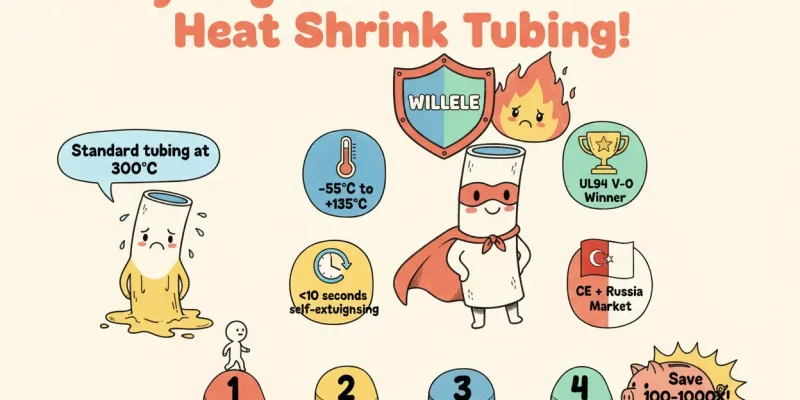
The Silent Killer in Your Control Cabinet: Why Standard Heat Shrink Tubing Fails When You Need It Most
Picture this: It’s 2 AM, and you’re standing in front of a smoking control cabinet in a critical production line. The entire system is down. As you investigate, you discover that a simple wire connection overheated, the standard heat shrink tubing melted, exposed conductors sparked, and now you’re facing thousands of dollars in downtime. Sound familiar?
I’ve witnessed this scenario more times than I care to admit over my 15+ years in electrical automation. The irony? This catastrophic failure could have been prevented with one simple decision made during installation: choosing flame-retardant heat shrink tubing instead of standard tubing.
Key Takeaway: The difference between standard and flame-retardant heat shrink tubing isn’t just a checkbox on a spec sheet—it’s the difference between a minor issue and a complete system meltdown.
The Real Problem: When “Good Enough” Insulation Becomes a Liability
Most engineers select heat shrink tubing based on a simple criterion: “Does it fit?” But in high-stakes industrial environments—chemical plants, offshore platforms, automotive manufacturing, railway systems—this approach is dangerously inadequate. Here’s why:
The Three Critical Failure Modes Standard Tubing Can’t Handle:
- Thermal Runaway Events: When electrical faults occur, temperatures can spike to 300°C+ within seconds. Standard tubing melts, drips, and propagates fire.
- Secondary Ignition Risk: Even if the tubing doesn’t ignite first, melting insulation exposes live conductors that can arc and ignite surrounding materials.
- Toxic Smoke Generation: In enclosed spaces like control rooms or ship engine compartments, burning plastic releases toxic fumes faster than fire itself.
Pro-Tip: If your application involves temperatures above 125°C, proximity to flammable materials, or enclosed spaces where smoke evacuation is limited, standard heat shrink tubing is not just inadequate—it’s a liability waiting to materialize.
The Engineering Solution: WILLELE Flame-Retardant Heat Shrink Tubing
Think of flame-retardant heat shrink tubing as the “emergency brake system” for your electrical installations. Just as your car needs brakes that work when you need them most, your electrical connections need protection that activates precisely when thermal events occur.
WILLELE’s flame-retardant heat shrink tubing is engineered with halogen-free, self-extinguishing polymers that create a protective barrier against fire propagation. Here’s what sets it apart:
Core Performance Characteristics
Temperature Performance:
- Operating range: -55°C to +135°C (some grades up to +150°C)
- Shrink activation: 70-110°C
- Short-term resistance: up to 200°C without structural failure
Flame Retardancy Standards:
- Meets UL94 V-0 rating (highest flame retardancy classification)
- Self-extinguishing within 10 seconds of flame source removal
- Zero flaming drip formation
- Complies with IEC 60684-3 international standards
전기 절연:
- Dielectric strength: >15 kV/mm
- Volume resistivity: >10¹⁴ Ω·cm
- Perfect for voltages up to 600V applications
The 4-Step Selection Framework: Matching WILLELE Tubing to Your Application
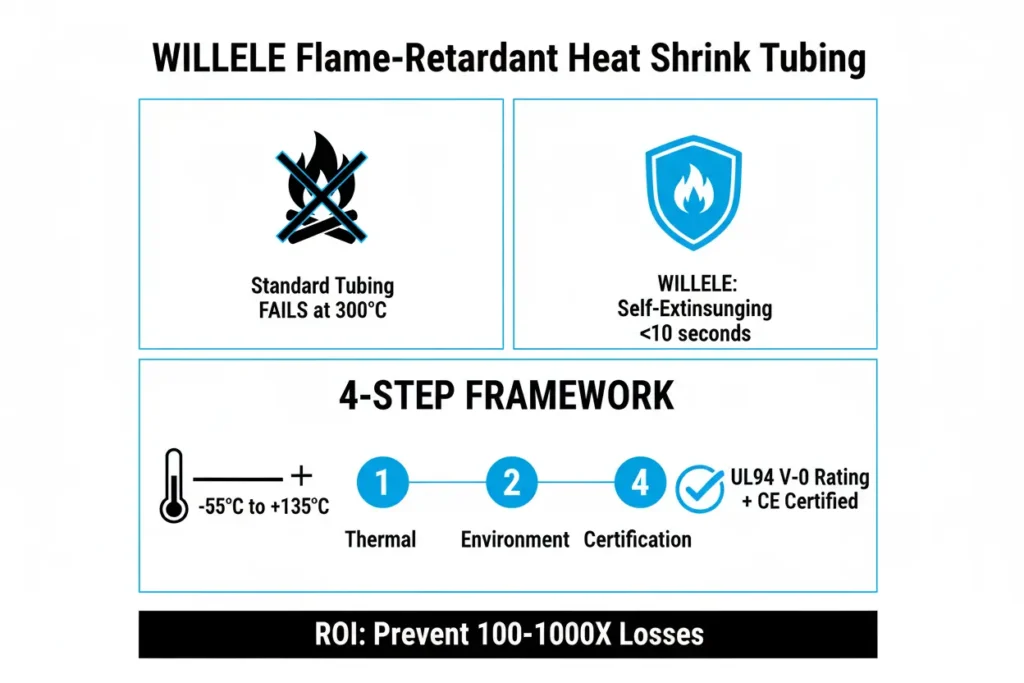
Let me walk you through the exact process I use when specifying flame-retardant heat shrink tubing for critical installations:
Step 1: Assess Your Thermal Environment
Ask yourself:
- What’s the highest ambient temperature the tubing will experience?
- Are there nearby heat sources (motors, resistors, exhaust systems)?
- What’s the maximum fault current your circuit could experience?
Selection Guide:
- Standard environments (≤105°C): WILLELE 2:1 shrink ratio tubing
- High-temperature zones (105-135°C): WILLELE high-temp grade
- Extreme conditions (>135°C): Consider dual-wall adhesive-lined options
Key Takeaway: Always add a 20°C safety margin to your maximum expected temperature. In industrial environments, “typical” temperatures are often exceeded during fault conditions or seasonal variations.
Step 2: Identify Fire Risk Factors
Critical questions:
- Is the installation near flammable materials (lubricants, solvents, gases)?
- Is it in an enclosed space with limited ventilation?
- Does local regulation require specific flame retardancy ratings?
Risk Assessment Matrix:
- High Risk: Offshore platforms, chemical plants, aircraft, railway coaches → Mandatory flame-retardant tubing with UL94 V-0 rating
- Medium Risk: Factory control cabinets, automotive harnesses → Flame-retardant strongly recommended
- Standard Risk: Open-air installations, residential → Flame-retardant provides extra safety margin
Pro-Tip: In Russia and Eastern European markets, where WILLELE has established strong market presence, regulations increasingly mandate flame-retardant materials in industrial settings. Check local electrical codes—what’s optional today may be mandatory tomorrow.
Step 3: Determine Environmental Exposure
WILLELE flame-retardant tubing offers superior protection against:
내화학성:
- Acids and alkalis (pH 3-11)
- Industrial solvents and oils
- Hydraulic fluids and coolants
Moisture Protection:
- Water absorption: <0.5%
- Salt spray resistant (ideal for marine/offshore applications)
- Maintains insulation properties in humid environments
Mechanical Durability:
- Abrasion resistant outer layer
- Flexible even at low temperatures (-55°C)
- UV stabilized for outdoor applications
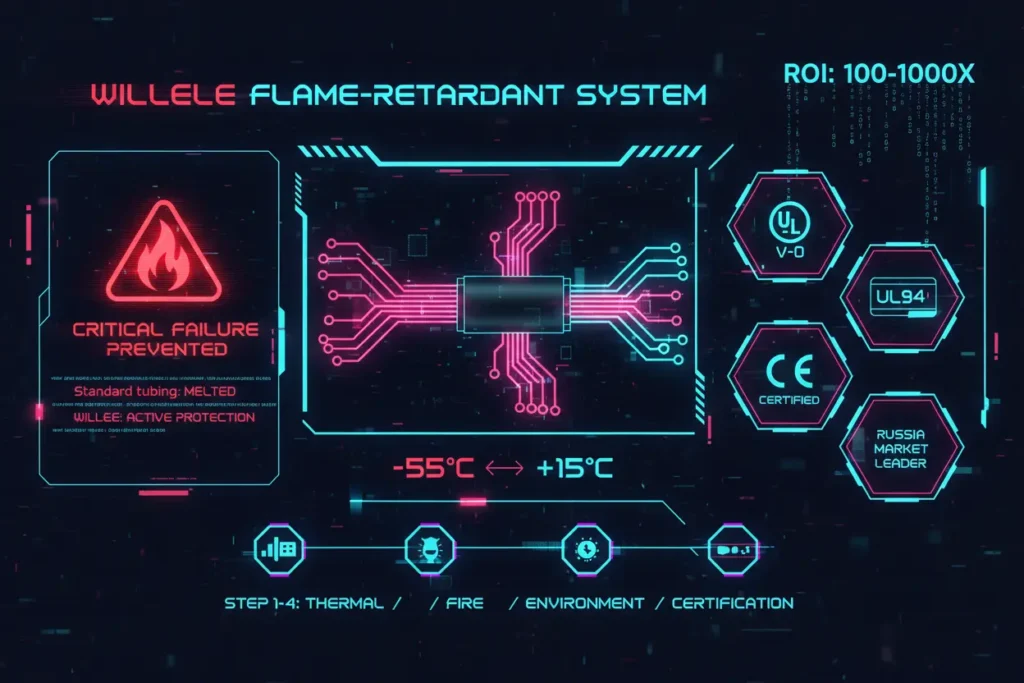
Step 4: Verify Certification and Compliance
This is where WILLELE’s commitment to quality becomes your competitive advantage:
CE Certification: All WILLELE flame-retardant heat shrink tubing carries CE marking, ensuring compliance with European safety directives. This is critical for:
- Equipment exported to EU markets
- Projects requiring internationally recognized certifications
- Quality assurance in procurement processes
Russia Market Expertise: WILLELE has developed deep expertise in Russia’s stringent electrical safety regulations, including:
- GOST standards compliance
- TR CU (Technical Regulations of the Customs Union) certification
- Local language technical support and documentation
Key Takeaway: Choosing CE-certified products isn’t just about compliance—it’s about demonstrable due diligence. When auditors or insurance inspectors review your installation, proper certification protects both your project and your professional reputation.
Real-World Applications: Where WILLELE Tubing Saves the Day
Application 1: Railway Signal Systems
The Challenge: A railway operator needed to protect thousands of signal cable terminations exposed to extreme temperature variations (-40°C to +85°C), vibration, and potential electrical faults near passenger areas.
The Solution: WILLELE flame-retardant heat shrink tubing provided:
- Self-extinguishing protection preventing fire spread along cable routes
- Flexible performance maintaining seal integrity through thermal cycling
- Zero toxic emissions protecting passengers and crew
The Result: Zero fire incidents over 5+ years of operation, compared to previous installations using standard tubing that required emergency replacements after multiple smoking incidents.
Application 2: Offshore Oil Platform Control Systems
The Challenge: Control cabinet wiring in a classified hazardous area (Zone 2) where any ignition source could trigger catastrophic explosion.
The Solution: WILLELE’s UL94 V-0 rated tubing ensured:
- Electrical faults self-contained without flame propagation
- Chemical resistance to oil mist and cleaning solvents
- Salt spray resistance for 20+ year service life
Pro-Tip: In offshore applications, factor in the “total cost of ownership.” The initial 15-20% premium for flame-retardant tubing becomes negligible compared to the cost of helicopter mobilization for emergency repairs.
Application 3: Automotive Manufacturing Robotics
The Challenge: Welding robot harnesses subjected to welding spatter, high temperatures, and continuous flexing—standard tubing failed within 6 months.
The Solution: WILLELE flame-retardant tubing delivered:
- Spatter resistance preventing burn-through
- Flexibility maintaining seal through millions of flex cycles
- Self-extinguishing properties preventing fire spread in paint booth areas
Key Takeaway: In automated manufacturing, unplanned downtime costs can exceed $20,000 per hour. The reliability difference between standard and flame-retardant tubing directly impacts your bottom line.
The Installation Advantage: Easier Than You Think
One common misconception is that flame-retardant tubing is difficult to work with. In reality, WILLELE’s design philosophy prioritizes installation ease:
Three-Minute Installation Process:
- Measure and Cut: Use standard cutting tools—no special equipment required
- Position Over Connection: Slide tubing over the joint with minimal effort (2:1 shrink ratio provides comfortable fit tolerance)
- Apply Heat: Use standard heat gun (recommended: 90-120°C air temperature). Tubing shrinks uniformly in 30-60 seconds
Installation Pro-Tips:
- Always cut tubing 10-15% longer than the connection to ensure complete coverage
- For large-diameter applications, pre-warm the tubing to improve flexibility
- Use a heat gun with temperature control to avoid overheating (optimal: 100-110°C)
- Observe the tubing surface—it should appear glossy and smooth when properly shrunk
Key Takeaway: WILLELE’s tubing memory properties ensure consistent, bubble-free shrinkage even with basic heat guns. This means technicians can achieve professional results without extensive training.
Why WILLELE: Engineering Quality You Can Trust
After specifying heat shrink tubing across hundreds of projects, I’ve learned that the manufacturer matters as much as the product specification. Here’s why WILLELE stands out:
Technical Excellence
- 15+ years of specialization in heat shrink technology
- In-house polymer formulation ensuring consistent quality batch-to-batch
- Advanced extrusion processes creating uniform wall thickness (critical for reliable shrinkage)
Certification and Compliance
- CE certification across entire product range
- Comprehensive test reports for every production batch
- Full material traceability for safety-critical applications
Market Expertise
- Strong presence in Russia market with local technical support
- Understanding of regional regulations and installation practices
- Multilingual documentation and customer service
Application Support
- Technical consultation for complex installations
- Custom sizing and packaging options
- Same-day response to specification inquiries
Pro-Tip: When evaluating suppliers, ask for batch test certificates and trace codes. WILLELE provides complete documentation, enabling full quality traceability—essential for industries with strict audit requirements.
The Cost-Benefit Reality: Why Flame-Retardant Tubing Pays for Itself
Let’s address the elephant in the room: Yes, flame-retardant heat shrink tubing costs approximately 15-25% more than standard tubing. But let’s put that in perspective:
Cost Comparison Example (1000-connection installation):
- Standard tubing: $500
- WILLELE flame-retardant tubing: $625
- Added cost: $125
Potential savings from preventing just ONE fire incident:
- Equipment damage: $5,000-$50,000
- Production downtime: $10,000-$100,000+
- Emergency response and repair: $2,000-$15,000
- Reputation and regulatory risk: Incalculable
ROI Calculation: If flame-retardant tubing prevents even one thermal event across your entire facility lifetime, you’ve achieved a 100-1000X return on investment.
Key Takeaway: In risk management terms, flame-retardant tubing isn’t an expense—it’s an insurance policy with a premium that’s almost negligible compared to potential losses.
Your Next Steps: Making the Switch to WILLELE
If you’re currently using standard heat shrink tubing in any of these scenarios, it’s time to reassess:
✓ Control cabinets and panel wiring
✓ Motor connection boxes
✓ Cable harness terminations
✓ High-temperature environments (>105°C)
✓ Hazardous area installations
✓ Applications requiring international certification
Immediate Action Plan:
- Audit your current installations: Identify connections using standard tubing in high-risk areas
- Review applicable regulations: Check if flame retardancy is already required (or soon will be)
- Contact WILLELE technical team: Discuss your specific application requirements and receive customized recommendations
- Request samples: Test WILLELE tubing in your actual installation conditions
- Update specifications: Standardize on flame-retardant tubing for all new projects
Key Takeaway: Upgrading to flame-retardant heat shrink tubing doesn’t require a complete system overhaul. Start with your highest-risk connections and expand from there. Each upgraded connection is one less potential failure point.
Final Thoughts: Engineering for Reality, Not Just Specifications
After 15 years in this industry, I’ve learned that the best engineers don’t just meet specifications—they anticipate failure modes and design systems that fail safely. Flame-retardant heat shrink tubing embodies this philosophy.
Standard heat shrink tubing works perfectly—until it doesn’t. And when it fails, the consequences ripple far beyond the immediate connection point. WILLELE flame-retardant heat shrink tubing is engineered for those critical moments when “good enough” simply isn’t good enough.
Whether you’re designing a new system or maintaining existing infrastructure, the choice is clear: invest a few extra cents per connection today, or risk catastrophic failures tomorrow.
The decision is yours. The consequences are permanent.
About WILLELE: With over 15 years of specialization in electrical insulation products, WILLELE manufactures CE-certified flame-retardant heat shrink tubing trusted by engineers worldwide. Our strong presence in the Russia market and commitment to international standards ensures you receive products that meet both current regulations and future safety requirements.
Ready to upgrade your installations? Contact WILLELE’s technical team today for application-specific recommendations and sample requests. Because when it comes to electrical safety, the right insulation isn’t just protection—it’s peace of mind.