Introduction
In modern telecommunications infrastructure, reliable cable management is critical for maintaining signal integrity and network performance. Using heat shrink sleeves in telecommunications cable management has become an industry-standard practice for protecting fiber optic and copper cable splices, connections, and terminations. As telecommunications networks expand globally to meet increasing bandwidth demands, the need for robust, long-lasting cable protection solutions has never been greater.
Heat shrink sleeves provide a hermetic seal that protects sensitive cable connections from environmental factors such as moisture, dust, chemicals, and mechanical stress. For telecommunications providers, network operators, and installation contractors, understanding the proper selection and application of heat shrink sleeves is essential for ensuring network reliability and minimizing costly downtime.
Willele Electric specializes in manufacturing high-performance heat shrink tubing solutions specifically engineered for telecommunications applications. Our products meet stringent industry standards and provide superior protection for mission-critical network infrastructure worldwide.
What Are Heat Shrink Sleeves in Telecommunications?
Definition and Basic Functionality
Heat shrink sleeves are tubular polymer materials that shrink radially when heated, conforming tightly to the substrate beneath. In telecommunications cable management, these sleeves serve as protective enclosures for cable splices, junction points, and connection interfaces. The shrinking process creates a secure, weatherproof barrier that maintains the mechanical and electrical integrity of the protected connection.
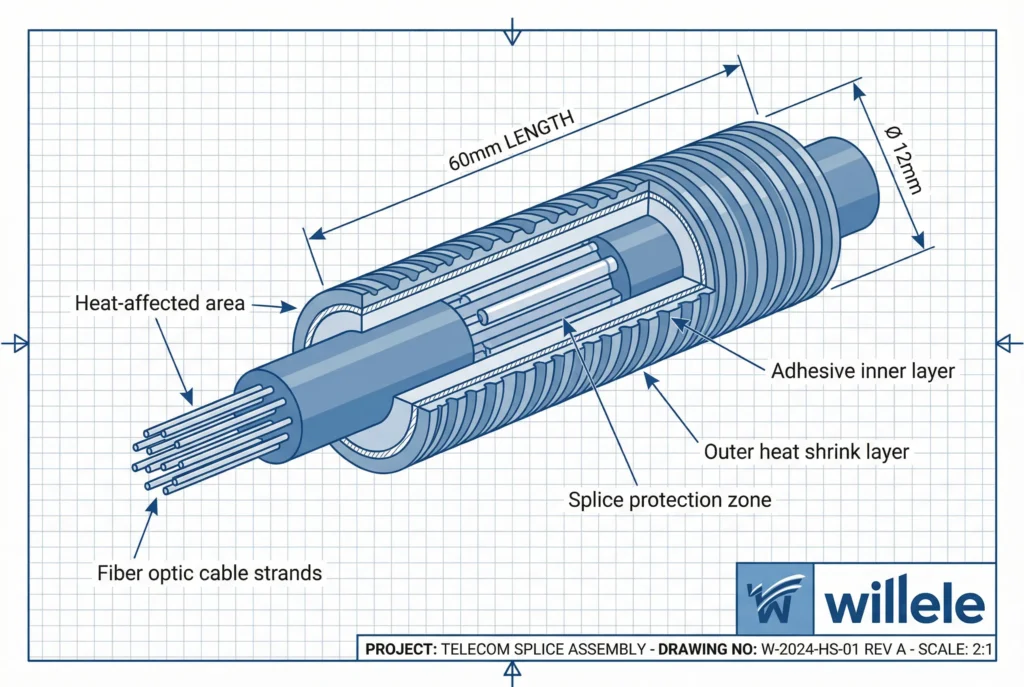
Modern telecommunications heat shrink sleeves typically feature multiple layers, including an outer protective tube and an inner adhesive layer that melts during heating to create a moisture-resistant seal. This dual-wall construction provides superior environmental protection compared to single-layer alternatives.
Role in Network Infrastructure
Heat shrink sleeves play several critical roles in telecommunications networks:
- Splice Protection: Safeguarding fusion splices in fiber optic cables from mechanical stress and environmental contamination
- Moisture Barrier: Preventing water ingress that can degrade signal quality and corrode metallic components
- Mechanical Reinforcement: Strengthening vulnerable connection points against pulling forces and vibration
- Código de cores: Facilitating cable identification and network documentation through color-coded sleeves
- Retardador de chama: Meeting fire safety requirements for indoor and outdoor installations
Benefits of Using Heat Shrink Sleeves in Telecommunications Cable Management
Proteção do ambiente
Telecommunications infrastructure operates in diverse environments, from climate-controlled data centers to harsh outdoor conditions. Heat shrink sleeves provide comprehensive protection against:
- Moisture and Humidity: Hermetic sealing prevents water penetration that causes signal attenuation
- UV Radiation: Stabilized polymers resist degradation from prolonged sunlight exposure
- Chemical Exposure: Resistant to oils, solvents, and industrial chemicals
- Temperature Extremes: Maintains integrity across wide temperature ranges (-55°C to +125°C)
Enhanced Network Reliability
Network downtime costs telecommunications providers significant revenue and damages customer relationships. Heat shrink sleeves contribute to network reliability by:
- Reducing splice failures by up to 95% compared to unprotected connections
- Extending cable assembly lifespan by 10-15 years
- Minimizing maintenance requirements and service calls
- Providing visual inspection capability to identify potential issues
Cost-Effectiveness
While representing a modest upfront investment, heat shrink sleeves deliver substantial long-term value:
- Reduced Maintenance Costs: Fewer repair interventions over the network’s operational life
- Extended Equipment Life: Protection extends the service life of expensive cable infrastructure
- Labor Efficiency: Quick installation reduces labor costs compared to alternative protection methods
- Warranty Compliance: Many cable manufacturers require proper splice protection to maintain warranty coverage
Types of Heat Shrink Sleeves for Telecommunications Applications
Classification by Construction
| Sleeve Type | Construction | Primary Application | Caraterísticas principais |
|---|---|---|---|
| Single-Wall | Single polymer layer | Indoor cable management, color coding | Lightweight, economical, various colors available |
| Dual-Wall | Outer polymer + inner adhesive | Outdoor splices, harsh environments | Moisture seal, superior environmental protection |
| Heavy-Wall | Thick polymer construction | Underground installations, mechanical protection | Maximum durability, crush resistance |
| Fiber Optic Splice Sleeves | Specialized multi-layer design | Fusion splice protection | Rigid reinforcement rod, precise dimensional tolerance |
Material-Based Classification
Different polymer materials offer specific performance characteristics for telecommunications applications:
Polyolefin Heat Shrink Sleeves
- Most common material for general telecommunications use
- Excellent electrical insulation properties
- Wide operating temperature range (-55°C to +135°C)
- Good chemical and moisture resistance
- Cost-effective for high-volume applications
Fluoropolymer Heat Shrink Sleeves
- Superior chemical and solvent resistance
- Exceptional high-temperature performance (up to +200°C)
- Minimal outgassing for sensitive equipment environments
- Higher cost, used for specialized applications
Elastomeric Heat Shrink Sleeves
- Soft, flexible construction
- Excellent low-temperature flexibility (-75°C)
- Ideal for cables subject to movement or vibration
- Superior abrasion resistance
Technical Specifications and Performance Standards
Key Performance Parameters
| Parameter | Standard Range | Premium Range | Application Notes |
|---|---|---|---|
| Rácio de retração | 2:1 to 3:1 | 4:1 to 6:1 | Higher ratios accommodate larger size variations |
| Shrink Temperature | 90°C – 120°C | 70°C – 100°C | Lower temperatures reduce installation time |
| Operating Temperature | -55°C to +125°C | -75°C to +200°C | Match to environmental conditions |
| Resistência à tração | 10.4 MPa min | 15.0 MPa min | Higher strength for mechanical stress applications |
| Alongamento na rutura | 200% min | 300% min | Greater flexibility for complex geometries |
| Resistência dieléctrica | 15 kV/mm | 20 kV/mm | Critical for high-voltage proximity |
| Flame Rating | UL 224 VW-1 | UL 224 VW-1 + Self-extinguishing | Meet local fire code requirements |
Industry Standards Compliance
Telecommunications heat shrink sleeves must comply with various international standards:
- Telcordia GR-771: Generic Requirements for Fiber Optic Splice Closures
- IEC 60684: Flexible insulating sleeving specifications
- UL 224: Standard for extruded insulating tubing
- RoHS Directive: Restriction of hazardous substances in electrical equipment
- REACH Compliance: European chemicals regulation
Willele Electric manufactures heat shrink sleeves that meet or exceed all applicable industry standards, ensuring compatibility with global telecommunications infrastructure projects.
Installation Procedures for Telecommunications Heat Shrink Sleeves
Pre-Installation Preparation
Proper installation begins with thorough preparation:
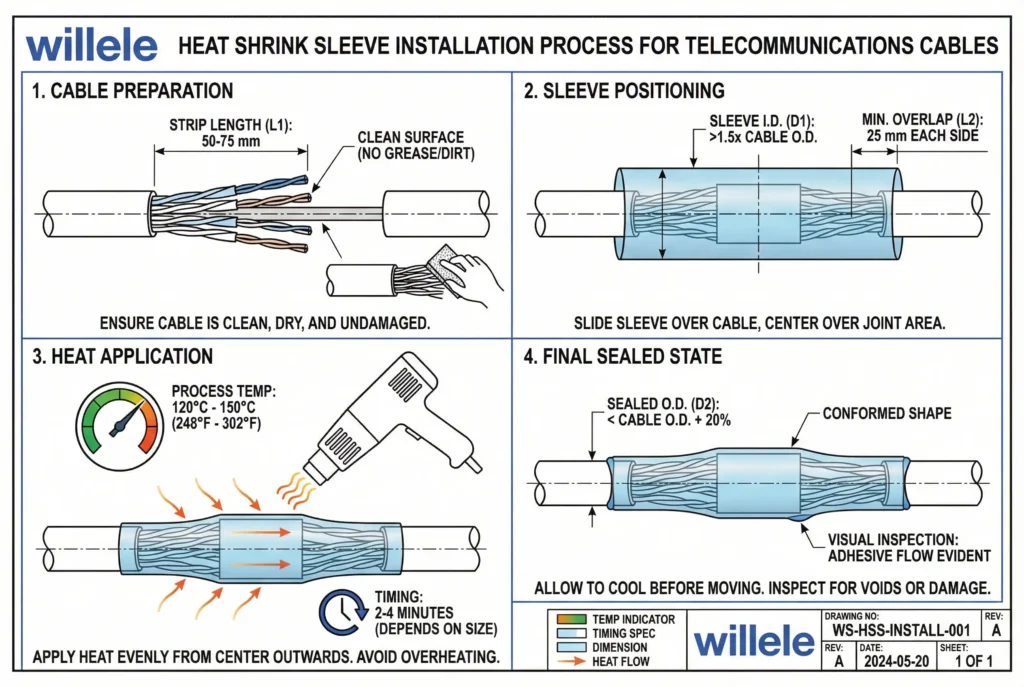
- Surface Cleaning: Remove all dirt, moisture, oils, and contaminants from the cable surface using isopropyl alcohol
- Cable Inspection: Verify cable integrity and identify any damage requiring repair before protection
- Sleeve Selection: Choose appropriate sleeve diameter, length, and material for the specific application
- Tool Preparation: Ensure heat source (heat gun or oven) is calibrated to correct temperature range
Step-by-Step Installation Process
Step 1: Sleeve Positioning
- Slide the heat shrink sleeve over one cable end before making the splice or connection
- Position the sleeve away from the work area to prevent premature heating
- Ensure the sleeve is properly oriented if it has directional features
Step 2: Cable Connection
- Complete the splice, termination, or connection according to manufacturer specifications
- For fiber optic splices, verify splice loss meets required specifications
- Allow any adhesives or mechanical fasteners to fully cure
Step 3: Heat Application
- Center the sleeve over the connection point
- Apply heat evenly using a controlled heat source (heat gun set to 120°C – 150°C)
- Begin heating from the center and work toward both ends
- Rotate the assembly to ensure uniform shrinkage
- Continue heating until sleeve is fully shrunk and adhesive is visible at both ends
Step 4: Quality Verification
- Allow sleeve to cool naturally (do not force cooling)
- Inspect for complete adhesion with no gaps or bubbles
- Verify that internal components are not visible through the sleeve
- Check that sleeve ends are sealed against the cable jacket
Common Installation Mistakes to Avoid
| Mistake | Consequence | Prevention |
|---|---|---|
| Overheating | Sleeve degradation, internal damage | Use temperature-controlled heat gun, maintain proper distance |
| Insufficient heating | Incomplete seal, moisture ingress | Heat until adhesive flows visibly at both ends |
| Improper sizing | Poor mechanical protection, installation difficulty | Measure cable diameter accurately, follow manufacturer guidelines |
| Surface contamination | Adhesion failure | Clean thoroughly with appropriate solvent before installation |
| Uneven heating | Asymmetric shrinkage, weak points | Rotate assembly continuously during heating, use heat reflectors if needed |
Application Scenarios in Telecommunications Networks
Fiber Optic Network Applications
Fiber to the Home (FTTH) Installations Using heat shrink sleeves in telecommunications cable management is essential for FTTH deployments where fiber optic cables terminate at residential locations. These installations require:
- Weather-resistant protection for outdoor drop cable splices
- Compact sleeve designs for confined pedestals and terminal boxes
- Color-coded sleeves for efficient fiber identification
- Quick installation to minimize service activation time
Long-Haul Fiber Networks Interstate and international fiber networks demand the highest reliability standards:
- Heavy-duty sleeves for buried cable splice points
- Enhanced UV resistance for aerial cable applications
- Extended operating temperature range for diverse climates
- Superior mechanical protection against ground movement and stress
Copper Cable Applications
Despite fiber optic adoption, copper infrastructure remains prevalent in telecommunications networks:
- DSL and telephony circuit protection
- Coaxial cable connector insulation
- Multi-pair cable splice enclosures
- Hybrid fiber-copper network transitions
Data Center and Central Office Applications
Indoor telecommunications facilities have specific requirements:
- Flame-retardant materials meeting plenum ratings
- Low-smoke, zero-halogen formulations
- High-density cable management compatibility
- Easy identification through color coding and labeling
Selection Criteria for Telecommunications Heat Shrink Sleeves
Considerações ambientais
| Environment Type | Recommended Specifications | Willele Product Recommendations |
|---|---|---|
| Indoor Controlled | Single-wall polyolefin, flame-retardant, -20°C to +85°C | Standard telecommunications grade |
| Outdoor Aerial | Dual-wall with adhesive, UV-stabilized, -40°C to +85°C | Weather-resistant series with UV inhibitors |
| Direct Burial | Heavy-wall, moisture-proof, crush-resistant, -55°C to +85°C | Premium underground installation grade |
| Marine/Coastal | Corrosion-resistant, salt-fog rated, dual-wall adhesive | Marine-grade telecommunications series |
| Industrial | Chemical-resistant, wide temperature range, flame-retardant | Industrial telecommunications grade |
Performance Requirements
When selecting heat shrink sleeves for telecommunications applications, consider:
Mechanical Requirements
- Tensile strength adequate for cable pulling forces
- Flexibility for tight bending radii in confined spaces
- Abrasion resistance for cables subject to movement
- Impact resistance for exposed installations
Electrical Requirements
- Dielectric strength appropriate for voltage levels present
- Insulation resistance to prevent signal leakage
- Low dielectric constant to minimize signal loss
- Corona resistance for high-frequency applications
Regulatory Requirements
- Local fire code compliance (plenum, riser, or general purpose ratings)
- Environmental regulations (RoHS, REACH compliance)
- Telecommunications standards (Telcordia, IEC specifications)
- Safety certifications (UL, CSA, CE marking)
Quality Assurance and Testing
Manufacturing Quality Controls
Willele Electric implements comprehensive quality assurance throughout the manufacturing process:
Raw Material Testing
- Polymer resin verification for chemical composition and purity
- Adhesive formulation testing for bond strength and temperature activation
- Additive verification (flame retardants, UV stabilizers, colorants)
Process Monitoring
- Extrusion temperature and speed control
- Wall thickness measurement with statistical process control
- Shrink ratio verification on production samples
- Dimensional accuracy inspection
Final Product Testing
- Mechanical property testing (tensile strength, elongation, flexibility)
- Electrical property verification (dielectric strength, insulation resistance)
- Environmental resistance testing (UV exposure, salt fog, chemical immersion)
- Flame resistance certification testing
Field Performance Validation
Long-term reliability is verified through:
- Accelerated aging tests simulating 20+ years of environmental exposure
- Thermal cycling between temperature extremes
- Moisture ingress testing under pressure
- Mechanical stress testing including pull forces and vibration
Cost-Benefit Analysis for Telecommunications Operators
Initial Investment vs. Lifecycle Costs
| Cost Category | Without Heat Shrink Protection | With Quality Heat Shrink Sleeves | 10-Year Difference |
|---|---|---|---|
| Initial Material Cost | $0 | $2-8 per splice | Higher upfront |
| Installation Labor | Padrão | +5-10 minutes per splice | Minimal increase |
| Splice Failure Rate | 15-25% over 10 years | 1-3% over 10 years | 85-90% reduction |
| Repair Cost per Failure | $500-2000 | $500-2000 | Same per incident |
| Average Repairs (1000 splices) | 150-250 repairs | 10-30 repairs | 120-220 fewer repairs |
| Total 10-Year Cost | $75,000-500,000 | $10,000-68,000 | $65,000-432,000 savings |
Return on Investment Timeline
For a typical telecommunications deployment of 1,000 splice points:
- Initial investment: $2,000-8,000 for heat shrink sleeves
- Labor premium: $1,500-3,000 for additional installation time
- First-year failure prevention savings: $7,500-30,000
- ROI breakeven: 3-6 months
- 10-year net savings: $65,000-430,000
These figures demonstrate that using heat shrink sleeves in telecommunications cable management provides exceptional value, with cost savings far exceeding the modest initial investment.
Future Trends in Telecommunications Heat Shrink Technology
Smart Monitoring Integration
Emerging technologies integrate sensors into heat shrink sleeves:
- Temperature monitoring for early failure detection
- Moisture sensors to identify seal breaches
- Strain gauges for mechanical stress monitoring
- RFID tags for automated asset tracking and inventory management
Advanced Materials Development
Material science innovations are producing next-generation heat shrink products:
- Self-healing polymers that repair minor punctures automatically
- Nano-composite materials with enhanced strength-to-weight ratios
- Bio-based polymers for improved environmental sustainability
- Color-changing materials indicating installation quality or environmental exposure
5G and Next-Generation Network Requirements
As telecommunications networks evolve to 5G and beyond, heat shrink sleeve requirements are advancing:
- Higher frequency performance requirements (minimal signal loss at 28+ GHz)
- Increased density demanding smaller, more precise sleeve designs
- Edge computing deployments requiring versatile indoor/outdoor protection
- Accelerated installation timelines driving quick-shrink formulations
Frequently Asked Questions
Q: How long do heat shrink sleeves last in telecommunications applications?
A: Quality heat shrink sleeves from manufacturers like Willele Electric typically provide 20-30 years of reliable service when properly installed in outdoor environments. Indoor applications can last even longer, often exceeding 40 years. The actual lifespan depends on environmental conditions, material quality, and installation practices.
Q: Can heat shrink sleeves be removed and reused?
A: No, heat shrink sleeves are designed for permanent installation and cannot be removed without cutting. Once heated and shrunk, the molecular structure of the polymer is permanently altered. Attempting to remove a heat shrink sleeve will damage both the sleeve and potentially the cable beneath. For temporary protection or connections requiring future access, use mechanical closure alternatives.
Q: What is the difference between 2:1 and 3:1 shrink ratios?
A: The shrink ratio indicates how much the sleeve’s diameter reduces when heated. A 2:1 sleeve shrinks to half its original diameter, while a 3:1 sleeve shrinks to one-third. Higher shrink ratios offer greater flexibility in accommodating size variations but may require more careful installation to avoid over-shrinking. For telecommunications applications, 3:1 ratios are often preferred for fiber optic splices to accommodate variations in cable diameter.
Q: Are heat shrink sleeves compatible with all cable types?
A: Most telecommunications heat shrink sleeves are compatible with common cable jackets including PVC, polyethylene, and polyurethane. However, some specialized cables with silicone or fluoropolymer jackets may require specific sleeve materials for optimal adhesion. Always verify compatibility between the sleeve material and cable jacket, particularly for critical applications. Willele Electric provides compatibility guidance for all product lines.
Q: What causes heat shrink sleeves to fail prematurely?
A: The most common failure causes are: (1) inadequate surface preparation allowing moisture underneath, (2) improper heating resulting in incomplete shrinkage or adhesive activation, (3) mechanical damage during or after installation, (4) using sleeves not rated for the environmental conditions present, and (5) selecting incorrect sleeve dimensions. Following proper installation procedures and choosing quality products dramatically reduces failure risk.
Q: How do I choose between single-wall and dual-wall heat shrink sleeves?
A: Single-wall sleeves are suitable for indoor applications, color coding, and situations where environmental sealing is not critical. Dual-wall sleeves with internal adhesive are essential for outdoor installations, underground applications, or any environment where moisture protection is required. When in doubt, dual-wall sleeves provide superior protection with minimal cost premium. For telecommunications infrastructure intended to last decades, dual-wall construction is the industry best practice.
Conclusão
Using heat shrink sleeves in telecommunications cable management represents an essential best practice for ensuring network reliability, longevity, and performance. These simple yet effective protection devices provide comprehensive environmental sealing, mechanical reinforcement, and electrical insulation for critical cable connections throughout telecommunications infrastructure.
From fiber to the home installations to long-haul backbone networks, properly selected and installed heat shrink sleeves prevent costly failures, extend equipment lifespan, and minimize maintenance requirements. The modest initial investment delivers exceptional return through reduced downtime, fewer service calls, and extended infrastructure life.
As telecommunications networks continue evolving toward higher speeds, greater density, and more demanding applications, the importance of quality cable protection solutions only increases. Partnering with experienced manufacturers like Willele Electric ensures access to heat shrink products that meet stringent industry standards and deliver reliable performance across diverse operating environments.
For telecommunications operators, contractors, and network designers worldwide, mastering the selection and application of heat shrink sleeves is fundamental to building infrastructure that performs reliably for decades. The comprehensive protection these products provide makes them an indispensable component of professional telecommunications cable management practices.
About Willele Electric
Willele Electric is a leading B2B manufacturer of specialized heat shrink tubing and cable management solutions for telecommunications, electrical, and industrial applications. With decades of manufacturing expertise and a commitment to quality, Willele provides innovative products that meet the demanding requirements of modern telecommunications infrastructure worldwide. Our comprehensive product line includes fiber optic splice sleeves, heavy-wall protection tubing, and custom solutions engineered for specific application requirements.