In modern public transportation systems—such as railways, subways, buses, and electric transit vehicles—electrical safety is not optional. It is a critical engineering requirement that directly impacts passenger safety, system reliability, and regulatory compliance.
Among the many insulating materials used in electrical wiring systems, heat-shrink tubing plays a vital role in protecting cables, terminals, and connectors. However, in public transportation environments, standard-grade tubing is not enough. Fire safety compliance becomes the defining factor in material selection.
This article explains the fire safety standards for heat-shrink tubing, compares key international regulations, and helps engineers and procurement teams choose compliant solutions for transportation-grade applications.
1. Why Fire Safety Matters in Public Transportation
Public transportation systems operate in highly demanding environments:
- High passenger density
- Confined enclosed spaces
- Continuous vibration and mechanical stress
- Complex electrical systems (HVAC, traction, lighting, control units)
In such environments, electrical failure or fire can escalate rapidly. Therefore, every insulating component—including heat-shrink tubing—must meet strict flame-retardant and low-smoke requirements.
Key safety objectives:
- Prevent flame propagation
- Minimize toxic smoke emission
- Reduce corrosive gas release
- Maintain insulation integrity under heat stress
2. Role of Heat-Shrink Tubing in Transit Electrical Systems
Heat-shrink tubing is widely used in:
- Cable harness protection
- Busbar insulation
- Terminal sealing
- Wire splicing and marking
- Control cabinet wiring systems
In public transport applications, it must provide:
- High dielectric strength
- Strong abrasion resistance
- Flame retardancy (self-extinguishing behavior)
- Thermal stability under vibration and load conditions
3. Key Fire Safety Standards for Heat-Shrink Tubing
Different regions apply different certification systems for flame-retardant materials used in transportation systems.
Global Fire Safety Standards Overview
| Standard / Regulation | Region | Key Requirement | Application Focus |
|---|---|---|---|
| UL 224 | USA | Flame retardant, insulation integrity | General electrical insulation |
| UL VW-1 | USA | Vertical flame test (self-extinguishing) | Wire & cable components |
| IEC 60684 | International | Flexible insulating sleeving standards | Railway & industrial systems |
| EN 45545-2 | Europe | Fire behavior of railway materials | Railway rolling stock |
| DIN 5510-2 | Germany | Fire protection in rail vehicles | Smoke toxicity & flame spread |
| BS 6853 | UK (legacy) | Toxic gas emission control | Public transport interiors |
4. EN 45545-2: The Most Critical Railway Fire Standard
For Europe and most international rail projects, EN 45545-2 is the leading fire safety benchmark.
It evaluates materials based on:
- Flame spread rate
- Heat release
- Smoke density
- Toxic gas emissions
Fire Performance Categories
| Hazard Level | Application Example | Severity |
|---|---|---|
| HL1 | Low-risk components | Minimal fire exposure |
| HL2 | Regional trains, metro systems | Medium risk |
| HL3 | High-speed trains, tunnels | Highest safety requirement |
Heat-shrink tubing used in rail systems typically must meet HL2 or HL3 requirements depending on installation location.
5. UL 224 vs IEC Standards: Key Differences
While UL standards are widely used in North America, IEC and EN standards dominate global transportation projects.
Comparison Table
| Item | UL 224 / VW-1 | IEC 60684 / EN 45545 |
|---|---|---|
| Test Method | Vertical flame test | System-level fire evaluation |
| Focus | Material ignition resistance | Full fire behavior system impact |
| Smoke requirement | Not primary focus | Strict smoke density control |
| Toxicity control | Limited | Mandatory in rail systems |
| Application scope | General industry | Transportation systems |
👉 Conclusion:
UL-certified tubing is not automatically suitable for rail or metro systems. Transportation projects require system-level fire performance compliance, not just material ignition resistance.
6. Material Types and Fire Performance
Heat-shrink tubing performance depends heavily on material composition.
Common Materials Comparison
| Тип материала | Огнестойкость | Smoke Level | Гибкость | Typical Use |
|---|---|---|---|---|
| Polyolefin (cross-linked) | Высокий | Низкий | Высокий | Railway, EV systems |
| ПВХ | Medium | High smoke | Medium | Low-cost wiring |
| PTFE | Very high | Very low | Low flexibility | Aerospace, extreme environments |
| Fluoropolymer blends | Very high | Ultra-low | Medium | High-end transport systems |
For public transportation, cross-linked polyolefin is the most widely used solution due to its balance of cost, flexibility, and fire performance.
7. Fire-Safe Design Requirements in Transportation Wiring
When selecting heat-shrink tubing for railway or transit systems, engineers typically evaluate:
Critical Requirements Checklist
- Self-extinguishing behavior within seconds
- No dripping flame during combustion
- Low smoke generation
- Halogen-free composition preferred
- Stable performance at -40°C to +125°C
- Resistance to vibration and mechanical stress
8. Application Scenarios in Public Transportation
Heat-shrink tubing is widely used across multiple subsystems:
Electrical System Applications
- Traction power cables
- Battery energy storage systems (BESS)
- Control cabinets and signal systems
- HVAC wiring protection
- Door control and safety systems
Structural Protection Applications
- Wire bundling in ceiling panels
- Cable routing in floor channels
- Terminal insulation in junction boxes
9. Compliance Strategy for Procurement Teams
For global transportation OEMs and distributors, selecting compliant tubing requires more than checking labels.
Recommended Evaluation Process
- Verify fire certification (EN 45545-2 or equivalent)
- Request test reports (smoke density, toxicity index)
- Confirm material composition (halogen-free preferred)
- Validate temperature resistance range
- Conduct sample flame test in controlled conditions
10. Why Fire-Safe Heat-Shrink Tubing Improves System Reliability
Beyond safety compliance, certified heat-shrink tubing provides:
- Longer service life in vibration environments
- Reduced maintenance cost
- Higher system uptime
- Lower risk of electrical short circuits
- Improved passenger safety confidence
In modern smart transportation systems, reliability is directly linked to material quality.
11. Willele Electrical – B2B Manufacturing Capability
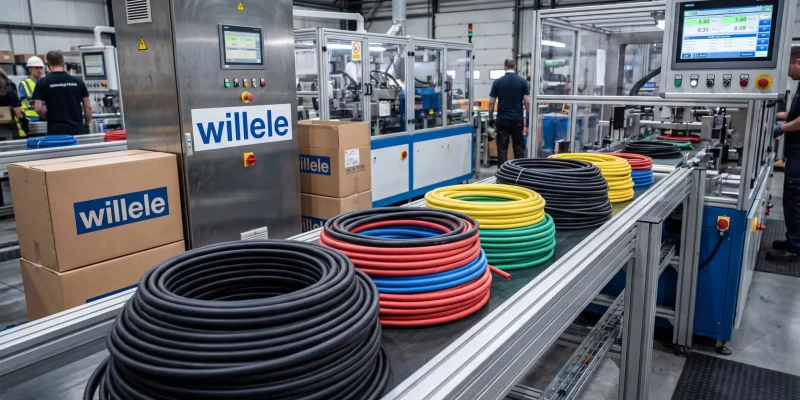
Willele Electrical focuses on industrial-grade heat-shrink tubing designed for demanding electrical environments, including transportation, energy, and infrastructure applications.
Core advantages:
- Halogen-free flame-retardant materials
- Stable dielectric performance
- OEM/ODM customization support
- Multiple shrink ratios (2:1 / 3:1 / 4:1)
- Global export capability for industrial projects
For procurement teams, consistent quality and certification traceability are key factors in long-term supply chain stability.
FAQ – Heat-Shrink Tubing in Public Transportation
Q1: What is the most important fire standard for railway heat-shrink tubing?
EN 45545-2 is the most critical standard for railway and metro systems in Europe and many international projects.
Q2: Is UL 224 enough for public transportation applications?
Not always. UL 224 mainly covers ignition resistance, while transportation systems require smoke and toxicity control as well.
Q3: What material is best for fire-safe heat-shrink tubing?
Cross-linked polyolefin is the most commonly used material due to its balance of flame retardancy, flexibility, and durability.
Q4: Why is halogen-free tubing preferred?
Halogen-free materials reduce toxic gas release during fire, improving passenger safety in enclosed environments.
Q5: Can heat-shrink tubing affect system certification?
Yes. Non-compliant insulation materials can cause failure in full system certification under EN 45545-2 or equivalent standards.