Heat Shrink Tubing Selection Guide | WILLELE When Prevention Saves Millions: A Tuesday Morning Audit
It was supposed to be a routine preventive maintenance walk-through at a pharmaceutical packaging facility. The operations manager was showing me their pride and joy—a fully automated bottling line that had been running flawlessly for 18 months. “We haven’t had a single unplanned stop,” he boasted. That’s when I noticed something that made my stomach drop.
Every motor junction box on the line—23 in total—had been sealed with standard single-wall heat shrink tubing. But these weren’t living in a clean room. They were mounted directly on the equipment, exposed to daily washdowns with high-pressure hot water and chemical sanitizers. I pulled out my pocket knife and carefully peeled back one tube. Beneath it, green corrosion was already creeping along the copper conductors.
“How much does it cost when this line goes down?” I asked quietly.
“About $47,000 per hour in lost production, plus FDA compliance paperwork,” he replied. His face went pale as he did the math. We had just discovered a $1.1 million problem waiting to happen—and it was entirely preventable with a $200 material specification change made 18 months earlier.
This is the real cost of heat shrink tubing selection mistakes. It’s not about the price difference between single-wall and adhesive-lined tubing—it’s about understanding the cumulative risk of choosing the wrong protection strategy for your specific application environment.
The Hidden Cost of Wrong Choices
In my work with industrial facilities across six continents, I’ve quantified the financial impact of improper heat shrink selection. The pattern is remarkably consistent:
Immediate Costs:
- Emergency callout fees: $150-500 per incident
- Expedited replacement parts: 2-4x normal cost
- Lost production during repair: $5,000-50,000 per hour depending on industry
Long-term Costs:
- Premature equipment replacement
- Damage to connected components (controllers, drives, sensors)
- Safety incidents and potential liability
- Reputation damage with customers
The ROI Reality: In every case I’ve analyzed, the incremental cost of specifying adhesive-lined tubing for harsh environments pays for itself after preventing just one unplanned failure. Yet I still encounter installations where engineers specified single-wall tubing to “save money” in applications where environmental sealing was clearly required.
Key Takeaway: The cheapest tubing is not the one with the lowest unit cost—it’s the one that eliminates unplanned maintenance events and extends mean time between failures (MTBF).
Understanding Heat Shrink Technology: Engineering Fundamentals
Before we can make intelligent selection decisions, we need to understand what we’re actually specifying. Let’s break down the technology.
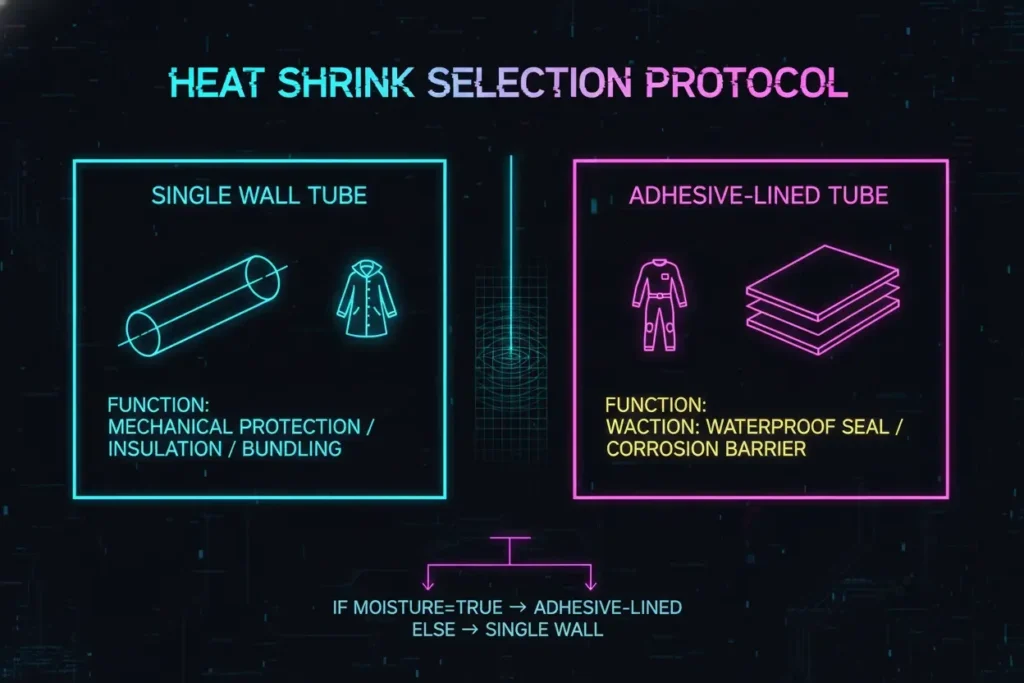
Single-Wall Heat Shrink Tubing: The Primary Barrier
Single-wall tubing is manufactured from cross-linked polymer—most commonly polyolefin, though fluoropolymers (like PTFE) and PVC variants exist for specialized applications. The cross-linking process creates a molecular memory: when heated above its transition temperature (typically 90-120°C), the material becomes pliable and shrinks back to its pre-expanded diameter.
Think of single-wall tubing as Level 1 armor plating. It excels at three primary functions:
- Electrical insulation: Dielectric strength typically ranges from 600V to 1000V per mil thickness, providing crucial voltage isolation
- Mechanical abrasion resistance: Protects against wear, vibration-induced chafing, and incidental physical contact
- Visual organization: Enables color-coded identification and professional wire bundling
Critical limitation: Single-wall tubing relies on physical coverage, not environmental sealing. Any gap at the ends or imperfections in the installation creates a pathway for moisture, chemicals, or contaminants to reach the underlying connection.
Adhesive-Lined (Dual-Wall) Heat Shrink Tubing: The Complete System
Adhesive-lined tubing adds a second engineering dimension: an inner layer of thermoplastic hot-melt adhesive, typically a modified polyamide or polyolefin formulation. During heat shrinking, this adhesive layer melts and flows before the outer wall completes its shrinkage, creating a unified seal.
Think of this as Level 3 armor with an integrated environmental suit. The technology provides:
- Hermetic sealing: The adhesive creates a moisture-proof barrier with seal integrity measured in g/m²/24hr (typically <0.1)
- Strain relief: The adhesive bond distributes mechanical stress across the entire covered area
- Corrosion prevention: Eliminates the air and moisture interface required for electrochemical corrosion
- Vibration dampening: The adhesive layer absorbs and dissipates mechanical shock
Performance metric to specify: Look for tubes with adhesive melt flow indices (MFI) optimized for your installation temperature range. Lower MFI provides better gap-filling for irregular surfaces; higher MFI offers faster installation cycles.
The Five-Factor Selection Matrix
I’ve developed this framework through thousands of field applications. Rate each factor for your specific application, and the right choice becomes clear.
Factor 1: Environmental Exposure Severity (Weight: 35%)
Evaluate the worst-case scenario your connection will experience over its design life:
- Benign (Score 1-2): Climate-controlled indoor environments, sealed enclosures with environmental gaskets, air-conditioned control rooms
- Moderate (Score 3-5): Indoor industrial environments with temperature cycling, occasional condensation, or dust exposure
- Harsh (Score 6-8): Outdoor installations, high-humidity environments (>80% RH), regular water spray, temperature extremes (-40°C to +125°C)
- Extreme (Score 9-10): Marine environments with salt spray, chemical processing areas, full submersion applications, continuous vibration plus moisture
Decision Rule: Scores 1-4 → Single-wall acceptable | Scores 5-10 → Adhesive-lined mandatory
Factor 2: Consequence of Failure (Weight: 30%)
Quantify the impact if this connection fails:
- Low (Score 1-3): Non-critical circuits, redundant systems, failures cause inconvenience only
- Medium (Score 4-6): Loss of production, customer impact, repair costs $1,000-10,000
- High (Score 7-9): Safety implications, significant production loss, repair costs $10,000-100,000
- Critical (Score 10): Life-safety systems, environmental release potential, costs >$100,000 or regulatory violations
Decision Rule: For scores ≥7, adhesive-lined tubing provides insurance against catastrophic costs
Factor 3: Accessibility for Maintenance (Weight: 15%)
How difficult is it to inspect and replace this connection?
- Easy (Score 1-2): Accessible in <5 minutes with no special tools or lockout procedures
- Moderate (Score 3-5): Requires panel access, basic lockout, or ladder work (15-30 minutes)
- Difficult (Score 6-8): Confined spaces, hot work permits, or equipment disassembly required (1-4 hours)
- Extreme (Score 9-10): Buried, embedded, or requiring major equipment shutdown (>4 hours or production stoppage)
Decision Rule: For scores ≥6, specify adhesive-lined to extend maintenance intervals
Factor 4: Mechanical Stress Profile (Weight: 10%)
Assess the physical environment:
- Static (Score 1-2): Stationary installation, no vibration, no movement
- Dynamic (Score 3-5): Occasional movement, low-frequency vibration (<30 Hz)
- High-stress (Score 6-8): Continuous vibration, flexing cables, or shock exposure
- Extreme (Score 9-10): High-frequency vibration (>60 Hz), impact loading, or thermal cycling with movement
Decision Rule: Scores ≥7 benefit from adhesive-lined tubing’s superior strain relief
Factor 5: Technical Specifications (Weight: 10%)
Verify compatibility with your electrical requirements:
- Voltage rating (ensure 2x safety margin)
- Temperature range (continuous + peak exposure)
- Chemical resistance to specific fluids
- Flame rating requirements (UL 224, CSA, military specs)
Decision Rule: Both types can meet most specs, but verify certification for your specific standards
Matrix Calculation Example
Application: Motor junction on outdoor conveyor
- Environmental Exposure: Score 8 × 0.35 = 2.8
- Consequence of Failure: Score 7 × 0.30 = 2.1
- Accessibility: Score 6 × 0.15 = 0.9
- Mechanical Stress: Score 5 × 0.10 = 0.5
- Technical Specs: Met by both × 0.10 = 0.5
- Total Weighted Score: 6.8 → Adhesive-lined tubing required
Installation Mastery: Seven Deadly Mistakes to Avoid
The best-specified tubing in the world fails if installed incorrectly. Here are the mistakes I see repeatedly—and how to prevent them.
Mistake #1: Inadequate Surface Preparation
The Error: Applying tubing over dirty, oily, or oxidized surfaces. I’ve seen installations where fingerprint oils from handling prevented proper adhesive bonding.
The Fix: Use isopropyl alcohol (IPA) wipes and lint-free cloths. For adhesive-lined applications, the surface must be clean enough to pass the “water break test”—water should sheet uniformly, not bead up.
Mistake #2: Wrong Shrink Ratio Selection
The Error: Using 2:1 tubing on connectors with large diameter steps, leaving gaps and poor mechanical grip.
The Fix: Pro-tip: Always specify 3:1 or 4:1 shrink ratio for connections where the covered components vary in diameter by more than 30%. The higher ratio provides geometric flexibility and ensures complete coverage.
Mistake #3: Insufficient Overlap
The Error: Cutting tubing to “just fit” the connection, with minimal or no overlap onto intact wire insulation or connector bodies.
The Fix: Minimum overlap specification: 6mm (1/4″) for low-voltage applications, 12mm (1/2″) for medium voltage (600V+), and 25mm (1″) for high-voltage or extreme environmental exposure.
Mistake #4: Overheating During Installation
The Error: Using excessive heat or concentrated flame, causing charring, bubbling, or adhesive degradation. I’ve witnessed installations where technicians used propane torches at full output.
The Fix: Use a professional heat gun with temperature control set to the manufacturer’s specified range (typically 120-150°C for most polyolefin tubes). Move the heat source continuously; never hold it stationary on one spot.
Mistake #5: Ignoring Adhesive Flow Indicators
The Error: Stopping heat application as soon as the tube appears shrunk, without verifying complete adhesive flow in dual-wall applications.
The Fix: Critical success indicator: Continue heating until you observe a uniform fillet (bead) of clear adhesive emerging from both ends of the tube. This confirms complete environmental sealing. The fillet should be 1-2mm wide and consistent around the entire circumference.
Mistake #6: Wrong Installation Sequence
The Error: Heating randomly or from end to end, trapping air pockets that compromise the seal.
The Fix: Always follow the center-to-end heating pattern: Start at the middle, work toward one end until sealed, return to center, work toward the opposite end. This technique systematically evacuates trapped air.
Mistake #7: Skipping Post-Installation Inspection
The Error: Assuming successful installation without verification, leading to field failures from incomplete shrinking or adhesive voids.
The Fix: Implement a three-point inspection: (1) Visual check for uniform diameter and no wrinkles, (2) Adhesive fillet verification on dual-wall applications, (3) Gentle pull test to confirm mechanical grip (should not slide or rotate).
Industry-Specific Application Guide
Different industries have learned expensive lessons about tubing selection. Here’s the distilled wisdom.
Automotive & Transportation
Environment: Underhood temperatures (125°C peaks), road salt, petroleum products, vibration 10-55 Hz
Specification Standard: Adhesive-lined tubing mandatory for all underhood connections. Single-wall acceptable only inside passenger compartment or trunk.
Material Upgrade: Consider fluoropolymer (PVDF) outer walls for direct fuel system exposure or continuous high-temperature zones near exhaust manifolds.
Real-world lesson: A major truck manufacturer recalled 47,000 vehicles due to trailer light harness failures traced to single-wall tubing that allowed moisture ingress, costing $18M in warranty claims.
Marine & Offshore
Environment: 100% humidity, salt spray (5% NaCl solution equivalent), UV exposure, thermal cycling, complete submersion potential
Specification Standard: Adhesive-lined with minimum 3:1 shrink ratio. Double-seal technique recommended (two layers of adhesive-lined tubing with staggered joints).
Inspection Protocol: Annual visual inspection; replace any tubing showing UV degradation (chalking, color fade) even if functionally intact.
Real-world lesson: An offshore platform experienced $2.3M in lost production when thruster motor controls failed due to corroded connections “protected” by single-wall tubing. The platform had been constructed by the lowest bidder.
Food & Beverage Processing
Environment: Daily hot water/steam washdowns (up to 85°C), chemical sanitizers (peracetic acid, sodium hypochlorite), USDA/FDA hygiene requirements
Specification Standard: Adhesive-lined tubing in blue or white colors (for visual contamination detection). Must meet FDA CFR 177.2600 for indirect food contact.
Installation Note: Ensure tubing extends fully into junction boxes; any exposed conductor near the box entry creates a contamination pathway that will fail sanitation audits.
Real-world lesson: A beverage bottler’s entire $4M packaging line failed inspection when auditors found moisture inside motor junction boxes sealed with non-adhesive tubing.
Industrial Automation & Robotics
Environment: Continuous flexing cycles (>1M cycles expected), cable track movement, electromagnetic interference, industrial dust/coolant spray
Specification Standard: For static installations, single-wall tubing acceptable. For moving cables, specify adhesive-lined with flexible adhesive formulation (shore hardness <80A after cure).
Design consideration: On robot arms and cable carriers, use strain relief boots in combination with tubing, and ensure minimum bend radius >10× cable diameter.
Real-world lesson: A major automotive assembly plant experienced 47 robot downtime events in one quarter, all traced to conductor fatigue at crimp points where standard adhesive-lined tubing created rigid stress points. Solution: Switched to flexible adhesive formulation, downtime dropped to zero.
Renewable Energy (Solar/Wind)
Environment: 25-year design life, extreme UV exposure, temperature swings -40°C to +90°C, outdoor precipitation, no maintenance access
Specification Standard: UV-stabilized adhesive-lined tubing mandatory. Specify black UV-resistant polyolefin or consider fluoropolymer for 30+ year installations.
Critical spec: Verify tubing meets UV aging tests per ASTM G155 (minimum 2000 hours xenon arc exposure with <20% elongation loss).
Real-world lesson: A 50MW solar farm required $780,000 in combiner box rewiring after five years when standard adhesive-lined tubing (without UV inhibitors) became brittle and cracked, allowing moisture into connections.
Mining & Heavy Equipment
Environment: Extreme vibration, impact shock, abrasive dust (silica, coal), hydraulic fluid and diesel fuel exposure, outdoor weather extremes
Specification Standard: Heavy-wall adhesive-lined tubing (minimum 2mm wall thickness) with abrasion-resistant outer jacket. Consider armored spiral wrap as secondary protection.
Maintenance strategy: Implement predictive replacement on 18-month cycles for critical connections; don’t wait for failure.
Real-world lesson: An underground mine loader experienced brake failure when vibration fatigued a sensor connection sealed with light-duty single-wall tubing. The resulting accident cost $4.2M in citations and lost time.
Cost-Benefit Analysis: Making the Business Case
Let’s quantify the financial decision with real numbers.
Scenario: 100 motor connections in a processing plant
Option A: Single-Wall Tubing
- Material cost: $3 per connection × 100 = $300
- Installation labor: 5 minutes each = $500 total
- Expected MTBF in harsh environment: 18 months
- Failure rate: 15% per year = 15 unplanned repairs
- Cost per failure: $3,500 (callout + parts + lost production)
- Annual cost: $300 + $500 + (15 × $3,500) = $53,300
Option B: Adhesive-Lined Tubing
- Material cost: $8 per connection × 100 = $800
- Installation labor: 8 minutes each = $800 total
- Expected MTBF in harsh environment: 10+ years
- Failure rate: <1% per year = 1 repair maximum
- Cost per failure: $3,500
- Annual cost: $800 + $800 + $3,500 = $5,100
Net Savings with Adhesive-Lined Tubing: $48,200 per year
ROI: Payback achieved in first 11 days of operation
This analysis assumes moderate failure costs. For critical systems where downtime costs exceed $10,000 per hour, the business case becomes even more compelling.
Conclusion: Engineering Reliability into Every Connection
The question “Which heat shrink tubing should I use?” is actually the wrong question. The right question is: “What level of reliability does my application require, and how do I engineer that into my electrical connections?”
Single-wall tubing provides essential electrical insulation and mechanical protection—it’s the correct choice for benign environments where cost efficiency matters and environmental sealing isn’t required.
Adhesive-lined tubing delivers environmental sealing, long-term corrosion prevention, and superior strain relief—it’s the required choice when connections face moisture, chemicals, or harsh conditions, and it’s always the smart choice when considering total cost of ownership.
The professional standard: When conducting a design review or maintenance audit, apply the Five-Factor Selection Matrix to every connection. Document your decision rationale. Specify installation procedures. Train your technicians. Inspect the results.
That pharmaceutical plant I mentioned at the beginning? We made the $200 material specification change. Eighteen months later, I received a call from the same operations manager. This time, his voice was relaxed. “We just passed our FDA audit with zero findings on electrical systems,” he said. “And we haven’t had a single electrical failure since you were here.”
That’s the difference between choosing tubing based on price and engineering reliability into every connection. It’s the difference between reactive maintenance and proactive design. It’s the difference between hoping it works and knowing it will.