
In the realm of high-reliability electrical engineering, the stability of insulation materials under fluctuating temperatures is paramount. For procurement officers and design engineers, a deep understanding of the Thermal Expansion Properties of Different Heat Shrink Materials is not just academic—it is the difference between a secure, long-lasting connection and a catastrophic system failure.
At Willele Electric, we recognize that our B2B partners require more than just plastic tubing; they need engineered solutions that withstand the rigors of thermal cycling. This comprehensive guide explores the physics behind polymer expansion and how to select the right material for your specific thermal environment.
The Physics of Thermal Behavior in Polymers
When we discuss the Thermal Expansion Properties of Different Heat Shrink Materials, we are primarily concerned with the Coefficient of Linear Thermal Expansion (CLTE). Unlike metals, which have a rigid crystalline lattice, polymers consist of long molecular chains. As temperature rises, the vibration of these chains increases, creating more free volume between them.

This leads to a critical engineering challenge: CTE Mismatch. If the heat shrink tubing expands at a significantly different rate than the copper wire or connector it covers, it can lead to:
- Gapping: Where the seal breaks, allowing moisture ingress.
- Stress Cracking: Where the tubing tears due to internal tension during cooling.
- Delamination: Where adhesive liners fail to maintain contact.
Material-Specific Thermal Analysis
Different polymer backbones exhibit distinct thermal behaviors. Willele Electric manufactures a broad spectrum of materials to suit varied thermal profiles.
1. Cross-Linked Polyolefin (PO)
The workhorse of the industry. Through electron beam irradiation, the molecular chains are cross-linked, preventing melting and improving thermal stability.
- Thermal Profile: Moderate expansion. It remains stable up to 135°C.
- Behavior: It provides a “snug” fit that moves relatively well with standard copper cabling.
2. Fluoropolymers (PTFE, PVDF, FEP)
These are the high-performance choice for extreme heat.
- PTFE (Teflon): Exhibits excellent dimensional stability. Its CTE is low, meaning it doesn’t change size much even at 260°C. However, it requires very high heat to shrink initially.
- PVDF (Kynar): A semi-rigid material. It is mechanically tough and resists thermal creep (deformation under stress at high temps).
3. Polyvinyl Chloride (PVC)
A budget-friendly option for low-temperature environments.
- Thermal Profile: PVC has a lower maximum temperature rating (typically 105°C). It can become brittle if exposed to cryogenic temperatures, making it unsuitable for environments with wide thermal swings.
4. Silicone Elastomers
Unique among heat shrink materials, silicone is a rubber, not a rigid plastic.
- Thermal Profile: While it has a high CTE (it expands a lot), its low modulus (high elasticity) means it stretches rather than breaks. It can survive from -75°C to 200°C without losing flexibility.
Comparative Engineering Data
To facilitate accurate material selection, we have compiled the Thermal Expansion Properties of Different Heat Shrink Materials into the following decision matrices.
Table 1: Thermal Performance Specifications
| Material Class | Linear CTE ($\mu$m/m·K) | Continuous Operating Temp | Shrink Temperature | Thermal Shock Resistance |
|---|---|---|---|---|
| Polyolefin (General) | 100 – 150 | -55°C to +135°C | 90°C | Good |
| PVDF (Kynar) | 80 – 140 | -55°C to +175°C | 175°C | Excellent |
| PTFE (Teflon) | 100 – 160 | -65°C to +260°C | 340°C | Superior |
| PVC | 70 – 250 | -30°C to +105°C | 100°C | Poor |
| Silicone | 250 – 300 | -75°C to +200°C | 135°C | Very Good |
Table 2: Material Selection Decision Matrix
| Application Environment | Primary Thermal Challenge | Recommended Material |
|---|---|---|
| Aerospace Wiring | Rapid altitude temp changes (-50°C to +150°C) | PVDF or FEP (Stable & Tough) |
| Automotive Engine Bay | High radiant heat & vibration | High-Temp Polyolefin |
| Subsea / Marine | Cold water, high pressure | Dual-Wall Polyolefin (Adhesive flows to seal) |
| Industrial Ovens | Constant extreme heat (>200°C) | PTFE (Will not degrade) |
| Outdoor Transformers | Seasonal freeze/thaw cycles | Silicone (Remains flexible) |
Engineering Considerations for Reliability
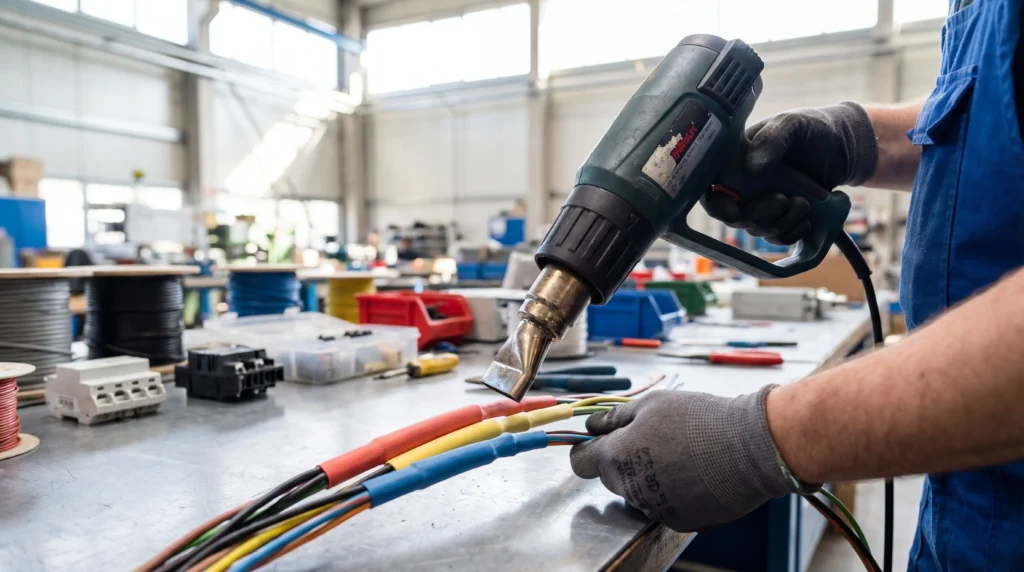
At Willele Electric, our manufacturing process ensures that the thermal properties are consistent throughout the entire spool. However, application technique is equally critical.
The Role of Wall Thickness
Thicker walls provide better thermal insulation but are more susceptible to internal thermal stresses. A thick-walled tube cooling rapidly might contract faster on the outside than the inside, causing warping. Uniform heating during installation is crucial to mitigate this.
Longitudinal Change vs. Radial Expansion
While we focus on radial shrinking, longitudinal change (shortening) is a thermal property that must be accounted for. High-quality manufacturing limits this to +/- 5%, ensuring that the tube doesn’t pull away from the connector it is meant to protect during the cooling phase.
FAQ: Advanced Thermal Inquiries
Q1: Does the shelf life of heat shrink tubing affect its thermal expansion properties?A: Generally, no. However, for materials like PVC, prolonged storage in hot warehouses can cause premature recovery or “blocking” (sticking together). Polyolefin and Fluoropolymers are very stable on the shelf.
Q2: Can I use heat shrink on materials that expand significantly, like aluminum busbars?A: Yes, but you must choose a material with some elasticity. Rigid PVDF might crack if the underlying busbar expands significantly. Flexible Polyolefin or Silicone is preferred for high-expansion substrates.
Q3: Is there a difference between “Heat Resistance” and “Thermal Expansion”?A: Yes. Heat resistance is the ability to not melt or degrade at high temperatures. Thermal expansion is the physical change in size due to temperature. A material can be very heat resistant (like ceramic) but have low expansion, or heat resistant (like silicone) with high expansion.
Q4: How does the “Recovery Force” relate to thermal expansion?
A: Recovery force is the pressure the tube exerts as it tries to return to its original size. High-expansion materials often exert less force once cooled, whereas semi-rigid materials like PVDF exert high force, providing mechanical strain relief.
Q5: What happens if I overheat the tubing during installation?
A: Overheating can cause “glazing” or crystallization in plastics, making them brittle. This alters the CTE locally, creating a weak point that may fail during future thermal cycling.
Conclusion
Selecting the correct insulation is a balancing act between mechanical strength, chemical resistance, and the Thermal Expansion Properties of Different Heat Shrink Materials. A mismatch in thermal coefficients can lead to hidden failures that only appear after months of operation.
Willele Electric stands ready to assist B2B clients in navigating these technical choices. Our rigorous quality control ensures that whether you choose Polyolefin, PTFE, or Silicone, the thermal performance will be consistent and reliable.
Ensure your equipment’s longevity. Contact the Willele engineering team today for data sheets and material samples tailored to your thermal requirements.