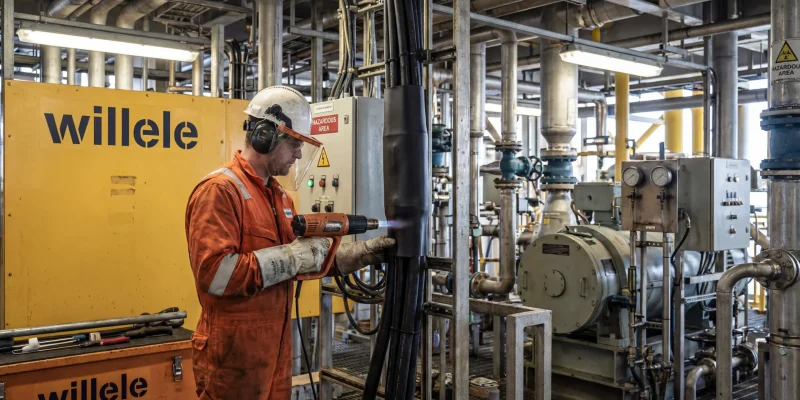
In the high-stakes environment of the energy sector, equipment reliability is not merely a goal; it is a prerequisite for safety and operational continuity. In the Oil and Gas Industry: Heat Shrink Tubing for Hazardous Locations serves as a critical defense mechanism, protecting vital electrical connections from the extreme conditions inherent to extraction, refining, and transportation.
At willele Electric, we understand that every component on an offshore rig or refinery must perform flawlessly. This guide explores the technical requirements, material science, and safety standards necessary for selecting the right heat shrink solutions for hazardous areas.
Understanding Hazardous Location Classifications
To select the appropriate Heat Shrink Tubing for Hazardous Locations, one must first understand the classification systems used to define the level of risk. In the oil and gas industry, these environments are typically defined by the presence of flammable gases, vapors, or mists.
The industry operates under two primary classification systems: the Zone system (IEC/NEC 505) and the Division system (NEC 500).
Zone vs. Division Systems
- Class I refers to locations where flammable gases or vapors are present.
- Zones define the frequency and duration of the explosive atmosphere.
- Divisions are the traditional North American standard, though Zones are increasingly adopted globally.
Hazardous Zone Classifications Comparison
| Classification | Definition | Presence of Hazard | Typical Tubing Requirement |
|---|---|---|---|
| Zone 0 | Explosive atmosphere is present continuously or for long periods. | > 1,000 hours/year | Highest grade, chemically resistant, hermetically sealed. |
| Zone 1 / Div 1 | Explosive atmosphere is likely to occur in normal operation. | 10 – 1,000 hours/year | Heavy-wall, flame-retardant, high-impact resistance. |
| Zone 2 / Div 2 | Explosive atmosphere is not likely to occur in normal operation, and if so, only for a short period. | < 10 hours/year | Medium-wall, standard flame retardancy, UV resistant. |
Why Heat Shrink Tubing is Essential for Oil and Gas Applications
The Oil and Gas Industry: Heat Shrink Tubing for Hazardous Locations creates a barrier against more than just electricity. In upstream, midstream, and downstream operations, cabling is exposed to a barrage of aggressive stressors.
- Kimyasal Direnç: Drilling muds, crude oil, hydraulic fluids, and cleaning solvents can degrade standard insulation. High-quality heat shrink tubing must resist swelling or cracking when exposed to these hydrocarbons.
- Çevresel Sızdırmazlık: Salt spray on offshore platforms leads to rapid corrosion. Adhesive-lined (dual-wall) tubing melts during installation to encapsulate the connection, preventing moisture ingress.
- Mekanik Koruma: Cables are often subjected to abrasion, vibration, and impact. Heavy-wall tubing acts as a sacrificial layer, absorbing physical damage that would otherwise compromise the conductor.
- Gerilim Giderme: At termination points, tubing provides rigidity, preventing the cable from snapping under tension or vibration.
Key Technical Specifications and Properties
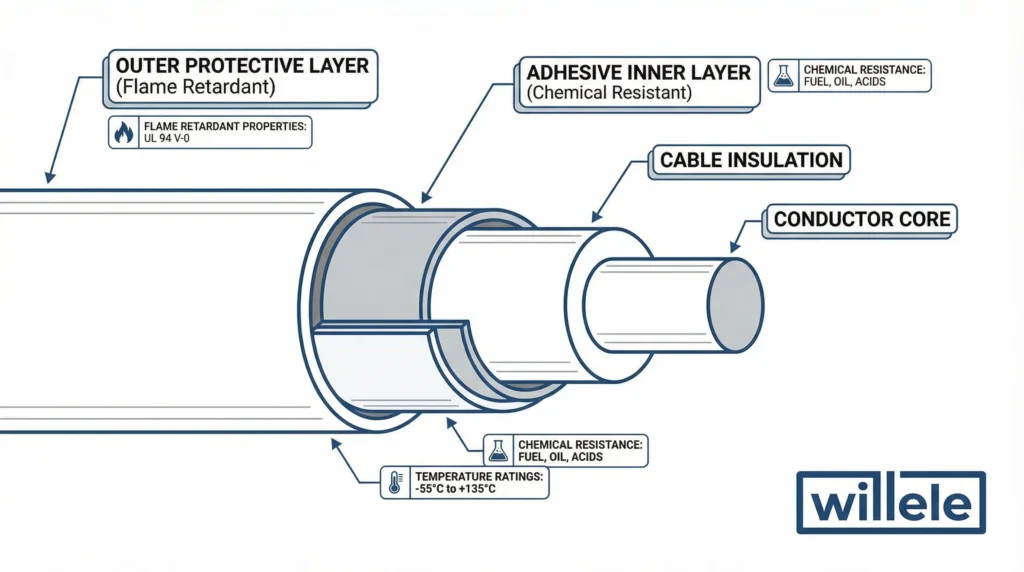
When specifying tubing for these environments, willele Electric recommends focusing on specific technical properties that align with industry standards.
Material Types and Their Applications
Not all polymers are created equal. The choice of material dictates the tubing’s longevity and suitability for specific hazardous zones.
Heat Shrink Material Properties Comparison
| Malzeme Türü | Heat Resistance | Kimyasal Direnç | Esneklik | Typical O&G Application |
|---|---|---|---|---|
| Polyolefin (Cross-linked) | Good (-55°C to +135°C) | Moderate (Resists fuels/oils) | Yüksek | General purpose insulation, control panels in Zone 2. |
| Fluoropolymer (PVDF/Kynar) | Excellent (-55°C to +175°C) | Superior (Resists solvents/acids) | Low (Semi-rigid) | High-temperature sensors, downhole instrumentation. |
| Fluoroelastomer (Viton) | High (-55°C to +200°C) | Extreme (Resists corrosives/fuels) | İyi | Zone 0/1 environments, direct exposure to crude oil. |
| Silicone Rubber | Very High (-75°C to +200°C) | Good (Poor fuel resistance) | Mükemmel | High-flexibility areas, extreme cold/heat environments. |
Compliance Standards: Ensuring Safety
In the oil and gas sector, using non-compliant components is a significant liability. Heat shrink products must meet rigorous international standards to ensure they do not become a source of ignition.
Compliance Standards Overview
| Standard Body | Standard Code | Focus | Region |
|---|---|---|---|
| IECEx | IEC 60079 | Explosive Atmospheres – General Requirements | Global |
| ATEX | Directive 2014/34/EU | Equipment for Potentially Explosive Atmospheres | European Union |
| NEC (NFPA 70) | Articles 500-506 | Hazardous Locations Electrical Standards | North America |
| UL / CSA | UL 224 | Extruded Insulating Tubing (Flammability VW-1) | North America |
| DNV | DNV-OS-D201 | Electrical Installations (Offshore) | Maritime/Offshore |
willele Electric ensures that our specialized tubing lines undergo rigorous testing to meet or exceed these flammability and performance benchmarks.
Installation Best Practices for Hazardous Locations
Even the highest-rated tubing can fail if installed incorrectly. In hazardous locations, a poor seal allows explosive gases to penetrate the cable jacket, potentially migrating to safe areas (a phenomenon known as “gas migration”).
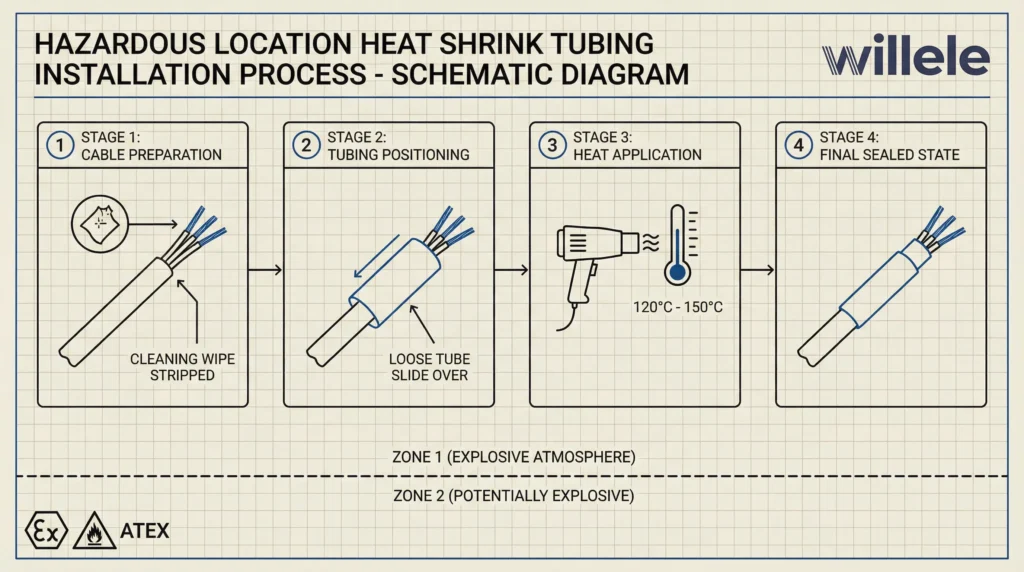
Step-by-Step Installation Protocol
- Surface Preparation: Degrease the cable jacket and connector thoroughly. Any residue of oil or drilling mud will prevent the adhesive lining from bonding effectively.
- Selection: Choose a tubing with a shrink ratio (e.g., 3:1 or 4:1) that accommodates the size difference between the connector and the cable.
- Positioning: Ensure the tubing overlaps the cable insulation by at least 10% of the tube’s length to ensure a proper moisture seal.
- Heating Technique:
- Start shrinking from the center working outwards to eliminate trapped air pockets.
- Use a heat gun calibrated to the material’s shrink temperature (usually 120°C – 175°C).
- Warning: Do not use open flames (torches) in hazardous zones without a hot work permit.
- Adhesive Flow: Apply heat until you see a small bead of adhesive flow out from the ends of the tubing. This visual indicator confirms a hermetic seal.
- Cooling: Allow the assembly to cool naturally. Moving the cable while hot can disrupt the adhesive bond.
Benefits and Specific Applications
Implementing robust Heat Shrink Tubing for Hazardous Locations provides immediate ROI by reducing maintenance intervals and preventing shutdowns.
- Subsea Umbilicals: Protecting hydraulic and electrical lines bundled together in deep-water extraction.
- Topside Switchgear: Insulating busbars in Zone 1 distribution panels to prevent arc flash.
- Motor Lead Connections: Sealing connections on mud pumps and drawworks where vibration is constant.
- Instrumentation: protecting sensitive sensor wiring in refinery processing units from corrosive sulfur compounds.
FAQ Section
Q1: Can standard polyolefin tubing be used in Zone 1 hazardous areas?
Generally, no. Standard polyolefin may lack the flame retardancy and chemical resistance required for Zone 1. You typically need heavy-wall, flame-retardant tubing with specific certifications for these high-risk areas.
Q2: What is the difference between single-wall and dual-wall tubing for oil and gas?
Single-wall tubing provides electrical insulation and abrasion resistance. Dual-wall tubing includes an inner adhesive layer that melts to create a waterproof, gas-tight seal. Dual-wall is strongly recommended for offshore and outdoor O&G applications to prevent corrosion.
Q3: How do I choose the right shrink ratio for my equipment?
Calculate the ratio between the largest component the tube must slide over (the connector) and the smallest component it must grip (the cable). A 3:1 or 4:1 ratio is standard for O&G to accommodate bulky connectors while tightly sealing the cable.
Q4: Does willele Electric offer tubing resistant to diesel and hydraulic fluids?
Yes, willele Electric manufactures specialized fluoroelastomer and high-grade polyolefin tubing specifically designed to resist prolonged exposure to diesel, hydraulic fluids, and drilling chemicals without degrading.
Q5: What certifications should I look for?
Look for UL VW-1 flammability ratings, DNV approval for offshore use, and compliance with IEC 60079 standards for explosive atmospheres.
Sonuç
In the Oil and Gas Industry, Heat Shrink Tubing for Hazardous Locations is a small component with a massive impact on safety and reliability. From the drilling floor to the refinery processing unit, ensuring your electrical connections are sealed against explosive gases and corrosive elements is non-negotiable.
willele Electric is dedicated to engineering high-performance heat shrink solutions that exceed the rigorous demands of the energy sector. Contact our technical team today to discuss your specific hazardous location requirements and secure your operations with industry-leading protection.