Engineering Safer Electrical Infrastructure for Healthcare Environments
Hospitals and medical facilities operate under one non-negotiable principle: zero tolerance for electrical failure and fire risk. Every cable, connector, and insulation layer must comply with strict safety and hygiene standards to ensure uninterrupted operation of life-support systems, diagnostic equipment, and critical infrastructure.
Flame-Retardant Heat-Shrink Tubing plays a vital role in safeguarding medical electrical systems by providing stable insulation, fire resistance, and long-term reliability in sensitive healthcare environments.
For B2B procurement teams, hospital facility engineers, and OEM medical equipment manufacturers, selecting certified tubing is a key factor in ensuring compliance and operational safety.
Why Hospitals Require Flame-Retardant Heat-Shrink Tubing
Unlike industrial environments, healthcare facilities combine high-density electrical systems with human safety-critical operations. Any electrical fault can escalate into life-threatening consequences.
Key Risk Factors in Medical Facilities:
- High concentration of electronic medical devices
- Continuous 24/7 power demand in ICU and operating rooms
- Sensitive diagnostic equipment requiring stable signal integrity
- Strict fire safety and evacuation compliance requirements
- Dense wiring systems in limited installation spaces
Flame-retardant tubing ensures that even in fault conditions, electrical insulation does not contribute to fire propagation.
Core Safety Requirements for Medical Electrical Systems
To meet hospital-grade standards, heat-shrink tubing must satisfy strict performance criteria:
- Flame retardancy (UL224 / VW-1 equivalent)
- Low smoke emission during combustion
- Non-toxic material composition (halogen-free preferred)
- High dielectric insulation stability
- Resistance to disinfectants and cleaning chemicals
- Long-term aging resistance under continuous operation
These properties ensure stable performance in sterile and controlled environments.
Material Engineering for Healthcare Applications
Flame-retardant heat-shrink tubing used in hospitals is typically engineered from cross-linked polyolefin materials, enhanced for safety, cleanliness, and durability.
Key Engineering Features:
- Halogen-free formulation for reduced toxic gas emission
- Smooth surface finish to reduce dust accumulation
- Stable shrink ratio for precision installation
- High resistance to medical cleaning agents
- Enhanced fire-retardant additives for emergency safety
These material improvements make tubing suitable for sensitive healthcare environments where air quality and safety are critical.
Product Type Comparison for Hospital Use
| Type | Structure | Key Advantage | Typical Application |
|---|---|---|---|
| Standard Flame-Retardant Tubing | Single-layer | Cost-effective insulation | General hospital wiring protection |
| Halogen-Free Heat-Shrink Tubing | Eco-safe formulation | Low toxicity and smoke emission | ICU, operating rooms, patient areas |
| أنابيب مبطنة باللاصق | Dual-layer sealing | Moisture + chemical resistance | Sterile equipment connections |
| Thin-Wall Precision Tubing | Lightweight insulation | High flexibility for compact devices | Medical instruments and diagnostic equipment |
Application Areas in Hospitals and Medical Facilities
Flame-retardant heat-shrink tubing is widely used across critical healthcare systems:
- Patient monitoring systems
- MRI, CT scan, and imaging equipment wiring
- Operating room electrical installations
- Hospital power distribution panels
- Emergency backup power systems
- Laboratory diagnostic devices
- Medical robotics and automation systems
- HVAC and sterilization equipment control wiring
Each application requires stable insulation performance and strict safety compliance.
Key Benefits for Healthcare Electrical Systems
1. Enhanced Fire Safety Protection
U significantly reduce fire propagation risk in high-density electrical environments.
2. Patient and Equipment Safety
Stable insulation ensures uninterrupted operation of life-critical systems.
3. Chemical Resistance for Sterile Environments
Resistance to alcohol-based disinfectants and hospital cleaning agents.
4. Low Smoke and Non-Toxic Performance
Critical for evacuation safety and indoor air quality during emergencies.
5. Long-Term Reliability
Reduces maintenance frequency in 24/7 operational healthcare facilities.
Technical Performance Overview
| Parameter | Standard Requirement | Medical-Grade Performance |
|---|---|---|
| مثبطات اللهب | Basic UL224 | VW-1 / enhanced UL224 |
| Smoke Emission | قياسي | Low-smoke formulation |
| Halogen Content | Optional | Halogen-free recommended |
| Operating Temperature | -40°C to +105°C | -55°C to +125°C |
| مقاومة المواد الكيميائية | معتدل | High resistance to disinfectants |
| قوة العزل الكهربائي | ≥15 kV/mm | Stable high insulation performance |
Installation Guidelines for Medical Facilities
Proper installation ensures compliance and long-term performance:
- Ensure all cables are clean and free from contamination
- Select tubing size with appropriate pre-shrink allowance (20–30%)
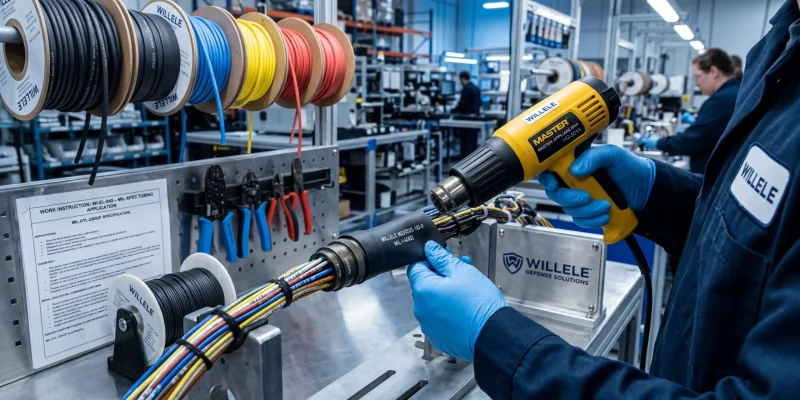
- Apply controlled heat evenly to avoid insulation damage
- Avoid overheating to preserve material integrity
- Ensure full coverage of connection points for sealing applications
- Use halogen-free variants in patient-critical zones
Why Willele Flame-Retardant Solutions Fit Medical Projects
Willele provides industrial-grade electrical insulation solutions designed for demanding B2B environments, including healthcare infrastructure projects.
Core Advantages:
- Stable OEM manufacturing for large hospital projects
- Strict quality control for flame-retardant materials
- Halogen-free options for medical safety requirements
- Consistent batch production for procurement reliability
- Suitable for medical equipment manufacturers and system integrators
Global Healthcare Market Demand
Demand for advanced electrical insulation materials is increasing across global healthcare infrastructure:
- North America: hospital modernization and retrofit projects
- Europe: strict fire safety and environmental regulations
- Middle East: large-scale medical city developments
- Asia-Pacific: rapid expansion of healthcare infrastructure
Regulatory pressure continues to drive adoption of safer, low-emission electrical insulation materials.
الخاتمة
In healthcare environments where system reliability directly impacts human life, Flame-Retardant Heat-Shrink Tubing is not just a component—it is a critical safety layer.
By implementing high-performance insulation solutions, hospitals and medical equipment manufacturers achieve enhanced fire protection, chemical resistance, and long-term electrical stability across all mission-critical systems.
FAQ
1. Why is flame-retardant tubing important in hospitals?
It prevents fire propagation in high-density electrical systems and ensures safer emergency conditions.
2. What is the benefit of halogen-free tubing in medical facilities?
It reduces toxic smoke and harmful gas emissions during fire events, improving patient and staff safety.
3. Where is heat-shrink tubing used in medical environments?
It is used in imaging systems, operating rooms, monitoring devices, and power distribution systems.
4. Can it resist hospital disinfectants?
Yes, medical-grade tubing is designed to withstand alcohol-based and chemical cleaning agents.
5. What is the expected service life in hospitals?
Typically 10–20 years depending on system load and environmental conditions.