Heat Shrink Tubing Customization: Cut Lengths, Colors, Printing, and Pre-Assembled Kits for Production Lines
Picture a production floor running at full tilt. Conveyor belts carry wire harness assemblies past six workstations. Each operator reaches for a length of tubing, positions it on a connector, and moves the assembly forward. Every second saved per unit compounds into hours saved per shift. Now picture the same floor where each operator must measure, cut, and sort raw bulk tubing before applying it. That gap—between ready-to-use and raw material—is where custom heat shrink tubing changes the math for B2B manufacturers.
The shift from bulk rolls to customized, pre-cut, color-coded, and pre-assembled kits is not a luxury. It is a lean manufacturing decision that reduces labor, cuts waste, and eliminates sorting errors. For operations managers sourcing heat shrink tubing for high-volume production lines, the customization options available today can reshape workflow efficiency. This article breaks down exactly what customization options exist, how to specify them, and what trade-offs to expect when ordering from a supplier like Willele.
Why Custom Heat Shrink Tubing Matters for Production Lines
Standard off-the-shelf heat shrink tubing comes in bulk rolls or straight lengths. It works fine for prototyping, low-volume repair work, and R&D labs. But when a line produces 5,000 harnesses per day, the cost of having operators manually measure and cut every piece becomes substantial. Each cut takes roughly 8 to 15 seconds. Multiply that by thousands of units, and the labor cost alone can exceed the material cost.
Custom heat shrink tubing eliminates that bottleneck. The supplier delivers pieces cut to exact lengths, ready for the operator to pick up and apply. No measuring. No cutting. No scrap offcuts piling up on the floor. The tubing arrives as a component, not a raw material.
Beyond labor savings, customization reduces variability. When every piece is identical in length, color, and marking, quality control becomes visual and immediate. A missing color band or a wrong-length piece stands out instantly. This is why industries from automotive to aerospace have moved toward fully specified, pre-customized tubing for their production lines.
Cut Lengths and Tolerances: Specifying the Right Dimensions
Cut-to-length is the most fundamental customization option. Instead of receiving a 1-meter bulk piece, you specify the exact length each application requires—whether that is 25 mm for a small connector boot or 300 mm for a cable splice. The supplier cuts every piece to that dimension before shipping.
Tolerance matters here. For general-purpose applications, a tolerance of ±1.0 mm is typical and cost-effective. For precision applications—such as medical device assemblies or aerospace connectors—you may need ±0.5 mm or tighter. Tighter tolerances require more sophisticated cutting equipment and add cost, so specify only what your application actually requires.
Consider also the relationship between cut length and shrink recovery. A piece cut to 50 mm will still be 50 mm in its expanded state. After shrinking, the length may change by 5 to 10 percent depending on the material. If your application requires a precise post-shrink length, communicate this to the supplier so they can calculate the correct pre-shrink cut length.
| Application Type | Typical Cut Length | Recommended Tolerance | Cutting Method |
|---|---|---|---|
| Connector boots (small) | 15–30 mm | ±0.5 mm | Precision rotary cut |
| Wire splices (mid-range) | 40–80 mm | ±1.0 mm | Automatic knife cut |
| Cable harness branches | 100–250 mm | ±1.5 mm | Automatic knife cut |
| Large cable joints | 250–500 mm | ±2.0 mm | Band saw or guillotine |
Color Coding: Organizing Complex Assemblies at a Glance
Color is the fastest visual sorting tool available on a production floor. When a harness bundle contains 40 wires, color-coded heat shrink tubing allows an operator to identify the correct wire in under two seconds. Compare that to reading printed labels or tracing wires with a multimeter, and the productivity difference is clear.
Standard colors for heat shrink tubing include black, white, red, yellow, blue, green, green/yellow (ground), and clear. Custom colors are available but typically require minimum order quantities of 5,000 to 10,000 meters because the supplier must run a dedicated extrusion batch. For most production lines, the standard color palette is sufficient.
Color coding also supports traceability. Many manufacturers assign specific colors to specific circuit types—red for power, blue for signal, green for ground, yellow for high-voltage interlock. This internal standard, combined with custom-cut tubing, creates a system where errors are visually impossible to overlook. Willele offers the full standard color range and can match custom Pantone references for qualifying volumes.
| Color | Typical Circuit Assignment | Visibility Rating | UV Stability |
|---|---|---|---|
| Black | General purpose / unassigned | High | Excellent (carbon black) |
| Red | Power / positive voltage | Very high | Moderate |
| Blue | Signal / data lines | High | Moderate |
| Green/Yellow | Ground / earth | Very high | Moderate |
| White | Neutral / reference | High | Poor (yellows outdoors) |
| Yellow | High-voltage interlock | Very high | Moderate |
Printing and Marking: Adding Identification Directly to the Tubing
Custom printing on heat shrink tubing transforms each piece into a self-documenting component. Instead of applying a separate label after shrinking, the identification is printed directly on the tubing surface before installation. This approach is faster, more durable, and eliminates the risk of labels falling off in service.
Printing options include text (part numbers, wire IDs, voltage ratings), barcodes (1D or 2D), logos, and sequential numbering. The most common methods are thermal transfer printing and inkjet printing. Thermal transfer produces smudge-resistant marks rated for 25-year service life. Inkjet printing allows full-color output but is less durable in harsh environments.
For production-line efficiency, pre-printed tubing is a significant advantage. Each piece arrives with the correct identifier already applied. The operator matches the tubing to the wire by reading the print, applies it, and moves on. No separate labeling step is needed. This is particularly valuable in industries with strict traceability requirements, where each wire must be uniquely identified throughout the product lifecycle. For more on wire marking standards, refer to the wire marking conventions documented by industry standards bodies.
| Printing Method | Durability | Color Options | Best For | Min Order |
|---|---|---|---|---|
| Thermal transfer | 25-year rated | Single color (black on various) | Part numbers, barcodes, wire IDs | 1,000 pcs |
| Inkjet | 10-year rated | Full color | Logos, complex markings | 5,000 pcs |
| Hot stamp | 15-year rated | Single color (metallic) | Aerospace, military specs | 10,000 pcs |
| Laser mark | Permanent | Single color (etched) | High-contrast, tamper-proof IDs | 2,000 pcs |
Pre-Assembled Kits: Bundling Everything the Line Needs
A pre-assembled kit takes customization to its logical endpoint. Instead of ordering cut lengths, colors, and printed pieces separately, you receive a single kit containing every piece of heat shrink tubing that a specific assembly requires. Each kit is organized, labeled, and ready to deploy at the workstation.
For example, an automotive wire harness for a door module might require 23 different tubing pieces: 8 connector boots in red, 5 splice covers in black, 4 branch seals in adhesive-lined blue, and 6 identification sleeves printed with wire numbers. A kit delivers all 23 pieces in a single bag, sorted by installation sequence. The operator opens the bag, and every piece is there in the right order.
Kitting reduces picking errors to near zero. It also simplifies inventory management. Instead of tracking 23 separate SKUs, the warehouse tracks one kit SKU. When the kit runs low, a reorder triggers replenishment of all 23 components simultaneously. This approach aligns with just-in-time manufacturing principles and reduces the working capital tied up in partial inventory.
Willele has built pre-assembled tubing kits for clients across automotive, solar, and appliance manufacturing. The key to a successful kit is a clear bill of materials (BOM) and a well-defined assembly sequence. If you can provide your drawings and BOM, the kit can be assembled and quoted within 24 hours.
How to Specify Custom Heat Shrink Tubing: A Practical Checklist
Specifying custom tubing requires more than choosing a size and color. A complete specification ensures the supplier delivers exactly what your line needs, with no back-and-forth clarification. The following checklist covers the essential parameters.
Start with the material and shrink ratio. Polyolefin with a 2:1 ratio covers most general-purpose applications. For waterproof sealing, specify dual-wall adhesive-lined tubing. For high-temperature environments, consider PVDF or PTFE. Next, define the expanded inside diameter, the recovered inside diameter, and the wall thickness after recovery. These three dimensions determine whether the tubing will fit over your connector and provide the right level of insulation.
Then specify cut length and tolerance, color, and any printing requirements. For printing, provide the exact text, font size, barcode format, and print position on the piece. Finally, specify packaging: bulk bags, kitted sets, or reel-pack for automated equipment. The more detail you provide upfront, the faster the supplier can quote and produce.
Cost and Lead Time Considerations for Custom Orders
Customization adds cost, but the total cost of ownership often decreases. A pre-cut piece costs 10 to 20 percent more per unit than the equivalent bulk material. However, when you factor in the labor saved from cutting, sorting, and labeling, the total installed cost per harness typically drops by 15 to 30 percent. The math favors customization at volumes above roughly 2,000 units per month.
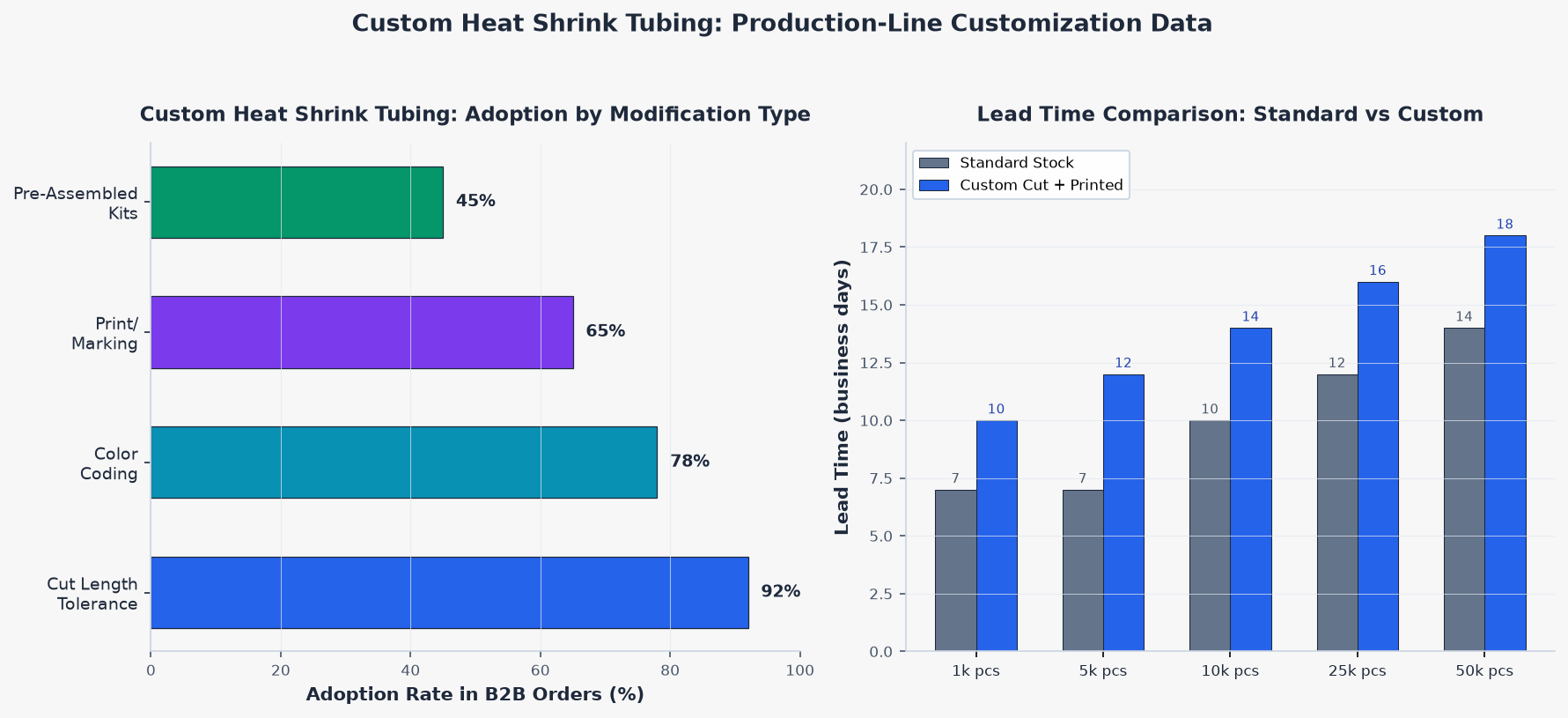
Lead times for custom orders depend on complexity and volume. Simple cut-to-length in standard colors can ship in 7 to 10 business days. Printed tubing adds 3 to 5 days. Fully kitted assemblies with multiple components may take 14 to 18 days for the first run, with subsequent runs faster as the supplier stabilizes the process. Always communicate your production schedule so the supplier can align delivery dates with your line startup.
Minimum order quantities vary by customization type. Cut-to-length typically has no minimum beyond the material itself. Printing usually requires 1,000 pieces minimum. Custom colors may require 5,000 to 10,000 meters. Kitting has no hard minimum but is most cost-effective at 500 kits or more. Discuss these thresholds with your supplier early in the quoting process to avoid surprises.
Frequently Asked Questions
Can I get custom heat shrink tubing in non-standard colors?
Yes. Custom colors are available, but they typically require minimum order quantities of 5,000 to 10,000 meters because the supplier must run a dedicated extrusion batch. For smaller volumes, the standard color palette (black, white, red, yellow, blue, green, green/yellow, clear) covers most production needs. You can also use colored print marks on black tubing as a cost-effective alternative to custom-colored material.
What is the tightest cut-length tolerance available?
For precision applications, cut-length tolerances of ±0.5 mm are achievable using rotary cutting equipment. Tolerances of ±0.25 mm are possible with specialized laser cutting, but this method is expensive and limited to thin-wall materials. For most production-line applications, ±1.0 mm provides an excellent balance of precision and cost.
How durable is thermal transfer printing on heat shrink tubing?
Thermal transfer printing produces marks rated for 25-year service life under normal conditions. The print is smudge-resistant, solvent-resistant, and rated for continuous operating temperatures up to 135°C for polyolefin materials. In environments with extreme chemical exposure or UV radiation, consider laser marking for maximum permanence.
Can pre-assembled kits include tubing from different material types?
Yes. A single kit can contain polyolefin, adhesive-lined dual-wall, and even high-temperature PVDF pieces. This is common in automotive and aerospace harnesses where different sections of the assembly face different environmental conditions. Specify each piece individually in the kit BOM with its material, dimensions, color, and marking.
What documentation should I provide when requesting a custom quote?
The ideal documentation package includes assembly drawings, a bill of materials with quantities, specification of each tubing type (material, shrink ratio, diameters, wall thickness), cut lengths with tolerances, color assignments, print content and format, and packaging requirements. CAD files or PDF drawings help the supplier verify dimensions and identify potential fit issues before production begins.
How does Willele handle custom heat shrink tubing orders?
Willele accepts custom specifications including cut lengths, colors, printing, and pre-assembled kits. Submit your drawings and BOM, and the team responds within 24 hours with a quote and production timeline. Orders are produced in-house at the Willele manufacturing facility, ensuring consistent quality and traceability from material to finished kit.
Summary
Custom heat shrink tubing is a strategic choice for B2B manufacturers running production lines at scale. Pre-cut lengths eliminate measuring and cutting labor. Color coding enables instant visual identification. Printing embeds traceability directly on each piece. Pre-assembled kits bundle everything into a single, error-proof package that aligns with lean manufacturing principles. The per-unit cost may be higher, but the total installed cost per assembly drops significantly when labor, scrap, and error rates are factored in.
The key to a successful custom order is precise specification. Define your material, dimensions, tolerance, color, printing, and packaging requirements upfront. Communicate your production schedule and volume expectations. Work with a supplier who can deliver cut, printed, and kitted tubing with consistent quality and reliable lead times. Contact Willele with your specifications and drawings—the team responds within 24 hours to get your production line running with the right tubing, ready to apply.