
Heat Shrink Tubing Temperature Ratings Demystified: Continuous vs Short-Term vs Minimum Operating Temperatures
A design engineer comparing three datasheets for heat shrink tubing intended for the same 125°C under-hood application will typically encounter three entirely different sets of numbers: one vendor lists a single figure of 125°C, a second quotes 125°C continuous with a 200°C short-term allowance, and a third specifies -55°C to 135°C alongside a separate shrink temperature of 90°C. None of these numbers is wrong, and none of them means the same thing. The first describes a long-term thermal aging limit, the second adds a transient overload envelope, and the third bundles a low-temperature flexibility floor and a processing parameter into what appears at a glance to be a single service range.
Specifying heat shrink tubing on the basis of that headline number, without knowing which physical phenomenon each figure governs, is one of the most common and most expensive errors in harness engineering.
Temperature is the dominant degradation mechanism for polymer insulation. Every hour the tubing spends at elevated temperature consumes part of its useful life through oxidative chain scission, plasticizer migration, and progressive embrittlement, and the rate of consumption is exponential rather than linear. Understanding the distinction between continuous service temperature, short-term excursion limits, and minimum operating temperature, and knowing how each is established and verified, lets engineers specify heat shrink tubing that survives the full design life rather than merely passing incoming inspection. This article unpacks the thermal rating structure used across the industry, explains the test methods behind each number, and provides a practical framework for matching ratings to real thermal environments.
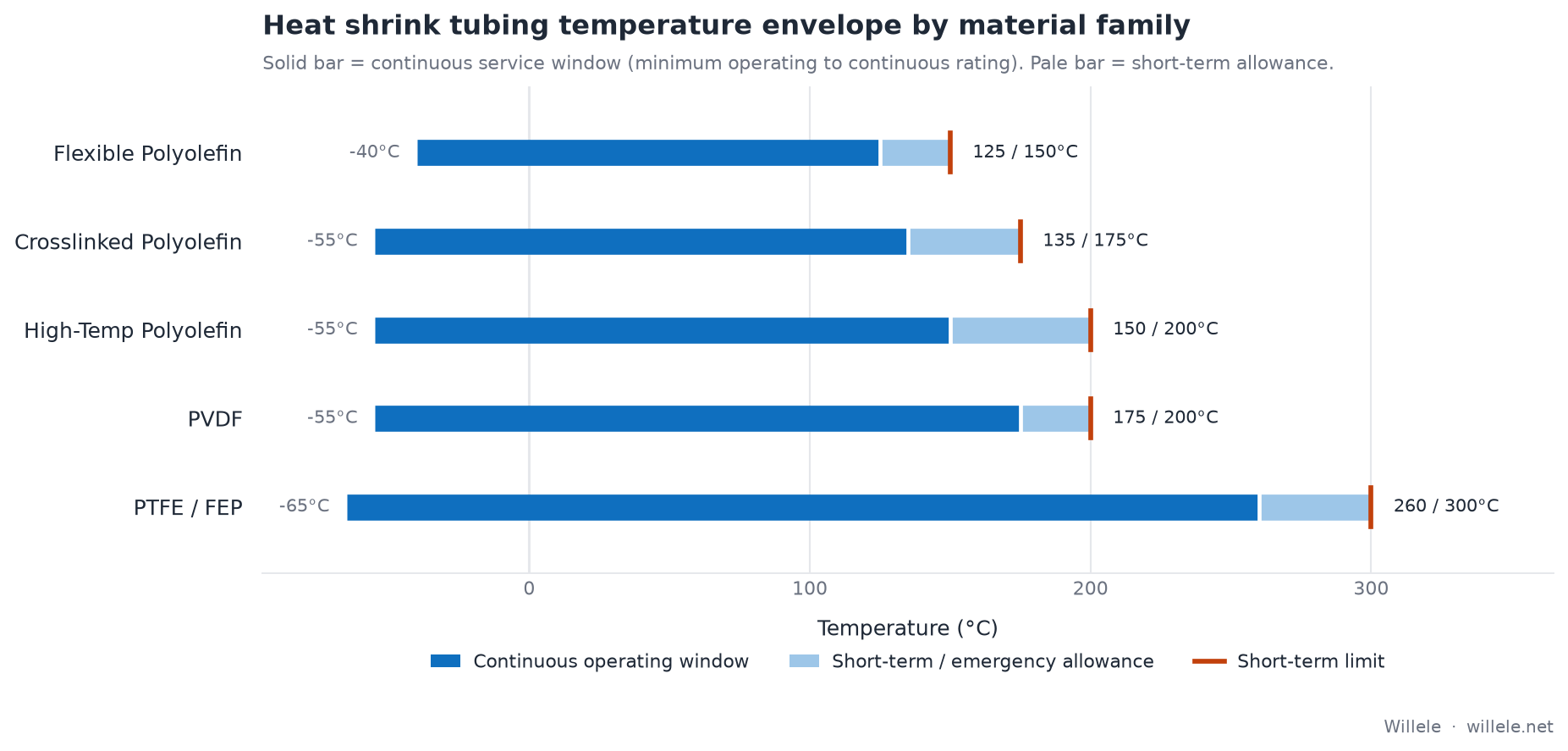
The Three Numbers on a Datasheet and Why They Are Not Interchangeable
Continuous operating temperature defines the maximum temperature at which heat shrink tubing retains its mechanical and dielectric properties over an extended service period. The figure is derived from accelerated heat aging per UL 224, IEC 60684-2, or ASTM D2671, in which specimens are aged in a circulating air oven and then tensile tested. The rating represents the temperature at which the material retains a specified percentage of original elongation, typically 50%, after a defined aging period. It is fundamentally a long-term property and says nothing about brief thermal transients.
Short-term temperature rating, sometimes called emergency overload, describes the maximum temperature the tubing can withstand for a limited duration without irreversible degradation. This matters where abnormal conditions produce heat spikes: a motor in locked-rotor, a battery pack during thermal propagation testing, or a connector carrying fault current before protection operates. The short-term rating is not a license for continuous operation and is valid only for a cumulative duration that is a small fraction of design life.
Minimum operating temperature governs low-temperature behavior rather than high-temperature endurance. It defines the lowest temperature at which heat shrink tubing retains enough flexibility to resist cracking under mechanical stress, whether during installation or in service. Below this point the polymer approaches its glass transition region and becomes susceptible to brittle fracture from vibration, bending, or impact. Two products rated to the same upper limit may differ by 25°C at the cold end, and that difference can decide whether a harness survives a cold-climate cold start.
| Rating Parameter | What It Governs | Typical Test Basis | Duration | Consequence of Exceedance |
|---|---|---|---|---|
| Continuous Operating Temperature | Long-term thermal aging, property retention | UL 224 / ASTM D2671 oven aging + elongation | 1,000–10,000+ h | Embrittlement, cracking, dielectric loss |
| Short-Term / Emergency Rating | Transient thermal overload tolerance | Vendor-defined, typically 1–48 h cumulative | Hours, cumulative | Irreversible degradation, outgassing |
| Minimum Operating Temperature | Low-temperature flexibility, impact resistance | Cold bend (ASTM D746) / cold impact | Instantaneous | Brittle cracking, insulation breach |
| Shrink Temperature | Processing window for recovery | Free-shrink / recovery verification | Seconds to minutes | Incomplete recovery, substrate damage |
Continuous Operating Temperature: The Baseline for Long-Term Heat Shrink Tubing Reliability
The continuous rating is the most consequential number for design life calculations and the most frequently misapplied. The critical subtlety is that the rating applies to the tubing’s own temperature, not to the ambient air. In a tightly bundled harness carrying current, conductor temperature may exceed ambient by 20°C to 40°C depending on load, bundling density, and airflow, and the tubing in direct contact with the conductor tracks that conductor temperature. A designer who specifies 105°C-rated tubing for a 90°C ambient has, in effect, specified a component that operates above its rating for most of its life.
Thermal aging follows Arrhenius kinetics, meaning reaction rate roughly doubles for every 8°C to 10°C rise in polyolefin systems. The consequence is unforgiving: operating the tubing 10°C above its continuous rating does not cut life by 10%, it roughly halves it. Tubing rated for 20,000 hours at 125°C but run continuously at 135°C may reach only 10,000 hours before elongation falls below the acceptance threshold, and at 145°C the figure drops toward 5,000 hours. Since industrial and automotive equipment is often expected to serve 10 to 20 years, halving thermal life can separate a component that lasts the design life from one that fails at year six.
Formulations differ in heat response, driven by base polymer chemistry and stabilization packages, and the Willele heat shrink tubing range covers the full spectrum from 125°C standard polyolefin to 260°C fluoropolymer, with each rating substantiated by oven aging data rather than nominal claims. Readers who want the underlying polymer science before comparing grades will find a useful primer in this overview of crosslinked polyolefin and fluoropolymer materials.
Short-Term Ratings and the Time-Temperature Trade-Off
Short-term ratings exist because real thermal environments are not isothermal. A traction motor, hydraulic pump, or battery pack during fast charging produces heat spikes far above steady state but lasting minutes rather than months. The engineering question is not whether the heat shrink tubing survives the spike, but how much accumulated thermal life the spike consumes and whether cumulative consumption stays within budget.
The correct method is time-temperature equivalence, converting each excursion into equivalent hours at the continuous rating via the Arrhenius relationship. Consequently, a 200°C excursion lasting 30 minutes, for a material with a 125°C rating and typical polyolefin activation energy, may equal several hundred hours at the rated temperature. If such excursions occur daily, the thermal budget erodes quickly, and a component that appeared to have a 20-year life at steady state may fall short of a 10-year target. Datasheets quoting a short-term rating without permissible cumulative duration, and without stating whether it applies to one event or repeated events, are essentially unusable for design.
Practical specification practice is to require the short-term rating together with its basis: temperature, permissible cumulative duration, allowable cycles, and the retention criterion after exposure. For most industrial applications, a short-term rating of 1.2 to 1.6 times the continuous rating, valid for 1 to 48 cumulative hours over service life, is a reasonable expectation for crosslinked polyolefin heat shrink tubing.
| Material | Continuous | Typical Short-Term | Cumulative Duration | Minimum Operating | Shrink Temperature |
|---|---|---|---|---|---|
| Flexible Polyolefin (standard) | 125°C | 150°C | 1–4 h | -30°C to -55°C | 90–125°C |
| Crosslinked Polyolefin (general purpose) | 135°C | 160–175°C | 1–24 h | -55°C | 90–125°C |
| High-Temperature Polyolefin | 150°C | 175–200°C | 1–8 h | -55°C | 125–135°C |
| PVDF | 175°C | 200°C | 1–4 h | -55°C | 150–175°C |
| PTFE / FEP | 200–260°C | 260–300°C | 0.5–2 h | -65°C to -70°C | 330–350°C |
Minimum Operating Temperature: The Cold End of the Envelope
The minimum operating temperature gets far less attention than the high-temperature ratings, yet cold-related failures are common in field returns from northern climates, high-altitude sites, and refrigerated applications. The governing test is cold bend per ASTM D746, in which specimens conditioned at the specified low temperature are bent around a mandrel of defined diameter, with no cracking permitted. A related cold impact test evaluates resistance to mechanical shock at low temperature, closer to real vibration and handling loads.
The practical significance lies in the gap between installation and service temperature. The tubing is often installed at room temperature in a factory, then shipped and commissioned well below its minimum rating. If the harness must flex during assembly in a cold environment, brittle tubing may crack at the bend radius with no visible indication, leaving an insulation defect that surfaces only at dielectric testing or in the field. For equipment assembled in unheated facilities or installed outdoors in winter, a -55°C minimum rather than -30°C provides meaningful margin at modest cost.
However, cold performance is also shaped by wall thickness and adhesive. Thick-wall and adhesive-lined products have more thermal mass and are more prone to brittle cracking than thin-wall single-wall tubing of the same polymer, because the adhesive layer typically has a higher glass transition temperature than the polyolefin backing.
Shrink Temperature Is Not a Service Rating
A persistent confusion in specification work is treating shrink temperature as part of the service range. Shrink temperature, typically 90°C to 125°C for polyolefin heat shrink tubing, is where the material softens enough to recover its expanded diameter and conform to the substrate. It is a processing parameter describing the installation window, not a ceiling on service temperature. The two figures often coincide numerically for standard polyolefin products, which is exactly what generates the misunderstanding.
The distinction cuts both ways. For example, an engineer may wrongly reject 135°C-rated heat shrink tubing because its shrink temperature is 125°C, when the crosslinked network providing the 135°C rating is precisely what prevents re-softening and flow. Conversely, an engineer may select a high-shrink-temperature fluoropolymer for a 150°C application without confirming the heat source can deliver 340°C, resulting in incomplete recovery, poor conformity, and a joint that fails mechanically long before thermal limits are reached.
Installation equipment capability is therefore part of the thermal specification. High-temperature polyolefin with a 135°C shrink point requires a heat gun or oven with sustained delivery and adequate airflow, and fluoropolymer tubing demands specialized high-temperature ovens or radiant heaters, with open flame avoided because it degrades the surface before recovery temperature is reached through the wall.
Temperature Classes, Thermal Index, and Derating Practice
Beyond the vendor datasheet, specifications often reference insulation classes from IEC 60085, which classify systems by the maximum temperature for acceptable life: Class B at 130°C, Class F at 155°C, Class H at 180°C, and Class C at 220°C and above. These are system-level designations developed for motor and transformer insulation, so applying them directly to heat shrink tubing needs care, since the class refers to the complete insulation system rather than an individual component.
The more rigorous route for critical applications is the thermal index per IEC 60216, determined through aging at three or more temperatures with extrapolation to the target life. A material with a thermal index of 140 and a halving interval of 9°C offers substantially more margin at 125°C than one at 128 with 7°C, even though both may be marketed as 125°C products under a less rigorous regime.
In addition, derating completes the picture. Most reliability standards, including guidance derived from MIL-HDBK-217 and IEC 60664, recommend operating polymeric insulation at no more than 70% to 80% of rated thermal capability, reserving margin for manufacturing variation, unanticipated load, and cumulative transient exposure. Applied to the tubing, a 135°C-rated product suits continuous environments up to roughly 95°C to 108°C. Specifying at 100% of rating leaves no allowance for the gap between calculated and actual field conditions.
| Design Practice | Applied Rule | 125°C Rated | 135°C Rated | 150°C Rated |
|---|---|---|---|---|
| No derating (not recommended) | 100% of rating | 125°C | 135°C | 150°C |
| Moderate derating | 80% of rating | 100°C | 108°C | 120°C |
| Conservative derating | 70% of rating | 88°C | 95°C | 105°C |
| With conductor rise allowance | 70% rating minus 25°C rise | 63°C ambient | 70°C ambient | 80°C ambient |
Matching Ratings to Real Thermal Environments
Translating an environment into a defensible specification requires the actual temperature at the tubing surface, not nominal ambient. In a harness this means accounting for conductor self-heating at maximum continuous current, the contribution of adjacent loaded conductors, local ambient, and radiant heat from nearby hot components; thermocouple measurements on prototype hardware under worst-case load routinely reveal surface temperatures 30°C to 50°C above ambient-based calculations.
Engine-adjacent installations then warrant high-temperature polyolefin or PVDF heat shrink tubing with verified excursion data, while cold-climate installations demand attention to cold bend performance and adhesive flexibility, and projects with formal qualification requirements should confirm the rating through UL 224, IEC 60684-2, or ISO 6722 test reports for the specific product variant rather than accepting a marketing datasheet.
Frequently Asked Questions
Q: If heat shrink tubing is rated to 125°C continuous, can it run in a 125°C oven indefinitely?
A: Not with confidence. The continuous rating comes from accelerated aging at higher temperatures extrapolated to the rated point, and corresponds to a defined end-point, commonly 50% retention of original elongation after 1,000 to 10,000 hours. Running continuously at exactly the rated temperature consumes thermal life at the design rate with no margin for material, load, or environmental variation. Derate to 70% to 80% for long-life applications.
Q: What is the difference between a short-term rating and a peak temperature?
A: A short-term rating is a bounded allowance specifying temperature, permissible cumulative duration, and usually a property retention criterion. A peak temperature is simply the highest value observed in a transient, with no implication the component tolerates it. Convert each excursion to equivalent hours at the continuous rating using time-temperature equivalence, then check cumulative consumption against the design life budget.
Q: Why do two heat shrink tubing products with the same continuous rating have different minimum operating temperatures?
A: The two limits depend on different aspects of formulation. The continuous rating reflects the base polymer’s oxidative stability and antioxidant package, while low-temperature flexibility reflects glass transition temperature and the plasticizer or impact modifier system. A formulation can be optimized for aging resistance at the expense of cold flexibility, or the reverse, which is why the full envelope must be specified.
Q: Does color affect the temperature rating?
A: Color has a measurable but usually secondary effect. Dark colors absorb radiant heat more effectively and can reach higher surface temperatures than light colors under identical radiant loading, which matters near heat sources or in solar exposure. The continuous rating generally applies across the standard color range, but that radiant-load difference is real when tubing sits in line of sight of a hot component.
Q: Can heat shrink tubing be used above its shrink temperature?
A: Yes, and this is a normal intended condition. Shrink temperature is the processing point at which expanded tubing recovers, not a service ceiling. Crosslinked polyolefin is chemically and physically stable well above recovery temperature, which is why a product with a 125°C shrink point can carry a 135°C or 150°C continuous rating.
Q: How should I specify heat shrink tubing for both high-temperature excursions and cold-climate exposure?
A: Specify the full envelope explicitly: continuous temperature with derating margin, short-term rating with permissible cumulative duration, minimum operating temperature verified by cold bend, and shrink temperature compatible with available equipment. Then confirm a single product variant is qualified across that whole envelope, and request test reports for the specific size and color.
Summary
Temperature ratings on heat shrink tubing datasheets describe three distinct physical behaviors that are routinely conflated: long-term thermal aging endurance, transient overload tolerance, and low-temperature flexibility. Each is established by a different test method, governs a different failure mode, and must be specified separately if the component is to perform reliably across the service envelope. The continuous rating anchors design life calculations, but applies to tubing surface temperature rather than ambient, follows exponential Arrhenius kinetics that halve life for every 8°C to 10°C of excess, and should be derated to 70% to 80% for long-life applications. As a result, short-term ratings are meaningful only with a permissible cumulative duration and a retention criterion.
Minimum operating temperature determines whether tubing survives installation and vibration in cold environments.
Willele supplies heat shrink tubing across the full thermal spectrum, from 125°C standard polyolefin through 150°C high-temperature grades to 175°C PVDF and 260°C fluoropolymer products, each supported by documented aging data. Contact us with your specifications and drawings, including the measured or calculated surface temperature profile of your application, and our engineering team will respond within 24 hours with a material recommendation and the thermal test documentation your qualification file requires.
About Willele: Willele manufactures heat shrink tubing and cable protection products for industrial, automotive, energy, and transportation applications. Our engineering team supports material selection against measured thermal profiles, supplies thermal aging and cold bend data for qualification programs, and produces custom cut lengths and pre-assembled kits for production lines. Browse the Willele heat shrink tubing range or send your drawings and thermal requirements for a response within 24 hours.