Wind energy has grown from a niche power source into a backbone of the global energy transition, and every megawatt of that capacity travels through cables that must survive twenty-plus years of punishing conditions inside a turbine. The nacelle vibrates, the tower sways in the wind, temperatures swing from sub-zero winters to heat-soaked summers, and offshore installations add salt spray and relentless humidity. In that environment, a cable joint or termination is the weakest link in the electrical chain — and σωλήνωση θερμικής συρρίκνωσης is the engineered answer that keeps those links intact.
Why Cable Protection Is Non-Negotiable in Wind Power
Medium-voltage (MV) cables rated at 12/20 kV and 18/30 kV carry power from the generator in the nacelle down through the tower to the collection network and substation. Unlike cable inside a controlled factory environment, this cable lives under constant mechanical stress: it bends as the nacelle yaws, absorbs vibration from gearbox and generator, and expands and contracts with every thermal cycle. Any breach in insulation — a hairline crack, a pinched jacket, water creeping into a joint — can cascade into a partial discharge, a short circuit, or a full turbine outage that costs operators tens of thousands of dollars per day in lost production.
The failure mechanisms are well documented. Water that penetrates a poorly sealed joint triggers water treeing — microscopic channels that grow inside the insulation under electrical stress until the cable breaks down, sometimes years after the water entered. Vibration and thermal cycling fatigue the crimps and stress cones at terminations, slowly cracking semi-conductive layers. Corrosion attacks unsealed copper and aluminium conductors, raising resistance and creating hot spots. Each of these modes fails silently for years and then suddenly — which is why wind operators treat accessory quality, not cable cost, as the real driver of electrical reliability.
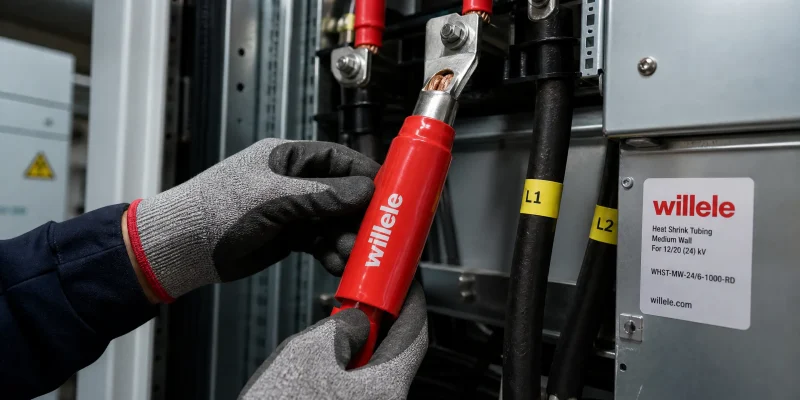
Heat shrink tubing addresses this by rebuilding the cable’s protective envelope at exactly the points where it is most exposed: splices, terminations, lug connections, and stress cones. It is a thermoplastic tube that shrinks radially when heated to form a tight, continuous layer over the connection, providing electrical insulation, mechanical strain relief, moisture sealing, and abrasion resistance in a single installation step. The tubing was invented for exactly this kind of mission-critical duty, and it has become the default protection method across the wind industry precisely because it fails less often than any alternative.
How Heat Shrink Tubing Works
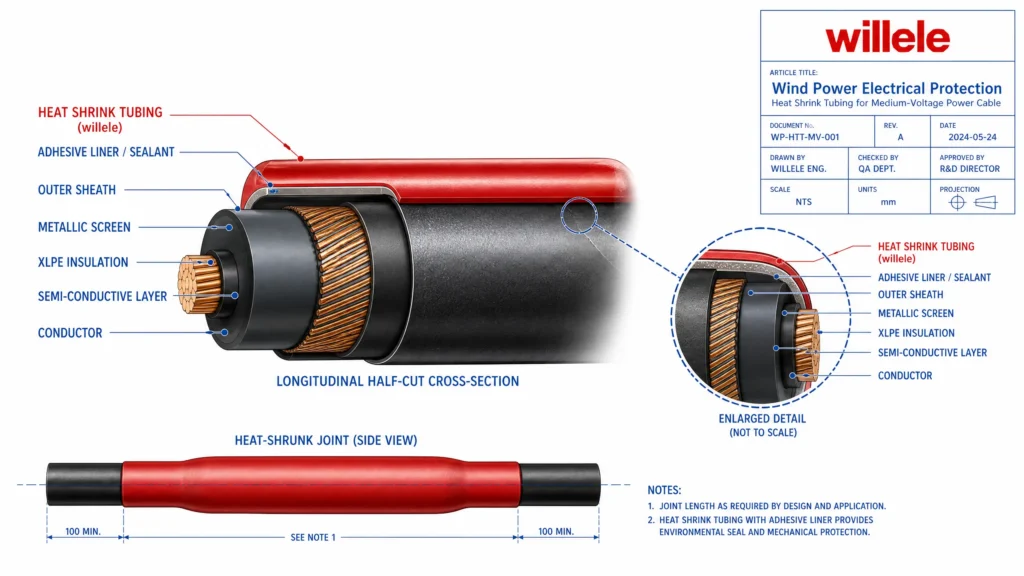
The diagram above shows a longitudinal cross-section of a protected cable. The principle is simple: the tubing is manufactured in an expanded state, cross-linked by electron-beam radiation, and then heated during installation. At temperatures typically between 90°C and 120°C for standard polyolefin, the material softens and contracts radially, conforming tightly to the conductor, lug, or joint underneath. It shrinks in diameter but barely changes in length, which is why it grips a connection firmly without pulling it apart.
Two design families dominate wind applications. Single-wall tubing is a single layer of cross-linked polymer that provides insulation and abrasion protection — the workhorse for phase marking, busbar insulation, and light environmental duty. Dual-wall tubing, sometimes called adhesive-lined tubing, carries a meltable hot-melt adhesive on its inner surface. When heated, the adhesive melts and flows into the microscopic gaps around a lug or cable screen, then sets into a watertight seal as the assembly cools. This dual-wall construction is the standard choice for outdoor and offshore cable joints, where a drop of water inside a termination is the difference between a decade of service and a catastrophic failure.
The cross-linking step is what gives the material its memory. Electron-beam radiation forms molecular bonds between the polymer chains, so when the tube is reheated it relaxes toward its manufactured dimensions instead of flowing like ordinary plastic. That is also why a correctly installed tube keeps its grip at operating temperature: the recovered wall stays under elastic tension, hugging the connection and holding the adhesive liner in compression against the cable. It explains the installation technique too — heat must be even and progressive, because overheating scorches the polymer while uneven heat leaves soft, unrecovered zones that invite moisture.
Where Heat Shrink Tubing Protects a Wind Turbine
Heat shrink tubing appears at every cable connection in a modern wind turbine, and each location places a different demand on the material:
- Generator and converter terminations in the nacelle, where MV cable lugs connect to switchgear and converter modules under continuous vibration.
- Tower down-lead cables, where joints connect tower sections during erection and must remain watertight for decades behind internal ladders.
- Cable entry seals where cables pass through the tower floor and transition to the collection network.
- Blade and pitch-system cabling, where smaller single-wall tubing bundles and insulates control and power wiring inside rotating components.
- Array and collector network joints — the buried or subsea cables that gather power from multiple turbines, where 3:1 and 4:1 dual-wall tubing seals the splice kits.
- Grounding and surge protection connections, where heat shrink reinforces bonds against corrosion and galvanic action.
Across these locations, the common requirement is the same: an insulation layer that resists UV, salt, temperature cycling, and mechanical wear, and a seal that keeps moisture out for the full service life of the turbine.
Onshore vs. Offshore: Requirements That Differ
The operating profile of a wind farm changes the specification, and the difference between an onshore and an offshore site is often the difference between single-wall and dual-wall tubing:
| Requirement | Onshore | Offshore / intertidal |
|---|---|---|
| Primary hazard | UV, temperature cycling, moisture | Salt spray, immersion, constant humidity |
| Cable environment | Tower interiors, trenches, above ground | Subsea arrays, transition joints, J-tubes |
| Recommended wall | Single-wall in towers; dual-wall at entries | Dual-wall / heavy-wall on all joints |
| UV grade | Black required outdoors | Black plus salt-spray rating |
| Testing emphasis | Thermal cycling, UV aging | Salt-spray, water immersion, long-term sealing |
Offshore developers therefore specify adhesive-lined tubing almost everywhere, while onshore projects reserve it for the few locations where water can collect. Matching the product to the site profile is the fastest way to avoid both over-specification cost and under-specification failure.
Choosing the Right Heat Shrink Tubing Material
Not all heat shrink tubing is equal, and material selection is the single most important decision a procurement or engineering team makes. The table below compares the material families most relevant to wind power:
| Υλικό | Continuous temp. range | Key strengths | Best suited for |
|---|---|---|---|
| Standard polyolefin | −55°C to 135°C | Low cost, fast shrink, flame retardant, flexible | General insulation, phase marking, bundling |
| Dual-wall adhesive-lined polyolefin | −55°C to 125°C | Watertight adhesive seal, strain relief | Outdoor joints, cable entries, MV terminations |
| Heavy-wall polyolefin | −55°C to 110°C | High dielectric strength, thick rigid wall | Cable repair sleeves, mechanical reinforcement |
| Fluoropolymer (PTFE/FEP) | up to 260°C | Extreme heat and chemical resistance | Hot zones near converters and brakes |
| Elastomeric | −75°C to 150°C | Cold flexibility, abrasion and fluid resistance | Pitch cabling, cold-climate turbines |
| EVA | −40°C to 105°C | Clarity, low-temperature flexibility | Visual inspection points, light insulation |
For most wind applications, dual-wall adhesive-lined polyolefin offers the best balance of cost, performance, and sealing. Black is the recommended color for any outdoor or UV-exposed installation, because black polyolefin carries the UV stabilizers that colored and clear grades lack.
Shrink Ratio and Sizing: 2:1, 3:1, or 4:1?
The shrink ratio states how many times larger the expanded (as-supplied) diameter is compared to the recovered (heated) diameter. Choosing the right ratio prevents two common field failures: tubing that is too small to slide over the connector, and tubing that only partially recovers and leaves voids.
| Ratio | Expanded vs. recovered | Typical wind application |
|---|---|---|
| 2:1 | Fits components up to 2× its recovered size | Straight cable runs, phase marking, lug insulation |
| 3:1 | Fits components up to 3× its recovered size | Connectors, irregular profiles, cable entries |
| 4:1 | Fits components up to 4× its recovered size | Wide step-downs, splice kits, boot covers |
As a rule, select tubing whose recovered diameter is slightly smaller than the smallest diameter it must seal, so it grips with pressure, but whose expanded diameter clears the largest connector or lug it must slide over. Engineers should also account for longitudinal shrink — typically 5–15% of the cut length — when cutting tubing to size.
Heat Shrink Accessories That Complete the System
Cable joints are not the only place heat shrink earns its keep in a wind farm. A complete protection system adds several specialized pieces built from the same cross-linked materials:
| Accessory | Function | Typical wind use |
|---|---|---|
| Breakout boots | Seals where a multi-core cable splits into single cores | Nacelle and tower cable entries |
| End caps | Watertight termination of unused or spare cores | Spare phases, future capacity |
| Busbar insulation sleeves | Insulates bare copper or aluminium busbar | Switchgear and converter cabinets |
| Transition pieces | Bridges cables of different diameters or materials | Collector network transitions |
| Identification sleeves | Printed or colored markers | Phase coding, cable tracing |
| Repair sleeves / heavy wall | Rebuilds damaged outer sheath | Tower down-lead repair |
Because every accessory shares the same shrink-temperature window and adhesive chemistry as the tubing, one installation crew and one heat source can cover the entire cable system. Standardizing on a single supplier for tubing and accessories also simplifies the compliance file — one datasheet set, one certificate set, one quality system.
Key Performance Specifications to Compare
When evaluating heat shrink tubing suppliers, procurement teams should compare the specifications that actually drive reliability in a wind environment:
| Προδιαγραφές | What it measures | Typical value for wind-grade tubing |
|---|---|---|
| Dielectric strength | Ability to withstand voltage without breakdown | 600 V/mil and higher for thin-wall polyolefin; voltage ratings from 600 V to 69 kV by wall thickness |
| Continuous operating temperature | Safe service window | −55°C to 135°C for standard polyolefin |
| Shrink temperature | Temperature at which recovery occurs | 90°C to 120°C (polyolefin); higher for fluoropolymers |
| Flammability rating | Resistance to burning | UL VW-1 flame-retardant grade |
| UV resistance | Longevity in sunlight | Black grades with UV stabilizers for outdoor use |
| Shelf life | Storage stability | 3–5 years when stored cool and dry |
These numbers matter because they translate directly into turbine uptime. A termination rated for −55°C low-end operation still seals in a Canadian winter; a flame-retardant grade contains the damage if a fault ever occurs inside the nacelle.
Standards and Certifications
For an export-oriented B2B supplier, compliance documentation is part of the product. Wind project engineers and EPC contractors routinely require evidence that heat shrink tubing meets recognized international standards before approving a vendor:
| Standard / requirement | Scope |
|---|---|
| UL 224 | Extruded insulating tubing — dimensional, dielectric, and flame testing |
| ASTM D2671 | Test methods for heat-shrinkable tubing |
| IEC 60684 | Flexible insulating sleeving — construction and performance |
| RoHS | Restriction of hazardous substances for EU and global markets |
| REACH | EU chemical safety registration and evaluation |
| ISO 9001:2015 | Manufacturer quality management system |
willele Electric manufactures under ISO 9001:2015 quality management and provides documented test data and compliance certificates for its heat shrink tubing, giving wind project teams the paper trail they need for grid connection approval and long-term asset records.
Heat Shrink Tubing vs. Other Cable Protection Methods
Heat shrink is not the only way to protect a cable connection, but it is usually the best one. The comparison below shows how it stacks up against the alternatives wind operators sometimes consider:
| Method | Moisture seal | Insulation | Install time | Long-term reliability | Κόστος |
|---|---|---|---|---|---|
| Heat shrink tubing (single-wall) | Μέτρια | Καλή | Fast | Υψηλή | Low–moderate |
| Heat shrink tubing (dual-wall) | Εξαιρετικό | Εξαιρετικό | Fast | Very high | Μέτρια |
| Cold shrink | Εξαιρετικό | Εξαιρετικό | Fastest (no heat) | Very high | Higher |
| Insulation tape | Poor | Καλή | Slow, variable | Low (unwinds over time) | Very low |
| Cable ties / sleeving | None | None | Fast | Χαμηλή | Very low |
| Resin / epoxy encapsulation | Εξαιρετικό | Εξαιρετικό | Slow, permanent | High (non-removable) | Υψηλή |
Dual-wall heat shrink offers the best combination of sealing performance, install speed, and cost for the vast majority of wind cable applications. Cold shrink is preferable only where a heat source is impractical — for example, tight spaces where a heat gun cannot reach — at a premium price. Tape remains a temporary fix, not a 20-year protection strategy.
Best Practices for Installing Heat Shrink Tubing in the Field
Even the best heat shrink tubing fails when installed carelessly. Wind contractors who achieve multi-decade joints follow a disciplined process:
- Prepare the surface. Clean the cable, lug, or joint with a degreaser to remove oil, moisture, and dust. For adhesive-lined tubing, surface cleanliness is critical — any contamination compromises the watertight seal.
- Cut and position accurately. Select the correct ratio and diameter, account for 5–15% longitudinal shrink, and slide the tubing so it fully covers the connection with overlap on both sides.
- Pre-shrink and anchor. For long lengths, shrink one end first to anchor the tubing in position before heating the rest.
- Heat from the center outward. Apply the heat gun with a diffuser nozzle, working from the middle of the tubing toward each end to push trapped air out and avoid air bubbles under the wall. Keep the nozzle moving and never concentrate heat in one spot.
- Verify full recovery. After heating, the tubing should be smooth, tight, and continuous, with adhesive visible at both ends of a dual-wall installation — a visual confirmation that the seal is complete.
Heat Shrink Tubing That Survives a 20-Year Service Life
Quality variation between suppliers is the hidden risk in wind procurement. Two tubes that look identical on a shelf can perform very differently after a decade of UV exposure and thermal cycling, depending on the base polymer, the cross-linking dose, the stabilizer package, and the consistency of the manufacturing line.
willele Electric is a specialized B2B manufacturer of electrical equipment and heat shrink tubing with more than 17 years of expertise in flame-retardant and environmentally resistant heat shrinkable tubes. Its production is built on electron-beam cross-linking technology, advanced extrusion lines, and in-house testing laboratories, so every batch is verified for shrink ratio, dielectric strength, and flame performance before it ships. The product family spans single-wall polyolefin tubes in 2:1 and 3:1 ratios, dual-wall adhesive-lined tubes for environmental sealing, heavy-wall repair sleeves, and specialty materials for demanding service — a range wide enough to cover every cable connection in a wind farm from the nacelle to the collector network.
Serving Wind Power Projects in North America, Europe, and Beyond
Wind project engineering is a global discipline, and the heat shrink tubing specified in Germany, the United States, and Australia is often subject to the same core requirements: IEC and UL compliance, RoHS and REACH documentation, UV and salt-spray resistance, and batch traceability. willele serves B2B buyers worldwide — turbine OEMs, EPC contractors, cable accessory distributors, and maintenance organizations — from its manufacturing base in Yueqing, Zhejiang, China, with ready-to-ship inventory and fast export logistics. For engineering teams evaluating a new supplier, that means the same documented quality delivered to any port, supported by application engineering for custom sizing and installation guidance.
FAQ: Heat Shrink Tubing for Wind Power
What temperature does heat shrink tubing need to reach? Standard polyolefin heat shrink tubing activates at 90°C to 120°C, easily reached with a heat gun. Fluoropolymer materials require higher temperatures, typically 170°C to 343°C, and are used only where extreme heat resistance is needed.
What is the difference between single-wall and dual-wall heat shrink tubing? Single-wall tubing is one insulating layer, ideal for bundling, marking, and light protection. Dual-wall tubing adds an inner adhesive liner that melts and forms a watertight seal, making it the right choice for outdoor cable joints, MV terminations, and any connection exposed to moisture.
What shrink ratio should I choose for cable joints? Use 2:1 for straight runs and simple lug insulation, 3:1 for connectors and irregular profiles, and 4:1 for wide step-downs and splice kits. The recovered diameter must be slightly smaller than the smallest surface it seals, while the expanded diameter must clear the largest connector.
Why is black heat shrink tubing recommended for outdoor wind installations? Black polyolefin contains UV stabilizers that resist sunlight degradation. Colored and clear grades lack this protection and should not be used outdoors, where UV exposure is constant.
How long does heat shrink tubing last in a wind turbine? Installed correctly, heat shrink tubing is designed to last the service life of the turbine — 20 years or more. Proper material selection, surface preparation, and installation technique are the determining factors.
Can heat shrink tubing be removed once installed? It is a permanent protection method. To rework a connection, the tubing must be cut away and replaced with a new piece — which is why installers confirm fit and position carefully before applying heat.
How do I know which heat shrink tubing size to order? Measure the smallest and largest diameters the tubing must cover: the expanded diameter must exceed the largest, and the recovered diameter must be smaller than the smallest. Choose the closest standard size above the expanded requirement, then verify the ratio covers the step-down. willele provides sizing tables and free application guidance for wind projects.
Spec Heat Shrink Tubing for Your Wind Project
Whether you are an OEM qualifying components for a new turbine platform, an EPC contractor equipping a wind farm, or a distributor stocking cable accessories, the right heat shrink tubing starts with a specification conversation, not a catalog page. Contact willele Electric for datasheets, compliance certificates, custom sizing, and application engineering support for your wind power electrical protection needs.