
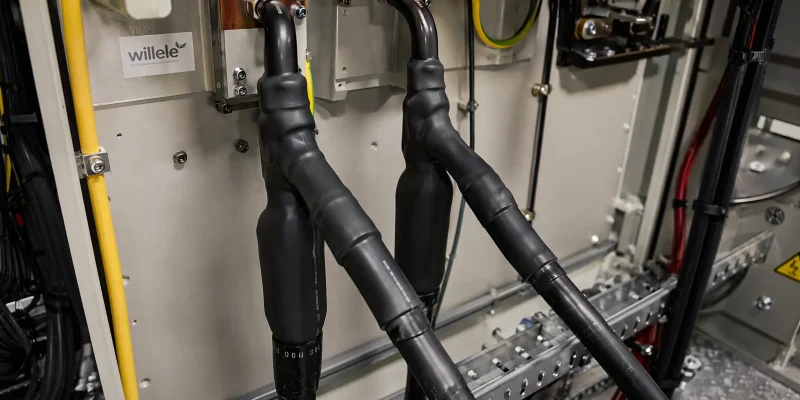
Wind turbines operate in some of the harshest electrical environments imaginable. From the constant torsional stress on nacelle cables to salt spray corrosion in offshore installations, every electrical connection faces relentless mechanical and environmental challenges. Heat shrink sleeves have emerged as a critical protective technology, delivering reliable insulation, environmental sealing, and mechanical reinforcement exactly where wind turbine systems need it most.
Understanding Heat Shrink Technology in Wind Energy
Heat shrink sleeves are thermoplastic tubes that contract radially when exposed to heat, conforming tightly to cables, joints, and terminations. Manufactured through a cross-linking process, these sleeves are expanded during production and retain their enlarged diameter until heat application triggers a molecular “memory effect,” causing them to shrink to approximately 50% of their original diameter.
In wind turbine applications, heat shrink technology addresses three fundamental requirements simultaneously: electrical insulation to prevent voltage breakdown, environmental protection against moisture and contaminants, and mechanical reinforcement to withstand vibration and cable movement. The cross-linking process creates molecular bonds that provide enhanced mechanical strength, chemical resistance, and thermal stability—properties essential for the 20-25 year operational lifespan expected from modern wind installations.
Critical Application Points in Wind Turbine Systems
Nacelle Cable Management
The nacelle houses the generator, gearbox, and control systems—all connected by power and control cables that must rotate continuously as the nacelle tracks wind direction. This constant twisting motion creates severe mechanical stress on cable insulation and joints. Heat shrink sleeves with adhesive lining provide both abrasion resistance and moisture sealing, maintaining insulation integrity despite thousands of rotation cycles.
Dual-wall heat shrink tubing has proven particularly effective in nacelle applications. The outer polyolefin layer provides mechanical protection and UV resistance, while the inner adhesive layer creates a watertight seal that prevents moisture ingress—a leading cause of insulation failure in rotating cable assemblies.
Cable Loop Protection
Wind turbine towers contain cable loops that accommodate nacelle rotation, typically allowing 540° of movement in each direction. These loops experience continuous flexing and inter-cable contact, leading to insulation wear. Cable protection sleeves prevent abrasion damage that can reduce facility output and require costly repairs—a single loop cable replacement can consume two full work days. citation
Heat shrink sleeves applied at cable crossing points and support locations distribute mechanical stress and prevent the insulation damage that occurs when cables twist around each other during rotation cycles. This protection extends cable operational life significantly, reducing unplanned maintenance and improving overall system reliability.
Medium Voltage Terminations and Splices
Wind turbines typically generate power at 690V, which is then stepped up to 11kV-33kV for collection and transmission. These medium voltage cable terminations require precise electrical stress control to prevent partial discharge and insulation breakdown. Heat shrink termination kits provide stress control through specially designed tubes with conductive or semi-conductive layers that grade the electrical field uniformly across the insulation cutback.
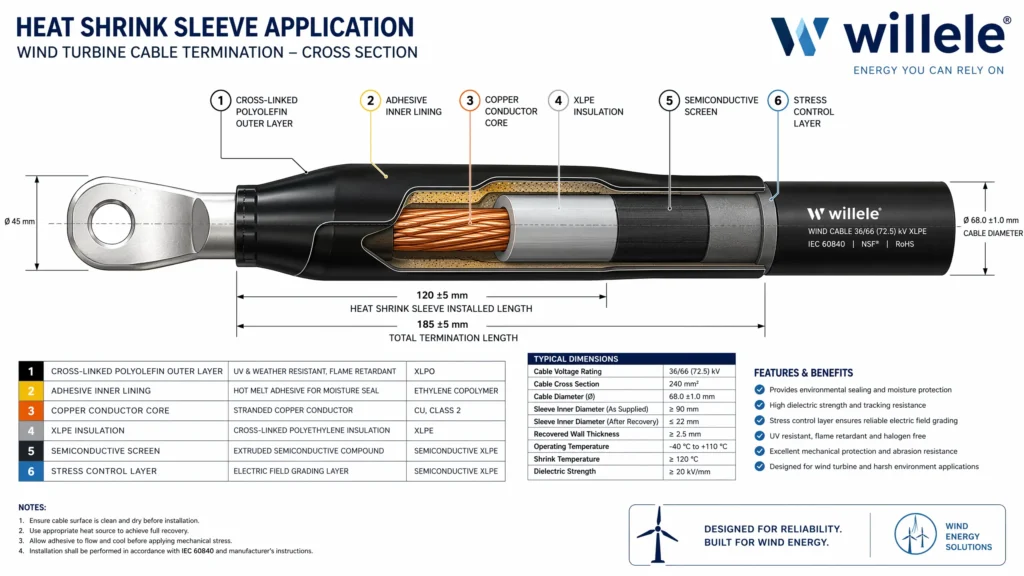
The installation process is critical: cable preparation must remove all grease and semi-conductive residue, stress control mastic or tubing must be applied precisely over the screen cutback, and the heat shrink sleeve must be heated uniformly to achieve complete adhesive flow and void-free installation. When properly installed, heat shrink terminations provide more reliable and uniform performance over the installation lifetime compared to tape wrapping or molding compounds.
Offshore Wind Challenges
Offshore wind installations face additional environmental stresses: salt spray, humidity cycling, temperature extremes, and potential submersion during maintenance operations. Heat shrink tubing with adhesive lining and corrosion-resistant materials maintains insulation and mechanical integrity under these harsh marine conditions.
Specialized formulations with high melting point adhesives (such as SA47-HT tubing) handle the temperature fluctuations and humidity that would degrade standard materials. These advanced heat shrink products meet automotive-grade corrosion protection standards, providing the durability offshore wind operators require for subsea cable connections and tower base terminations.
Material Selection and Performance Specifications
Selecting the appropriate heat shrink material for wind turbine applications requires matching material properties to specific environmental and electrical stresses.
| 素材タイプ | Operating Temperature | Key Advantages | Typical Wind Turbine Applications |
|---|---|---|---|
| Polyolefin (PO) | -55°C to +135°C | Excellent balance of electrical, chemical, and physical properties; cost-effective | General cable insulation, wire bundling, nacelle cable protection |
| Dual-Wall Adhesive | -55°C to +110°C | Watertight sealing, superior moisture protection | Cable loops, outdoor connections, offshore installations |
| Fluoropolymer (PTFE/FEP) | -200°C to +260°C | Extreme temperature resistance, chemical inertness | High-temperature generator connections, specialized sensor cables |
| Medium-Wall Anti-Track | -40°C to +90°C | Electrical tracking resistance for MV applications | Busbar covering, medium voltage terminations (11kV-33kV) |
Polyolefin remains the most widely used material, offering versatile performance across the majority of wind turbine cable protection needs. Its activation temperature of 90-120°C allows field installation with standard heat guns while providing long-term stability across the -40°C to +90°C temperature range typical in wind farm environments.
For critical medium voltage applications, anti-tracking formulations prevent surface carbonization that can create conductive paths across insulation. These specialized materials meet stringent dielectric strength requirements and maintain insulation resistance even when contaminated with moisture or conductive dust.
Installation Best Practices for Wind Turbine Environments
Proper installation technique directly determines heat shrink sleeve performance and longevity. Field conditions in wind turbines—limited space, height access restrictions, and weather exposure—demand disciplined installation procedures.
Surface Preparation: Clean all surfaces thoroughly using approved solvents to remove grease, moisture, and contaminants. Any residue trapped under the heat shrink sleeve can create void spaces that compromise both electrical insulation and mechanical bonding.
Sizing and Positioning: Select heat shrink tubing with appropriate shrink ratio (typically 2:1 or 3:1) to ensure complete conformance without excessive thickness. Position the sleeve to provide adequate overlap beyond the protection zone—minimum 25mm beyond cable insulation cutbacks for medium voltage applications.
Heat Application: Apply heat gradually and evenly, maintaining the heat source 15-20cm from the sleeve surface. Rotate the cable continuously during heating to achieve 360° uniform shrinkage. For adhesive-lined tubing, continue heating until adhesive flows visibly from both ends of the sleeve, confirming complete void elimination.
Quality Verification: Inspect completed installations for smooth surface finish without bubbles, wrinkles, or gaps. Adhesive squeeze-out should be visible and uniform around both ends. For critical medium voltage terminations, perform high-voltage testing per manufacturer specifications before energization.
Comparative Analysis: Heat Shrink vs. Alternative Technologies
| Protection Method | Installation Time | 環境シーリング | Electrical Performance | Long-term Reliability | Field Repairability |
|---|---|---|---|---|---|
| Heat Shrink Sleeves | Moderate (15-30 min) | Excellent with adhesive lining | Superior stress control | High (20+ years) | Good—requires heat source |
| Tape Wrapping | Fast (5-10 min) | Poor—gaps allow moisture | Adequate for LV only | Moderate—degrades over time | 素晴らしい |
| Cold Shrink | Very Fast (2-5 min) | グッド | Good for MV applications | 高い | Limited—single use |
| Molded/Potted | Slow (60+ min) | 素晴らしい | 素晴らしい | Very High | Poor—requires complete replacement |
Heat shrink technology offers the optimal balance of installation speed, performance, and cost-effectiveness for the majority of wind turbine cable protection applications. While cold shrink sleeves reduce installation time by up to 90% for fiber optic applications, heat shrink remains superior for power cable terminations requiring precise stress control.
The reliability advantage becomes clear over multi-decade operational periods. Tape wrapping degrades under UV exposure and temperature cycling, requiring periodic inspection and re-wrapping. Heat shrink installations, once properly completed, require no maintenance and maintain consistent performance throughout the turbine’s operational life.
Standards and Compliance Requirements
Wind turbine electrical systems must comply with multiple international standards governing insulation materials, fire safety, and environmental performance.
UL 224 specifies requirements for extruded insulating tubing used in electrical applications, including dimensional stability, dielectric strength, and flammability ratings. Most critical wind turbine applications require UL 224 certified heat shrink tubing with traceable documentation.
IEC 60684 provides international standards for flexible insulating sleeving, including heat shrink tubes. This standard outlines property requirements, color coding, and testing methods that ensure consistent global performance.
RoHS Compliance restricts hazardous substances in electrical equipment sold in European markets. Wind farm developers increasingly require RoHS-compliant heat shrink materials even for installations outside EU jurisdictions, driven by corporate sustainability commitments.
Fire Safety Standards such as UL 94 V-0 flame rating ensure that heat shrink materials are self-extinguishing and do not propagate fire—critical for nacelle installations where fire suppression is challenging.
Specifying heat shrink products with documented compliance to these standards reduces project risk, ensures insurance coverage validity, and meets warranty requirements from turbine manufacturers.
Economic Impact and Lifecycle Considerations
The economic case for heat shrink sleeve technology extends beyond initial material costs to encompass installation labor, maintenance frequency, and unplanned downtime avoidance.
Installation Efficiency: While heat shrink requires more installation time than simple tape wrapping, the elimination of periodic re-inspection and maintenance delivers net labor savings over the turbine lifecycle. A properly installed heat shrink termination requires no maintenance for 20+ years, while taped connections may need re-wrapping every 3-5 years.
Failure Cost Avoidance: Cable insulation failures in operating wind turbines are expensive. Tower access requires specialized personnel and equipment, often costing $5,000-$15,000 per visit before repair work begins. Nacelle cable failures may require turbine shutdown for multiple days, with lost generation revenue compounding direct repair costs. Heat shrink protection that prevents these failures delivers substantial economic value.
Performance Reliability: Electrical connection failures account for a significant portion of wind turbine downtime. Studies of offshore wind farms show that cable and connection issues cause 15-20% of unplanned maintenance events. High-quality heat shrink protection reduces this failure mode, improving overall fleet availability and energy production.
For a typical 3MW turbine generating revenue of $300-$500 per day, even a single avoided shutdown event justifies the incremental cost of premium heat shrink materials across the entire cable system.
Future Developments in Heat Shrink Technology
The wind energy sector continues driving innovation in heat shrink materials and application methods. Several emerging technologies promise enhanced performance for next-generation wind installations.
Smart Heat Shrink Materials: Research into heat shrink sleeves with embedded sensors could enable real-time monitoring of cable temperature, moisture ingress, and mechanical stress—providing early warning of developing insulation problems before failure occurs.
Rapid-Cure Formulations: New polymer chemistries under development promise lower activation temperatures and faster shrinkage, reducing installation time while maintaining long-term performance. These materials could enable heat shrink installation in colder ambient temperatures currently requiring supplemental heating.
Enhanced UV Resistance: As wind turbines grow larger with more external cable routing, UV degradation becomes increasingly important. Next-generation stabilizers and pigment systems promise 30+ year outdoor exposure resistance without performance degradation.
Recyclable Materials: Sustainability pressures are driving development of heat shrink materials that can be recovered and recycled at end-of-life, reducing the environmental footprint of wind farm decommissioning.
Frequently Asked Questions
What temperature range can heat shrink sleeves withstand in wind turbine applications?
Standard polyolefin heat shrink sleeves operate reliably from -55°C to +135°C, covering the full temperature range encountered in most wind installations. Specialized fluoropolymer materials extend this range to -200°C to +260°C for extreme environments or high-temperature generator connections.
How long does heat shrink protection last in offshore wind farms?
Properly installed adhesive-lined heat shrink sleeves provide 20-25 years of reliable protection in offshore environments when specified with appropriate corrosion-resistant formulations. This matches the expected operational life of modern wind turbines.
Can heat shrink sleeves be installed in cold weather?
Yes, but ambient temperature affects installation quality. Most manufacturers recommend minimum ambient temperatures of -10°C to 0°C depending on material formulation. Below these temperatures, supplemental heating of the cable and sleeve before installation ensures proper adhesive flow and complete shrinkage.
What shrink ratio should be used for wind turbine cables?
A 2:1 or 3:1 shrink ratio is standard for most wind turbine cable applications. The ratio must provide sufficient shrinkage to conform tightly to the cable while avoiding excessive wall thickness that creates installation difficulties in confined spaces.
Are special tools required for heat shrink installation on wind turbines?
Standard industrial heat guns (1500-2000W) suffice for most applications. Medium voltage terminations may require propane torches for larger diameter sleeves. Always follow manufacturer specifications for heat source type and application technique to ensure proper installation.
How does heat shrink compare to cold shrink for wind turbine applications?
Heat shrink offers superior electrical stress control and is preferred for medium voltage power cable terminations. Cold shrink provides faster installation for fiber optic cables and low-voltage applications where installation speed outweighs the performance advantages of heat shrink technology.