
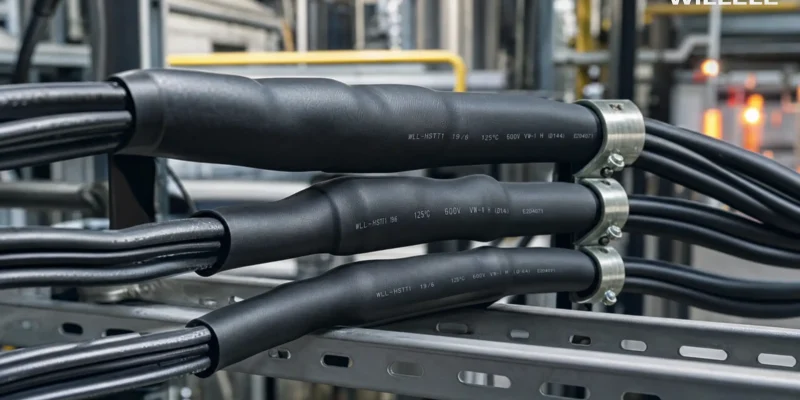
A short circuit in a control cabinet rarely starts a major fire on its own. What turns a contained electrical fault into a building-wide disaster is the cabling around it. When a cable jacket, splice, or joint catches fire, the flame can travel along the wire harness in seconds, igniting everything in its path. Flame retardant heat shrink tubes are the simplest and most reliable way to stop that flame in its tracks, before it spreads to the rest of the system.
For engineers, panel builders, and B2B buyers specifying connections for rail, marine, EV charging, data centers, energy storage, and industrial plants, choosing the right heat shrink tubes is no longer a nice-to-have. It is a baseline safety requirement, and increasingly, a regulatory one. The same installation that passes inspection in Frankfurt or Dubai must also satisfy a buyer in Riyadh, Toronto, or Singapore. Flame retardant grades make that cross-border compliance far simpler.
This guide walks through the three benefits that matter most on real projects, the international standards behind them, and how to specify the right tube for your application. willele supplies flame retardant heat shrink tubes to contractors, panel builders, distributors, and OEMs across Europe, North America, the Middle East, and Asia, and the questions below are the ones our technical desk answers every week.
What Are Flame Retardant Heat Shrink Tubes
A flame retardant heat shrink tube is a crosslinked polyolefin sleeve formulated to resist ignition and self-extinguish once the external flame is removed. The base polymer is similar to standard heat shrink, but the formulation includes fire-suppressing additives such as aluminum hydroxide (ATH), magnesium hydroxide (MDH), or intumescent compounds that release water vapor and char when exposed to heat. The result is a sleeve that shrinks, seals, and insulates exactly like a standard tube, but resists burning in fault conditions.
The flame retardancy is built into the material, not applied as a coating. That distinction matters. A coated sleeve can lose its protection if the surface is scored, abraded, or cut during installation. A properly formulated flame retardant tube keeps its fire rating across the full wall thickness, so a nick in the field does not turn into a safety failure on day one of service.
Flame retardant tubes are available in both single-wall and dual-wall (adhesive-lined) constructions, in standard polyolefin and low-smoke zero-halogen (LSZH) compounds. Shrink ratios of 2:1, 3:1, and 4:1 are common, with continuous operating temperatures typically rated from -55 °C to +125 °C or +135 °C depending on the grade.
Benefit 1: Self-Extinguishing Protection in the First Critical Seconds
The first ten to thirty seconds after a cable fault decide whether the event stays inside a cabinet or spreads through the building. In that window, ordinary cable insulation can melt, ignite, and start a propagating flame that races along the wire harness, often faster than a person can react.
Flame retardant heat shrink tubes are designed to interrupt that chain. When the external flame is removed, the sleeve self-extinguishes within seconds. The combustion does not propagate. The cable beneath is protected long enough for upstream protection—breakers, fuses, or arc-flash relays—to clear the fault. The difference between a service interruption and a write-off is often whether the cable harness around the fault continued to burn.
This property is tested and rated under standards such as UL 94 (the most widely cited plastics flammability standard in North America) and the more demanding VW-1 test used for wire and cable in the US. Under UL 94, common ratings for heat shrink include V-2 (self-extinguishing within 30 seconds, with flaming drips allowed) and V-0 (self-extinguishing within 10 seconds, no flaming drips). For B2B projects, V-0 is the default expectation in panel building, rail, and aerospace-grade applications.
The practical effect is straightforward. A V-0 rated sleeve keeps a localized fault from becoming a propagated one, which keeps a small incident from becoming a major one.
| Property | Standard Heat Shrink Tube | Flame Retardant Heat Shrink Tube (UL 94 V-0) |
| Behavior under direct flame | Continues to burn once ignited | Self-extinguishes within 10 seconds |
| Flame propagation along cable | Often propagates along the harness | Does not propagate |
| Drip behavior under flame | Flaming drips can ignite material below | No flaming drips (V-0) |
| Best fit | Dry indoor cabinets, low-risk loads | Rail, marine, EV, data center, public buildings |
| Typical project profile | Cost-driven, low regulatory demand | Safety-driven, multi-region regulatory demand |
Benefit 2: Reduced Smoke and Toxic Gas Emissions
Heat is only part of the fire problem. The leading cause of fire-related fatalities is not the flame itself but smoke inhalation, particularly smoke carrying toxic combustion gases. In an enclosed space—a subway tunnel, a server room, a ship’s engine room, a building riser—visibility drops in seconds and breathable air is gone in minutes.
Standard polyolefin heat shrink, like most petroleum-based plastics, releases dense black smoke and halogenated gases when it burns. In a tunnel or stairwell, that smoke can disorient and incapacitate occupants long before the fire reaches them.
Low-smoke zero-halogen (LSZH) flame retardant heat shrink tubes are formulated to address exactly this risk. They produce far less smoke, and the gases released are far less toxic. Most LSZH grades meet the requirements of standards such as IEC 60684-3 for low corrosive and toxic emissions, EN 45545-2 for rail vehicle materials, and the relevant clauses of UL 2885 for cable smoke release.
For projects where people share space with electrical infrastructure—subway stations, hospitals, schools, high-rise residential, data centers, passenger ships—LSZH is no longer optional. It is often mandated at the tender stage, and it is the difference between an evacuation that succeeds and one that does not.
| Material Family | Smoke Density (typical) | Halogen Content | Toxic Gas Release | Typical Use |
| Standard PVC heat shrink | Elevado | High (Cl, Br additives) | High (HCl on combustion) | Indoor, dry, non-public |
| Standard polyolefin heat shrink | Moderado | Halogen-free base, may include halogenated FR | Lower than PVC | General industrial |
| LSZH polyolefin flame retardant | Baixa | Zero halogen | Very low | Rail, marine, public buildings, data center |
| Fluoropolymer heat shrink (PVDF, PTFE) | Very low | Often halogenated (F content) | HF risk if burned above rating | Aerospace, chemical, high-temp |
Benefit 3: Compliance with International Fire Safety Standards
For B2B buyers, the most practical benefit of a properly certified flame retardant heat shrink tube is regulatory clearance. A certificate from a recognized test lab is the language every inspector, auditor, and procurement officer speaks.
Different regions emphasize different standards, but the underlying intent is the same: limit flame spread, limit smoke, and give people time to escape. The good news is that a single well-formulated LSZH polyolefin tube can satisfy most of them at once.
| Padrão | Region | What It Covers | Typical Use |
| UL 94 (V-0, V-1, V-2) | North America | Plastics flammability rating | OEM panels, appliances, electronics |
| VW-1 | North America | Wire and cable flame test | Power cable, control wiring |
| IEC 60684-3 | International | Flexible insulating sleeving, including low smoke and corrosive gas | Industrial, rail, energy |
| EN 45545-2 (HL1, HL2, HL3) | Europe | Rail vehicle fire protection | Trains, trams, metros |
| EN 50305 | Europe | Railway cable specific behavior | Rail cable harnesses |
| GB/T 2408 / GB 31241 | China | Plastics burning behavior, mobile energy storage | Domestic projects, ESS battery packs |
| CSA C22.2 | Canada | Canadian electrical code alignment | Canadian installations |
| IEEE 1202 / UL 1685 | North America | Cable tray flame propagation | Large cable bundles in buildings |
For Willele, the practical implication is that a single SKU line—LSZH polyolefin, UL 94 V-0, IEC 60684-3 compliant, with EN 45545 documentation available on request—can be quoted into a panel going to a German rolling-stock builder, a US data center, and a Saudi solar-plus-storage project without re-engineering. That simplicity is what B2B buyers are really buying.
Where Flame Retardant Heat Shrink Tubes Are Used
The application list is long, and most of it is driven by life-safety regulation rather than marketing preference.
Rail and mass transit is the largest single market. EN 45545 HL2 and HL3 ratings are the norm, and LSZH construction is mandatory for any cable run that shares space with passengers. Heat shrink is used on splice joints, terminations, and on the increasingly common cable harness assemblies inside traction equipment and door systems.
Marine and offshore vessels operate in enclosed, often high-heat environments with limited escape routes. Type-approved LSZH heat shrink is used throughout engine rooms, control consoles, and accommodation block wiring. Offshore wind turbines, where access for repair is expensive and safety is paramount, use flame retardant grades on every joint in the tower and nacelle.
Data centers are governed by strict fire codes due to the density of cables running in confined plenums above servers and beneath raised floors. LSZH construction reduces smoke in a fault and limits corrosive gas damage to expensive equipment.
EV charging and energy storage present new fire risks. Battery enclosures, DC busbars, and high-voltage cable harnesses are increasingly required to meet UL 94 V-0 at minimum, with LSZH expected as the standard moves toward GB 31241 and IEC 62619 for stationary storage.
Industrial control panels and OEM equipment use flame retardant heat shrink on power distribution, control wiring, and signal cables, particularly when the equipment is exported and must satisfy multiple regional codes at once.
Building services — fire alarm circuits, emergency lighting, public address — almost always specify LSZH in modern commercial builds, particularly in the EU, UK, Gulf states, and Singapore.
Regional Trends Driving Demand for Flame Retardant Heat Shrink
The geographic split in fire-safety regulation is narrowing fast. Standards that were once regional have become reference points elsewhere, and the market is moving in one direction: toward LSZH, lower smoke, and stricter ratings.
In Europe, EN 45545 has effectively standardized flame retardant requirements across the rail sector, and the EU’s Construction Products Regulation pushes LSZH performance into commercial buildings. In North America, the NFPA 130 and NFPA 502 standards for transit and tunnels, combined with stricter state-level building codes for public spaces, have moved the market decisively away from PVC-jacketed cable in occupied environments. In the Middle East, large infrastructure projects in Saudi Arabia, the UAE, and Qatar typically adopt IEC or EN-aligned specifications at the design stage, with LSZH expected in airports, metros, and high-rise buildings. In Southeast Asia, Singapore’s SS 510 and similar codes have pushed LSZH into the mainstream for both rail and commercial construction.
The practical effect for an OEM or panel builder exporting equipment is that specifying a single LSZH polyolefin flame retardant tube, V-0 rated and IEC 60684-3 compliant, covers the bulk of international tenders without rework. That is why LSZH volumes are growing faster than the overall heat shrink market.
How to Specify Flame Retardant Heat Shrink Tubes
A good specification is short and verifiable. Five questions cover most of what matters.
- What is the minimum flammability rating required by the project standard? For most B2B work this is UL 94 V-0. For rail, EN 45545 HL2 or HL3.
- Is LSZH required, or is a halogenated FR system acceptable? Most public-space and rail work requires LSZH.
- What shrink ratio and size range does the joint need? Match the recovered diameter to the smallest point, the expanded diameter to the largest.
- Single-wall or dual-wall (adhesive-lined)? Use dual-wall anywhere water, dust, or vibration is in play.
- What documentation comes with each batch? A reliable supplier provides test reports, batch traceability, and compliance statements without request.
If a quotation does not name the standard, the rating, and the material family, the price comparison is not yet meaningful.
Why Specify Willele Flame Retardant Heat Shrink Tubes
Willele manufactures flame retardant heat shrink tubes in polyolefin and LSZH polyolefin compounds, in single-wall and dual-wall constructions, across the shrink ratios and size ranges that international B2B projects call for most often. Standard SKUs cover UL 94 V-0, IEC 60684-3, and RoHS/REACH compliance out of the box, with EN 45545 documentation and lot-traceable test reports available on request.
We support OEM programs with cut-to-length tubing, custom colors, printed marking, and packaging configured to your logistics, and we can pre-kit accessories—end caps, boots, dual-wall transitions—to speed up your assembly line. Our technical team helps match material, ratio, and wall thickness to your cable, your voltage class, and the environment your installation will actually live in.
If you are specifying for a project that crosses borders, contact us with your BOM or drawing list. We will respond within 24 hours with datasheets, compliance documentation, and pricing for the standard parts—and a clear note on lead time for anything outside our stock range.
FAQ
Are flame retardant heat shrink tubes the same as fireproof heat shrink tubes? No. Flame retardant tubes resist ignition and self-extinguish when the flame source is removed. They are not designed to survive sustained fire indefinitely. For applications that require a defined fire-resistance rating (such as fire-survival cables), use a dedicated fire-resistant cable system. Flame retardant heat shrink is one layer of protection in that system, not a replacement for it.
Do I always need LSZH, or is standard flame retardant polyolefin enough? For indoor cabinets with no public occupancy and no plenum space, standard flame retardant polyolefin (UL 94 V-0) is usually acceptable. For rail, marine, public buildings, data centers, and most export projects, LSZH is the safer and more broadly accepted choice. When in doubt, follow the project specification, not the cheapest compliant option.
Can flame retardant heat shrink tubes be used outdoors? Yes. Black LSZH polyolefin is the standard outdoor choice. As with any heat shrink, confirm the UV rating before permanent outdoor exposure, and prefer adhesive-lined dual-wall construction for any joint that may see moisture.
Does the flame retardant rating degrade over time? Properly formulated tubes hold their rating across the rated service life, typically 20+ years for indoor applications. The rating can be lost if the tube is exposed to chemicals, oils, or temperatures outside its specification, or if the wall is mechanically damaged. Specify a tube rated for the actual service environment, not just the operating temperature.
What is the difference between VW-1 and UL 94 V-0? Both are flame tests run by Underwriters Laboratories. VW-1 is a vertical flame test for wire and cable, applied to finished cable. UL 94 V-0 is a plastics flammability rating applied to the material itself. They test slightly different things and are not interchangeable in a specification. A V-0 rated tube in a VW-1 approved cable is a common combination; a VW-1 test is usually run on the finished cable assembly.
Is flame retardant heat shrink more expensive than standard heat shrink? It is usually 20–60% more expensive per meter, depending on material, rating, and quantity. The cost is small in the context of a full electrical installation, and it is almost always offset by simpler multi-region compliance, faster inspection sign-off, and reduced risk of a propagating fire event.