A cable splice that fails at two in the morning rarely fails for an exotic reason. A jacket has chafed against a steel panel edge, moisture has worked its way into a junction box, a lug has loosened under years of thermal cycling, or a bundle has rubbed itself bare against a conduit. Each is a small defect, and each is enough to stop a line. What separates a team that spends its nights reacting from one that stays ahead of trouble is often something as plain as a length of sleeving. Heat shrink tubes, warmed for a few seconds over a joint, recover to grip the conductor, seal it, and hold that grip for years — in plants that run around the clock across North America, Europe, the Middle East, and Southeast Asia.
What Heat Shrink Tubes Actually Do
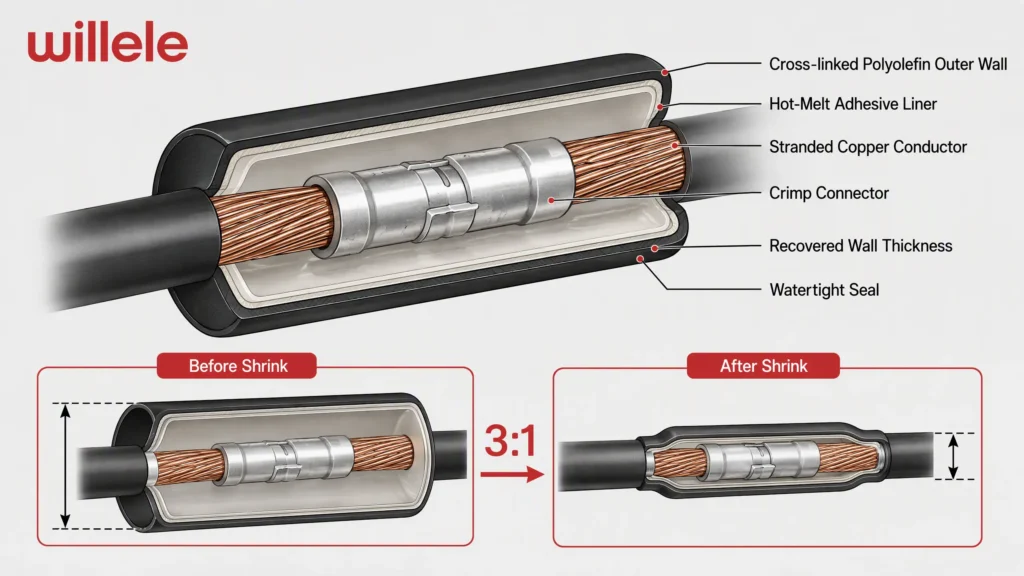
Heat shrink tubing is a polymer sleeve with memory. It begins as a tube extruded at a larger diameter, then cross-linked and expanded while hot. Cross-linking ties the polymer chains into a network that remembers the shape it was originally given, so when the tube is heated again, the material pulls back toward its extruded size. The sleeve contracts radially, closes over whatever lies beneath it, and cools into place, with only a small axial movement of a few percent.
What it delivers is a combination no single repair material manages as neatly: electrical insulation, abrasion resistance, environmental sealing, and mechanical strain relief, all from one component that installs in seconds. Because the recovered tube follows the contour of the joint rather than spanning it, the fit stays tight where a splice is not perfectly round — a crimp barrel, a bundle of strands, a connector shoulder.
Tube performance comes down to three numbers. The shrink ratio (2:1, 3:1, or 4:1) sets how far the diameter closes. The recovered wall thickness sets how much abuse the sleeve absorbs. The material’s continuous operating temperature sets where it can live. Get those three right and the repair outlasts the equipment; get one wrong and the same joint returns to the work order.
Where Heat Shrink Tubes Matter on the Plant Floor
The applications where heat shrink tubes earn their place are the ones where a bare repair invites a callback. Insulating a crimped lug or a splice is the everyday case: the tubing covers the exposed barrel and the transition to the conductor, restoring the dielectric barrier and adding strain relief where the cable flexes most. Jacket repair follows the same logic — a dual-wall sleeve bridged over a chafed or nicked jacket shields the damage and stops moisture from tracking along the conductor. Connector-to-cable transitions, motor leads, control-panel terminations, and conduit entries all obey the same rule: seal the joint, support the bend, keep the environment out. Flexible thin-wall tubing bundles loose conductors and, in colour, marks phases or circuits at a glance.
| Maintenance task | Recommended tube type | Typical shrink ratio | Property that matters most |
|---|---|---|---|
| Insulating a crimped lug or splice | Dual-wall, adhesive-lined, medium wall | 3:1 or 4:1 | Watertight seal plus strain relief |
| Repairing a damaged cable jacket | Dual-wall, adhesive-lined | 3:1 to 4:1 | Conforms to irregular surface, blocks moisture |
| Connector-to-cable transition | Dual-wall, semi-rigid | 3:1 | Mechanical support at the bend |
| Bundling and harnessing wires | Single-wall, flexible thin wall | 2:1 | Flexibility and low bulk |
| Colour coding and phase marking | Single-wall, thin wall | 2:1 | Crisp colour, tight conform |
| Motor leads and control-panel terminations | Dual-wall, medium wall | 3:1 | Dielectric strength and vibration resistance |
| Abrasion-prone runs near moving parts | Heavy-wall, single or dual | 3:1 | Abrasion and impact resistance |
| High-temperature electronics | Thin-wall fluoropolymer | 2:1 | High continuous operating temperature |
Single-Wall or Dual-Wall? Choosing the Right Construction
A single-wall tube is one cross-linked polyolefin sleeve that shrinks to grip its substrate. It insulates, bundles, and colour-codes reliably, and it is the economical choice wherever the joint stays dry and protected. What it does not do is seal: held by fit alone, a single-wall tube allows moisture to migrate along the conductor in wet, buried, or wash-down locations.
Dual-wall tubing bonds a hot-melt adhesive liner to the inside of the polyolefin wall. When the tube is heated, the wall shrinks while the liner melts, flowing around the conductor and into every gap and surface irregularity; on cooling, the adhesive sets into a watertight bond. The trade-off is stiffness and cost, and dual-wall sleeves are harder to remove once set — a fair exchange wherever a repair will meet water, dirt, or vibration.
| Feature | Single-wall | Dual-wall (adhesive-lined) |
|---|---|---|
| Construction | One cross-linked polyolefin wall | Polyolefin wall plus hot-melt adhesive liner |
| Seal | Mechanical fit only, not watertight | Watertight environmental seal |
| Best suited to | Insulation, bundling, colour coding | Splices, lug insulation, jacket repair, wet or buried runs |
| Esneklik | Generally more flexible | Semi-rigid to flexible |
| Common shrink ratios | 2:1 | 3:1 and 4:1 |
| Relative cost | Lower | Higher |
Specifying the Right Heat Shrink Tube for Maintenance Work
Sizing looks trivial and is where most field failures begin. Work from the recovered inside diameter, not the installed one: choose a tube whose recovered diameter is slightly smaller than the smallest part it must grip, while the expanded diameter still slides over the joint. Too large and the tube will not close fully and the seal leaks; too small and it will not go on without forcing.
Then check the fit against reality. A splice is rarely a clean cylinder — a crimp barrel bulges, a bundle is lumpy, a connector has a shoulder. A higher shrink ratio (3:1 or 4:1) covers a wider spread of diameters and conforms to irregular shapes, which is why it dominates repair kits. Wall thickness comes next: thin where space and flexibility rule, medium or heavy where abrasion, impact, or dielectric strength matter. Finally, confirm the continuous operating temperature exceeds the hottest condition the joint will meet, with margin for ambient peaks.
| Parameter | What to check | Why it matters |
|---|---|---|
| Shrink ratio | 2:1, 3:1, or 4:1 | Determines the diameter range covered and how well it grips an irregular joint |
| Expanded and recovered diameter | Match recovered diameter to the smallest substrate, keeping a grip margin | Too large will not seal; too small will not slide on |
| Duvar kalınlığı | Thin, medium, or heavy | Abrasion, impact, and dielectric strength |
| Continuous operating temperature | Must exceed the hottest condition the joint will see, with margin | Prevents softening, cracking, and loss of insulation |
| Malzeme | Polyolefin, PVDF, FEP, PTFE, or elastomer | Sets temperature, chemical, and flexibility limits |
| Adhesive type | Standard hot-melt or high-performance liner | Bond strength in wet or hot environments |
Matching the Material to the Environment
Most industrial heat shrink tubes are cross-linked polyolefin, and for good reason: it is flexible, economical, and handles the ordinary range of plant temperatures. When a joint runs hotter or faces aggressive chemicals, the material must change. Fluoropolymer sleeves such as PVDF, FEP, and PTFE push the usable temperature far higher and shrug off solvents that would degrade polyolefin. Elastomeric formulations trade some temperature ceiling for flexibility and weather resistance, which suits outdoor jackets and tight bends. Material is a temperature-and-chemistry decision first, a mechanical one second — a sensor lead baking at the top of a furnace and a control cable in a climate-controlled room may look identical at the splice, but they belong to different sleeves.
| Malzeme | Typical continuous range | Best suited to | Notes |
|---|---|---|---|
| Cross-linked polyolefin | roughly −55 °C to 135 °C | General insulation, splices, harnessing | Most common; flexible and economical |
| Flexible polyolefin | roughly −55 °C to 125 °C | Tight bends, delicate terminations | Higher flexibility |
| PVDF | up to about 175 °C | High-temperature electronics, sensors | Semi-rigid, solvent resistant |
| FEP | roughly −80 °C to 200 °C | Extreme heat, chemical exposure | Chemically inert, higher cost |
| PTFE | roughly −65 °C to 260 °C | Harsh chemicals, very high temperature | Rigid, highest cost |
| Elastomer | roughly −40 °C to 120 °C | Outdoor cable jackets, seals | High flexibility, weather resistance |
Installation Practice That Separates a Permanent Repair from a Repeat Visit
The tubing is only half the repair; the installation is the other half. Start clean: cut the damaged jacket back, remove oxidation and contamination from the conductor, and dry the area — adhesive bonds to a clean surface and lets go of a dirty one. Slide the tube onto the cable before you make the connection, not after; forgetting this is the most common reason a joint gets made twice. Position the sleeve so it overlaps the intact jacket on both sides by a comfortable margin, giving the adhesive sound material to seal against.
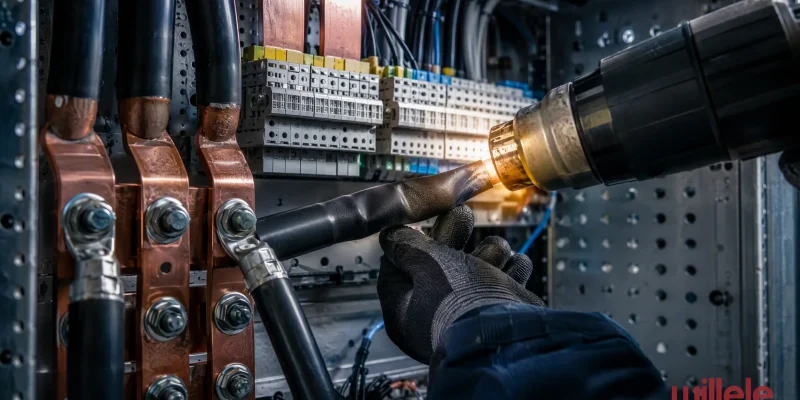
Heat evenly and patiently. A hot-air gun with a spreader nozzle is the workshop standard, swept along the tube rather than parked in one spot. The material relaxes, tightens, and takes the shape beneath it; the adhesive liner, when present, softens and turns glossy at the ends. Stop when the tube is fully recovered and the surface is smooth and conformal. Overheating is the quiet killer — scorched polymer loses its memory and its dielectric strength, and the failure surfaces months later. Keep the heat source moving, and de-energise where the procedure calls for it. Inspect the cooled joint before signing off: a lumpy, cloudy, or partially recovered sleeve is cheaper to redo now than at two in the morning.
Building Heat Shrink Tubes into a Preventive Maintenance Routine
The best maintenance use of heat shrink tubes is the one no one notices. Stocking repair kits by size and material, matching them to the equipment on site, and logging every repair with its tube type and shrink ratio turns a string of one-off fixes into data. When the same motor-lead termination keeps failing, the log shows whether the sleeve was undersized, the wrong material, or simply overheated. Scheduled inspection of high-vibration, high-moisture, or high-temperature areas — checking that existing sleeves are snug, uniform, and crack-free — catches degradation before it becomes an outage. Heat shrink tubes are cheap; downtime is not, and every planned hour spent re-insulating a suspect joint buys back many unplanned hours on the line.
Regional and Environmental Considerations
The specification that works in one plant can underperform in another, and climate is usually why. In the hot, dry interiors of Middle Eastern substations and process plants, ambient temperatures already sit high, so tubes need generous temperature margin and UV resistance on outdoor runs. In the tropical humidity of Southeast Asia, the priority flips to sealing: dual-wall, adhesive-lined tubing and corrosion-resistant conductors matter more than a high temperature ceiling, because moisture, condensation, and salt air do the damage. Across North America’s wide temperature swings and long outdoor runs, flexibility across the full range and a robust adhesive bond carry the day. In northern Europe and colder regions, tubing that stays flexible at low temperature avoids cracking when cables are moved or bent in winter. The pattern is simple: match the sleeve to the dominant threat — heat, moisture, chemicals, UV, or mechanical movement — and the repair stops being a risk.
Heat Shrink Tubes Versus Alternative Repair Methods
Heat shrink tubing is not the only way to repair a cable, but it is usually the most balanced. Electrical tape is fast and cheap and almost always temporary — it unwinds, ages, and seals poorly. Cold-shrink sleeves seal well without heat, which is valuable where a gun or torch cannot safely be used, but they are bulkier and less conformable to irregular joints. Molded or potted repairs achieve excellent protection for the most demanding connections, at the cost of time, labour, and any realistic chance of reworking the joint later. For the ordinary run of industrial repairs, heat shrink tubes land in the sweet spot: fast to install, watertight when adhesive-lined, and permanent when they are done right.
| Repair method | Seal quality | Longevity | Best used for | Main weakness |
|---|---|---|---|---|
| Heat shrink tubes | Excellent when adhesive-lined | Permanent | Splices, jacket repair, connector sealing | Requires a heat source |
| Electrical tape | Poor to moderate | Temporary | Quick field fix | Ages, unwinds, blocks moisture poorly |
| Cold-shrink sleeve | İyi | Permanent until cut | Tight spaces, no heat allowed | Bulkier, less conformable |
| Molded or potted joint | Mükemmel | Permanent | Harsh or highly loaded joints | Labour-intensive, expensive, hard to rework |
Frequently Asked Questions
Are heat shrink tubes reusable? No. Once a tube has recovered, its polymer memory is spent. Removing a sleeve means cutting it off, cleaning the joint, and installing a new one.
What shrink ratio do I need for a splice? For a straightforward splice, 2:1 is often enough. Where the joint is irregular — a bulging crimp, a bundle, a connector shoulder — a 3:1 or 4:1 tube conforms more reliably and covers a wider diameter range.
Can I use a heat gun instead of a torch? Yes, and for most industrial work you should. A hot-air gun with a spreader nozzle heats the tube evenly and avoids the scorching a direct flame can cause. Keep the gun moving along the sleeve until it is fully recovered.
How do I know the tube has fully shrunk? The surface becomes smooth and conformal, any adhesive liner turns glossy at the ends, and the sleeve no longer relaxes when pressure is released. A cloudy, lumpy, or still-rubbery sleeve is not finished.
Do heat shrink tubes work outdoors? Yes, provided the material resists UV and the temperature range suits the climate. For outdoor and wet locations, adhesive-lined dual-wall tubing gives the most dependable moisture seal.
Summary
Industrial electrical maintenance rewards boring, repeatable repairs. Heat shrink tubes are exactly that: a small, well-specified component that turns a fragile joint into a permanent one, installs with a heat gun in minutes, and keeps working long after the technician has moved on. Match the wall construction, shrink ratio, and material to the threat the joint will face — heat, moisture, chemicals, or movement — and the repair stops being a risk and becomes part of the equipment.